Ingeniería de Tráfico (Coursera)

Ingeniería de Tráfico (Coursera)

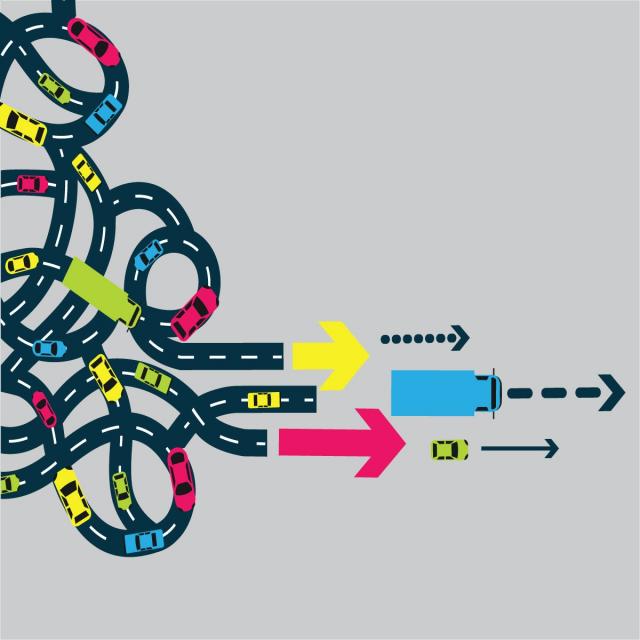
El curso presenta en primer lugar las principales relaciones que caracterizan la circulación de vehículos y que dan pie a la teoría de circulación de vehículos sobre redes de transporte. Posteriormente se discutirán aspectos relativos al control de tráfico en intersecciones, sean estas de prioridad o semaforizadas. Finalmente, discutiremos sobre las características que presentan algunos modelos dinámicos de tráfico bastante utilizados en la actualidad.

Class Deals by MOOC List - Click here and see Coursera's Active Discounts, Deals, and Promo Codes.

Syllabus

WEEK 1
Introducción del curso
Este módulo contiene una breve reseña histórica acerca del desarrollo de la ingeniería de tráfico a nivel global y local. También se presenta el diagrama x-t o trayectoria versus tiempo y algunas definiciones fundamentales para comprender los contenidos del curso

WEEK 2
Relación fundamental de tráfico
En este módulo se presenta la relación fundamental de tráfico y sus propiedades. También se presenta el diagrama fundamental de tráfico (q-k), sus aplicaciones y algunos modelos propuestos que se pueden ajustar a partir de esta relación.

WEEK 3
Control de tráfico en intersecciones
El siguiente módulo presenta las diferentes formas existentes para controlar el funcionamiento de una intersección vial. Particularmente, se detallan modelos asociados a intersecciones prioritarias e intersecciones semaforizadas, sus características e indicadores de rendimiento y funcionamiento.

WEEK 4
Modelos Dinámicos de tráfico
En este módulo se presentan los diferentes tipos de modelos que estudia la teoría de tráfico, los que se pueden dividir en modelos macroscópicos y microscópicos. Dentro de los modelos macroscópicos este módulo se enfocará en el modelo LWR, su funcionamiento y aplicaciones. Por el lado de los modelos microscópicos, se presentan modelos de seguimiento vehicular como el Modelo GM y el Modelo de Newell.

Go to Class
MOOC List is learner-supported. When you buy through links on our site, we may earn an affiliate commission.

Related Courses

Applications in Engineering Mechanics (Coursera) Coursera
Georgia Institute of Technology

Applications in Engineering Mechanics (Coursera)

This course applies principles learned in my course “Introduction to Engineering Mechanics” to analyze real world engineering structures. You will need to have mastered the engineering fundamentals from that class in order to be successful in this course offering. This course addresses the modeling and analysis of static equilibrium problems with an emphasis on real world engineering systems and problem solving.

Aug 10th 2026
5-12 Weeks
Fundamentals of Engineering Exam Review (Coursera) Coursera
Georgia Institute of Technology

Fundamentals of Engineering Exam Review (Coursera)

The purpose of this course is to review the material covered in the Fundamentals of Engineering (FE) exam to enable the student to pass it. It will be presented in modules corresponding to the FE topics, particularly those in Civil and Mechanical Engineering. Each module will review main concepts, illustrate them with examples, and provide extensive practice problems.

Aug 10th 2026
5-12 Weeks
Nanotechnology: A Maker’s Course (Coursera) Coursera
Duke University,University of North Carolina,North Carolina State University

Nanotechnology: A Maker’s Course (Coursera)

How can we create nano-structures that are 10,000 times smaller than the diameter of a human hair? How can we “see” at the nano-scale? Through instruction and lab demonstrations, in this course you will obtain a rich understanding of the capabilities of nanotechnology tools, and how to use this equipment for nano-scale fabrication and characterization.

Aug 10th 2026
5-12 Weeks
Engineering of Structures: Compression (Coursera) Coursera
Dartmouth College

Engineering of Structures: Compression (Coursera)

This course deals with compression. When we push an object, it compresses. Compression is what's going to hold up our building. Arches, vaults, domes, and anti-funicular forms help resist compression. In this course, you will learn about different columns and arches and their role in resisting compression. You'll also build anti-funicular forms.

Aug 3rd 2026
3 Weeks
Ferrous Technology I (Coursera) Coursera
Pohang University of Science and Technology - POSTECH

Ferrous Technology I (Coursera)

Steel, ever-evolving material, has been the most preeminent of all materials since it can provide wide range of properties that can meet ever-changing requirements. In this course, we explore both fundamental and technical issues related to steels, including iron and steelmaking, microstructure and phase transformation, and their properties and applications.

Aug 3rd 2026
5-12 Weeks
Engineering Maintainable Android Apps (Coursera) Coursera
Vanderbilt University

Engineering Maintainable Android Apps (Coursera)

Engineering Maintainable Android Apps, which is a 4 week MOOC that shows by example various methods for engineering maintainable Android apps, including test-driven development methods and how to develop/run unit tests using JUnit and Robotium (or equivalent automated testing frameworks for Android), as well as how to successfully apply common Java/Android software patterns to improve the extensibility and clarity of Android apps.

Aug 3rd 2026
4 Weeks
Cómo autoconstruir tu vivienda (Coursera) Coursera
Universidad Nacional Autónoma de México

Cómo autoconstruir tu vivienda (Coursera)

Aprenderás las bases y los procedimientos precisos paso a paso para que puedas llevar a cabo la autoconstrucción de una vivienda básica, segura y económica para ti y tu familia; también te será de gran utilidad si estás buscando aprender a reparar, mejorar la estructura de tu vivienda e incluso si buscas autoemplearte.

Aug 17th 2026
4 Weeks
Thermodynamique : fondements (Coursera) Coursera
École Polytechnique Fédérale de Lausanne

Thermodynamique : fondements (Coursera)

Ce cours vous apportera une compréhension des concepts fondamentaux de la thermodynamique du point de vue de la physique, de la chimie et de l’ingénierie. Il est scindé un deux MOOCs. Dans la première partie, le Professeur J.-Ph. Ansermet de l’EPFL et son collaborateur le Dr. Sylvain Bréchet ont rassemblé en quatre leçons tous les principes fondamentaux de la thermodynamique. La deuxième partie du MOOC illustre l’approche thermodynamique par une série d’applications présentées par des spécialistes provenant de diverses institutions partenaires du réseau RESCIF.

Aug 17th 2026
4 Weeks
Chemical Engineering Thermodynamics 2 (Coursera) Coursera
Korea Advanced Institute of Science and Technology - KAIST

Chemical Engineering Thermodynamics 2 (Coursera)

An appreciation of thermodynamics is required to become a chemical and biomolecular engineer. Thermodynamics can assess the viability of a process and is one of the curriculum's most essential topics. The principles are utilized in following engineering courses (kinetics, mass transfer, design, materials) and are applicable to numerous engineering disciplines. The increased emphasis on energy usage and transformation as a result of rising demand, diminishing supply, and global warming necessitates that the engineers who will tackle these issues have a firm grasp of thermodynamics.

Aug 3rd 2026
5-12 Weeks
Sistemas Digitales: De las puertas lógicas al procesador (Coursera) Coursera
Universitat Autònoma de Barcelona

Sistemas Digitales: De las puertas lógicas al procesador (Coursera)

En este curso aprenderemos los fundamentos del diseño de los circuitos digitales actuales, siguiendo una orientación eminentemente práctica. A diferencia de otros cursos más "clásicos" de Circuitos Digitales, nuestro interés se centrará más en el Sistema que en la Electrónica que lo sustenta. Este enfoque nos permitirá sentar las bases del diseño de Sistemas Digitales complejos.

Aug 3rd 2026
5-12 Weeks
Controle de Sistemas no Plano-s (Coursera) Coursera
Instituto Tecnológico de Aeronáutica

Controle de Sistemas no Plano-s (Coursera)

Após esse curso você será capaz de esboçar o Lugar Geométrico das Raízes (LGR - Root Locus) do denominador da Função de Transferência em Malha Fechada a partir dos polos e zeros da Função de Transferência em Malha aberta. Você também será capaz de projetar controladores de avanço de fase para atender simultaneamente requisitos de desempenho de amortecimento e de velocidade da resposta.

Aug 3rd 2026
5-12 Weeks
Engineering Practices for Building Quality Software (Coursera) Coursera
University of Minnesota

Engineering Practices for Building Quality Software (Coursera)

Agile embraces change which means that team should be able to effectively make changes to the system as team learns about users and market. To be good at effectively making changes to the system, teams need to have engineering rigor and excellence else embracing change becomes very painful and expensive. In this course, you will learn about engineering practices and processes that agile and traditional teams use to make sure the team is prepared for change. In additional, you will also learn about practices, techniques and processes that can help team build high quality software. You will also learn how to calculate a variety of quantitative metrics related to software quality.

Aug 3rd 2026
4 Weeks