EdX

Global Media, War, and Technology (edX)

Global Media, War, and Technology (edX)

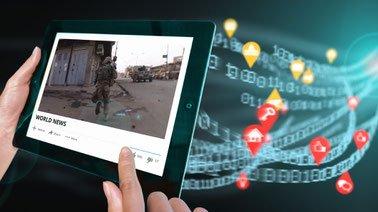
Explore the intersection of information technology, violent conflict, and resistance. The experience of war has changed fundamentally – not only for those fighting and reporting, but also for those on the home front. High-tech nations wage wars from a distance using satellite-guided weaponry while non-state military actors, terrorist organizations, and citizen journalists have increasingly added new voices and visual perspectives to the conversation about conflict.

Class Deals by MOOC List - Click here and see EdX's Active Discounts, Deals, and Promo Codes.

The ubiquity of smartphones, internet access, and social media transports the experience and complexity of war directly into our lives. Cyberspace offers greater freedoms and access to information at the same time as we discover a dramatic global rise of cyber espionage, internet censorship, and surveillance.

In this course, we map this emerging new terrain where violent conflict, information technology, and global media intersect and where the old distinctions between battlefront and home front, between soldier and civilian, between war and entertainment, and between public and private are being redrawn.
Considering these changes, this course engages with questions surrounding:

  • The relationship between media, information technology, and war
  • How violent conflict is presented in the media and the responsibilities of journalists during wartime
  • The effect of instantaneous, worldwide reporting on battle and the politics of conflict
  • How we can understand and critically engage with media and information technology

In order to engage with these questions, this course is taught through a number of conventional and unconventional forms of learning methods and activities. These include lecture videos, questionnaires, and discussion fora. But it also includes practical, experiential elements taught through crowdsourcing, individual research, critical viewing, media and image analysis, and surveys. Combined, these activities allow you to gain fresh and timely insights into what happens beneath the surface of the screen in front of you. They enable you to gain a deeper understanding of how the politics of today's wars play out on and behind the digital screens in our hypermediatized age.

What you'll learn

  • The history and evolution of global media technology as it relates to conflict
  • The major themes and trends of global media in times of war
  • Application of the history and major themes of global media to current issues
  • Skills to be a critical media consumer

Syllabus

Week 1: An introduction to global media and war
Introduction to the history of and context surrounding conflict in cyberspace.

Week 2: Transformation of the mediasphere
A look at the media revolution and its transformation from a multipolar to a heteropolar mediascape as well as an exploration of the disruptive nature of digital media.

Week 3: Surveillance
An analysis of the scale and scope of today’s global system of mass surveillance, of how it compares to older forms of surveillance such as the STASI, and what living under constant surveillance means for privacy and the future of democracy.

Week 4: Visual politics and conflict
Introduction to the role of images in conflict through an analysis of images connected to current events.

Week 5: Democratic states, the media and the production of clean wars
Discussion of the changing role of media as seen during the Vietnam War, the 1991 Gulf War, and the wars in Afghanistan and Iraq

Week 6: The military-industrial-media-entertainment complex
Analysis of the evolution of the military-industrial complex and the growing collaboration between militaries, Hollywood film studios, and the commercial gaming sector.

Week 7: Non-state military actors and media
Survey of media use by non-state military actors such as Al Qaeda, Hezbollah and the Islamic State.
Go to Class
MOOC List is learner-supported. When you buy through links on our site, we may earn an affiliate commission.

Related Courses

Electrotechnique I (edX) EdX
École Polytechnique Fédérale de Lausanne,EPFLx

Electrotechnique I (edX)

Découvrez les circuits électriques linéaires. Apprenez à les maîtriser et à les résoudre, dans un premier temps en régime continu puis en régime alternatif. Ce cours définit les notions de base des circuits électriques composés des trois éléments passifs (résistance, inductance et condensateur), linéaires et des sources de tension et de courant.

Self Paced
Self-Paced
Supply Chain Technology and Systems (edX) EdX
MIT,MITx

Supply Chain Technology and Systems (edX)

Learn how technology is used in supply chain systems from fundamental concepts to innovative applications. There are underlying fundamental principles and concepts that apply to all supply chains, which can be expressed in relatively straightforward models. However, to actually implement them across a real supply chain requires the use of technology across multiple systems. Supply chains have a long history of using technology to improve efficiency and effectiveness. The shear scale and scope of most supply chains require many distinct systems to interact with each other.

Jun 26th 2024
13-24 Weeks
Fundamentos de Comunicaciones Ópticas (edX) EdX
Universitat Politècnica de València,UPValenciaX

Fundamentos de Comunicaciones Ópticas (edX)

Se tratan conceptos básicos de las comunicaciones ópticas como el guiado, los modos, la atenuación o la dispersión y el diseño de sistemas. Este curso está destinado a estudiantes universitarios de la rama de las Tecnologías de la Información y las Comunicaciones que quieran conocer los mecanismos fundamentales de las comunicaciones por fibra óptica.

Self Paced
Self-Paced
Quantum Mechanics for Scientists and Engineers 2 (edX) EdX
StanfordOnline

Quantum Mechanics for Scientists and Engineers 2 (edX)

This course covers key topics in the use of quantum mechanics in many modern applications in science and technology, introduces core advanced concepts such as spin, identical particles, the quantum mechanics of light, the basics of quantum information, and the interpretation of quantum mechanics, and covers the major ways in which quantum mechanics is written and used in modern practice.

Self Paced
Self-Paced
Innovation and Technology Management in Tourism and Hospitality (edX) EdX
The Hong Kong Polytechnic University,HKPolyUx

Innovation and Technology Management in Tourism and Hospitality (edX)

Learn about information and communication technologies [ICTs] and innovations in the hotel and tourism industries. Gain an in-depth understanding of the strategic applications of ICT (information and communication technologies) innovations in the hospitality and tourism industry. You will learn about the roles of ICT infrastructures and tools in shaping business environment, business models, marketing practices, revenue strategies, and customer services.

Apr 26th 2024
5-12 Weeks
Introduction to Quantum Science & Technology (edX) EdX
Purdue University,PurdueX

Introduction to Quantum Science & Technology (edX)

Learn about fundamental concepts and engineering challenges of quantum technologies. Emerging quantum systems are disruptive technologies redefining computing and communication. Teaching quantum physics to engineers and educating scientists on engineering solutions are critical to address fundamental and engineering challenges of the quantum technologies.

Aug 21st 2023
13-24 Weeks
Android: introducción a la programación (edX) EdX
Universitat Politècnica de València,UPValenciaX

Android: introducción a la programación (edX)

Desarrollaremos una aplicación de ejemplo, "Mis Lugares Favoritos", para conocer el entorno de desarrollo de Android y sus elementos. Android es la plataforma libre desarrollada por Google, ampliamente utilizada en multitud de dispositivos como móviles, tabletas, TV, wearables o sistemas empotrados. Su expansión ha sido espectacular, superando en la actualidad al S.O. Microsoft Windows.

Self Paced
Self-Paced