EdX

Fundamentals of Nanoelectronics, Part B: Quantum Transport (edX)

Offered by Purdue University, PurdueX,
Fundamentals of Nanoelectronics, Part B: Quantum Transport (edX)

Explore quantum transport in nanoscale devices and spintronics in this introductory nanotechnology course. “This MOOC is one of the best. Exceptional in all regards.” – Student from Part A

Class Deals by MOOC List - Click here and see EdX's Active Discounts, Deals, and Promo Codes.

Nanoelectronic devices are an integral part of our life, including the billion-plus transistors in every smartphone, each of which has an active region that is only a few hundred atoms in length.
This nanotechnology course explains the fundamentals of nanoelectronics and mesoscopic physics.
Even with NO prior background in quantum mechanics, you should learn about cutting-edge developments and concepts that will prepare you for a future in nanotechnology and nanoelectronics.
Indeed we hope you will be excited to join the field and help invent the new devices that will shape the electronics of this century and meet its challenges.
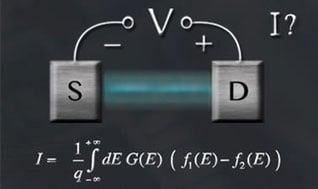
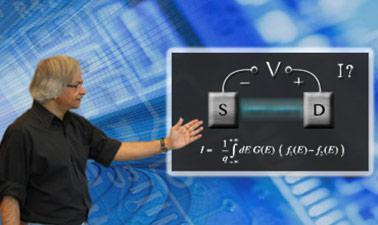
Second in a two part series, this nanotechnology course provides an introduction to more advanced topics, including the Non-Equilibrium Green’s Function (NEGF) method widely used to analyze quantum transport in nanoscale devices. We will explore a number of topics within nanoelectronics, taking a more in depth look at quantum transport, gaining greater insight into the application of the Schrodinger Equation, and learning the basics of spintronics.
“The course was just awesome!”

  • Student from Part A

This course is the latest in a series offered by the nanoHUB-U project which is jointly funded by Purdue and the National Science Foundation with the goal of transcending disciplines through short courses accessible to students in any branch of science or engineering. These courses focus on cutting-edge topics distilled into short lectures with quizzes and practice exams.
What you'll learn

  • Introduction to the Tight-binding Method
  • Introduction to Non-Equilibrium Green Function (NEGF) Method
  • Application of NEGF to Problems in Quantum Transport
  • Introduction to Spin Transport
Go to Class
MOOC List is learner-supported. When you buy through links on our site, we may earn an affiliate commission.

Related Courses

Introducción al diseño de hardware con Verilog (edX) EdX
Galileo University,GalileoX

Introducción al diseño de hardware con Verilog (edX)

Aprende el lenguaje de descripción de hardware Verilog, utilizado en la industria en el diseño de hardware digital y microprocesadores a la medida. En la actualidad, el hardware de soporte en sistemas digitales se suele diseñar en un solo circuito integrado FPGA (Field Programmable Gate Array), en parte debido al abundante espacio físico que ocuparía una implementación con varios circuitos integrados dedicados para este fin.

Self Paced
Self-Paced
Solar Energy: Integration of Photovoltaic Systems in Microgrids (edX) EdX
Delft University of Technology,DelftX

Solar Energy: Integration of Photovoltaic Systems in Microgrids (edX)

Learn how to integrate a photovoltaic system into a microgrid of your design. Photovoltaic systems are often placed into a microgrid, a local electricity distribution system that is operated in a controlled way and includes both electricity users and renewable electricity generation. This course deals with DC and AC microgrids and covers a wide range of topics, from basic definitions, through modelling and control of AC and DC microgrids to the application of adaptive protection in microgrids.

Self Paced
5-12 Weeks
Introduction to Semiconductor Packaging (Coursera) Coursera
Arizona State University

Introduction to Semiconductor Packaging (Coursera)

This course will cover various aspects of microelectronics and nanoelectronics. This field aims to advance and improve the functionality of electronic devices by scaling transistors to smaller feature sizes. The course will introduce you to essential concepts such as length scales, transistor actions, and feature sizes of integrated circuits.

Aug 24th 2026
5-12 Weeks
Electronique I (edX) EdX
École Polytechnique Fédérale de Lausanne,EPFLx

Electronique I (edX)

Introduction à l’électronique analogique- première partie. Fonctions de base réalisées à l’aide des amplificateurs opérationnels. Ce cours est un cours d’introduction à la réalisation des fonctions linéaires et non-linéaires de base à l’aide de l’amplificateur opérationnel.


Self Paced
Self-Paced
Machine Learning at the Edge on Arm: A Practical Introduction (edX) EdX
Arm Education,ArmEducationX

Machine Learning at the Edge on Arm: A Practical Introduction (edX)

This course will provide you with the hands-on experience you’ll need to create innovative ML applications using ubiquitous Arm-based microcontrollers. The age of machine learning has arrived! Arm technology is powering a new generation of connected devices with sophisticated sensors that can collect a vast range of environmental, spatial and audio/visual data. Typically this data is processed in the cloud using advanced machine learning tools that are enabling new applications reshaping the way we work, travel, live and play.

Self Paced
Self-Paced
Solar Energy: Photovoltaic (PV) Energy Conversion (edX) EdX
Delft University of Technology,DelftX

Solar Energy: Photovoltaic (PV) Energy Conversion (edX)

Learn how solar cells generate electricity, and about the semiconductor physics and optics required to design and manufacture solar cells. The key factor in getting more efficient and cheaper solar energy panels is the advance in the development of photovoltaic cells. In this course you will learn how photovoltaic cells convert solar energy into useable electricity. You will also discover how to tackle potential loss mechanisms in solar cells.

Self Paced
5-12 Weeks
Electrotechnique II (edX) EdX
École Polytechnique Fédérale de Lausanne,EPFLx

Electrotechnique II (edX)

Découvrez les systèmes alternatifs triphasés et leurs charges associées ainsi que les régimes transitoires, base des alimentations à découpage. Ce cours traite des systèmes alternatifs triphasés, piliers de l'alimentation électrique industrielle et de certains types de machines électriques. Les charges triphasées associées, symétriques ou dissymétriques, seront étudiées ainsi que les puissances actives, réactives et apparentes qui en découlent. Des méthodes de compensation de la puissance réactive seront développées.

Self Paced
Self-Paced
Introduction to Semiconductors, PN Junctions and Bipolar Junction Transistors (edX) EdX
The Hong Kong University of Science and Technology - HKUST,HKUSTx

Introduction to Semiconductors, PN Junctions and Bipolar Junction Transistors (edX)

An intuitive approach to operational principles of semiconductor devices. The course covers PN junction diodes, optical sensors, solar cells, LEDs, and Bipolar Junction Transistors. As a topic of study, semiconductor devices offer a unique challenge due to the complex mathematics involved. In this course, we take a more intuitive approach to explore the underlying concepts. Eschewing mathematics, we use engaging animations to help you visualize the working principles of many common semiconductor devices.

Self Paced
Self-Paced
Introduction to the Internet of Things (edX) EdX
Universitat Politècnica de València,UPValenciaX

Introduction to the Internet of Things (edX)

This is a preliminary course in which we deal with the basics of electronics and programming using Arduino and ESP boards. Internet of Things (IoT) is the present and the future of technology. Either, if you have none, few or some experience with electronics and you want to develop it projects this course will give you the necessary kick start to start creating amazing devices capable of sensing, controlling physical signals.

Self Paced
Self-Paced
Quantum Detectors and Sensors (edX) EdX
Purdue University,PurdueX

Quantum Detectors and Sensors (edX)

Learn how to analyze and design quantum sensors and devices that extract maximal information from the world around us. Classical detectors and sensors are ubiquitous around us from heat sensors in cars to light detectors in a camera cell phone. Leveraging advances in the theory of noise and measurement, an important paradigm of quantum metrology has emerged. Here, ultra-precision measurement devices collect maximal information from the world around us at the quantum limit.

Aug 24th 2026
13-24 Weeks