Fundamentals of Machine Learning for Healthcare (Coursera)

Offered by Stanford University,
Fundamentals of Machine Learning for Healthcare (Coursera)

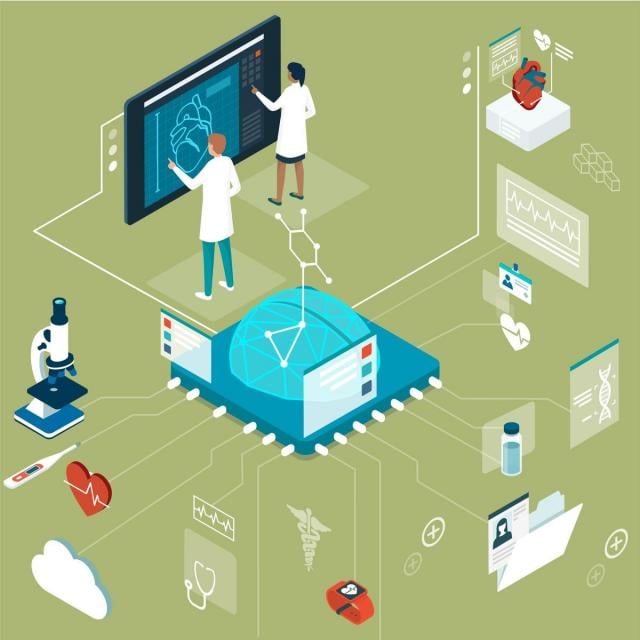
Machine learning and artificial intelligence hold the potential to transform healthcare and open up a world of incredible promise. But we will never realize the potential of these technologies unless all stakeholders have basic competencies in both healthcare and machine learning concepts and principles. This course will introduce the fundamental concepts and principles of machine learning as it applies to medicine and healthcare.

Class Deals by MOOC List - Click here and see Coursera's Active Discounts, Deals, and Promo Codes.

We will explore machine learning approaches, medical use cases, metrics unique to healthcare, as well as best practices for designing, building, and evaluating machine learning applications in healthcare.
The course will empower those with non-engineering backgrounds in healthcare, health policy, pharmaceutical development, as well as data science with the knowledge to critically evaluate and use these technologies.
What You Will Learn

  • Define important relationships between the fields of machine learning, biostatistics, and traditional computer programming.
  • Learn about advanced neural network architectures for tasks ranging from text classification to object detection and segmentation.
  • Learn important approaches for leveraging data to train, validate, and test machine learning models.
  • Understand how dynamic medical practice and discontinuous timelines impact clinical machine learning application development and deployment.

Course 3 of 5 in the AI in Healthcare Specialization.

Syllabus

WEEK 1: Why machine learning in healthcare?
WEEK 2: Concepts and Principles of machine learning in healthcare part 1
WEEK 3: Concepts and Principles of machine learning in healthcare part 2
WEEK 4: Evaluation and Metrics for machine learning in healthcare
WEEK 5: Strategies and Challenges in Machine Learning in Healthcare
WEEK 6: Best practices, teams, and launching your machine learning journey
WEEK 7: Course Conclusion

Go to Class
MOOC List is learner-supported. When you buy through links on our site, we may earn an affiliate commission.

Related Courses

Stories of Infection (Coursera) Coursera
Stanford University

Stories of Infection (Coursera)

This course introduces learners to a variety of infectious diseases using a patient-centered, story-based approach. Through illustrated, short videos, learners will follow the course of each patient’s illness, from initial presentation to resolution. Integrating the relevant microbiology, pathophysiology and immunology, this course aims to engage and entice the learner towards future studies in microbiology, immunology and infectious diseases.

Aug 17th 2026
5-12 Weeks
Disease Screening in Public Health (Coursera) Coursera
University of Geneva

Disease Screening in Public Health (Coursera)

Current and future public health is characterized by the increase of chronic and degenerative diseases, corresponding to the worldwide ageing of the population. The increasing prevalence of these conditions together with the long incubation period of the chronic diseases and the restless technological innovations, offer new opportunities to develop strategies for early diagnosis.

Aug 17th 2026
5-12 Weeks
Ethics of Artificial Intelligence (Coursera) Coursera
Politecnico di Milano

Ethics of Artificial Intelligence (Coursera)

This course deals with the problems created, aggravated or transformed by AI. It is intended to give students a chance to reflect on the ethical, social, and cultural impact of AI by focusing on the issues faced by and brought about by professionals in AI but also by citizens, institutions and societies. The course addresses these topics by means of case studies and examples analyzed in the light of the main ethical frameworks.

Aug 17th 2026
4 Weeks
Mathematical Biostatistics Boot Camp 1 (Coursera) Coursera
Johns Hopkins University

Mathematical Biostatistics Boot Camp 1 (Coursera)

This class presents the fundamental probability and statistical concepts used in elementary data analysis. It will be taught at an introductory level for students with junior or senior college-level mathematical training including a working knowledge of calculus. A small amount of linear algebra and programming are useful for the class, but not required.

Aug 17th 2026
4 Weeks
Strategies for Senior Housing Communities during COVID-19 (Coursera) Coursera
Johns Hopkins University

Strategies for Senior Housing Communities during COVID-19 (Coursera)

SARS-CoV-2, the virus that causes COVID-19, poses a high risk for senior housing communities and the people who live and work there. The COVID-19 response has largely focused on nursing homes, leaving independent living communities serving older adults in the United States with fragmented guidance on how to respond to COVID-19 challenges. This course provides comprehensive instruction and resources for property owners and managers, senior housing staff, service coordinators and providers, community housing leaders, and other senior housing stakeholders to build upon their emergency preparedness and response strategies related to COVID-19. The course lectures, interviews, and assignments are largely geared toward federally-subsidized, multifamily senior housing providers, but the material is relevant for all senior housing providers. **Free enrollment available until December 31, 2021. Valid for one enrollment per person.**

Aug 17th 2026
1 Week
Value-Based Care: Reimbursement Models (Coursera) Coursera
University of Houston

Value-Based Care: Reimbursement Models (Coursera)

This course is designed to help you build high-level knowledge of the current medical coding and payment mechanisms of most U.S. healthcare services, referred to as fee-for-service. You will explore why the fee-for-service model has contributed to higher costs in the U.S. healthcare system without clearly improving health outcomes. You will examine the importance of coding to reflect chronic conditions and other diagnoses accurately and how value-based care and payments utilize these measures and data. As you learn about a model to replace fee-for-service, you’ll encounter a range of payment options considered to be value-based that utilize a framework from the Health Care Payment Learning and Action Network (HCP-LAN). To build on those options, you will learn how risk-adjustment, quality scores, and patient satisfaction measures are critical parts of value-based care and payment contracts. In the summative assignment, you will demonstrate your knowledge by comparing fee-for-service and value-based contracts, using specific examples to explain and justify the importance of documentation and coding, and identifying ways that risk-adjustment and patient satisfaction are incorporated into value-based care contracts.

Aug 17th 2026
3 Weeks
Confronting Gender Based Violence: Global Lessons for Healthcare Workers (Coursera) Coursera
Johns Hopkins University

Confronting Gender Based Violence: Global Lessons for Healthcare Workers (Coursera)

This course introduces participants from the healthcare sector to gender based violence (GBV), including global epidemiology of GBV; health outcomes; seminal research; and clinical best practices for GBV prevention, support, and management. A core curriculum is supplemented by lectures that contextualize the content with specific examples and programs from around the world.

Aug 17th 2026
4 Weeks
Practical Machine Learning on H2O (Coursera) Coursera
H2O.ai

Practical Machine Learning on H2O (Coursera)

In this course, we will learn all the core techniques needed to make effective use of H2O. Even if you have no prior experience of machine learning, even if your math is weak, by the end of this course you will be able to make machine learning models using a variety of algorithms. We will be using linear models, random forest, GBMs and of course deep learning, as well as some unsupervised learning algorithms.

Aug 17th 2026
5-12 Weeks
Deep Learning Applications for Computer Vision (Coursera) Coursera
University of Colorado Boulder

Deep Learning Applications for Computer Vision (Coursera)

This course can be taken for academic credit as part of CU Boulder’s Master of Science in Data Science (MS-DS) degree offered on the Coursera platform. The MS-DS is an interdisciplinary degree that brings together faculty from CU Boulder’s departments of Applied Mathematics, Computer Science, Information Science, and others. With performance-based admissions and no application process, the MS-DS is ideal for individuals with a broad range of undergraduate education and/or professional experience in computer science, information science, mathematics, and statistics.

Aug 17th 2026
5-12 Weeks
Applied Text Mining in Python (Coursera) Coursera
University of Michigan

Applied Text Mining in Python (Coursera)

This course will introduce the learner to text mining and text manipulation basics. The course begins with an understanding of how text is handled by python, the structure of text both to the machine and to humans, and an overview of the nltk framework for manipulating text. The second week focuses on common manipulation needs, including regular expressions (searching for text), cleaning text, and preparing text for use by machine learning processes. The third week will apply basic natural language processing methods to text, and demonstrate how text classification is accomplished. The final week will explore more advanced methods for detecting the topics in documents and grouping them by similarity (topic modelling).

Aug 17th 2026
4 Weeks