EdX

Ethics in AI Design (edX)

Ethics in AI Design (edX)

Learn how to incorporate ethics into the development and implementation of AI systems. AI systems have a great potential to improve society, across a wide range of applications. The challenge is to do so responsibly. AI systems can lead to discrimination, loss of human control and a lack of explainability, to name a few ethical dilemmas they may present. Because of the great impact that AI and Machine Learning has (e.g. ChatGPT by OpenAI, or the use of ML for medical diagnoses), we need to ensure that we design and use them in a way that meets ethical standards.

Class Deals by MOOC List - Click here and see EdX's Active Discounts, Deals, and Promo Codes.

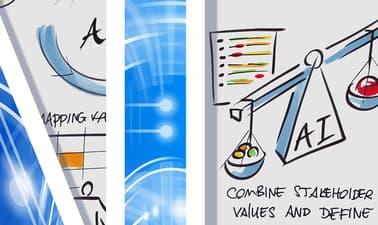
To do this requires a pro-active attitude towards ethics, for which we use the Delft Design for Values methodology. This identifies ethical values and has tools to translate them into concrete design requirements, which can then be tested. For this course, the focus is on aligning programming and design decisions with ethical values.
This course is for professionals developing AI systems, or for managers overseeing AI developments. The Design for Values methodology offers guidance on how to tackle the wide range of ethical challenges in the design process of AI systems. You will learn about bias, transparency, control, accountability, trust, and more. There will be a focus on the connection between the technological tools available and the ethical values. Most of all, you will practice how to make AI Ethics actionable and applicable for a wide range of systems and use cases.
To learn how to put ethics into practice we will use a running example from AI in healthcare. You will be challenged to think about how best to design an AI system in this context, while taking important ethical values into account. We will also work with other use cases from various sectors, such as government or industry, to see how ethical values and their consequences change from situation to situation.
This course has been designed by TU Delft’s experts on Digital Ethics, who hold a world-leading position in the operationalization of ethics in digital technology. They have played a central role in setting the EU directives on ethics, as well as the WHO Guidelines on AI Ethics in healthcare, and will now help you to put ethics into practice.

What you'll learn
After this course you’ll be able to:

  • Identify and explain possible ethical issues in AI design and development
  • Analyze what ethical issues could arise in AI applications
  • Determine steps to take for more responsible use of AI applications
  • Apply the steps involved in responsible AI design

Syllabus

Week 1
Introduction to the Ethical challenges with AI. A first overview of how ethics interacts with the design and use of AI systems.
Overview of how we will tackle these challenges during the course: introduction of the Design for Values methodology and its application to AI design.
We look into identifying values of different stakeholders and on the methods to then operationalize these, applied to our central case study in the healthcare domain.

Week 2
Trustworthiness of AI systems, accuracy and explainability.
When is an AI system trustworthy, and how does this interact with requirements for accuracy and explainability? Should systems always be explainable? What do we focus on with respect to accuracy and reliability/robustness of systems?
In addition, we briefly look into what is technically available. How explainable are these systems? What tools are available to improve the explainability of AI systems, and when do we use them?

Week 3
Bias in data and algorithmic fairness.
We will discuss both philosophical conceptions of fairness and bias as well as the connection to concrete metrics and tools that can be used to monitor and correct for biases.
Investigate which (statistical) biases are problematic and what appropriate steps are to tackle them.

Week 4
Accountability and human oversight.
Who is responsible when mistakes are made with AI systems? What organisational/socio-technical design is needed to ensure responsible use of AI?
Human oversight is discussed and the notion of meaningful human control is introduced. We then look at how oversight can be implemented in different ways, both technically (logs, audits, etc) and in the organisation (the role we give to an AI system).

Week 5
Value conflicts: what to do when different ethical values are difficult to realise at the same time?
Final assignment: for a new case, conduct the translation of ethical values into design requirements yourself.


Go to Class
MOOC List is learner-supported. When you buy through links on our site, we may earn an affiliate commission.

Related Courses

Assessment Design with AI (edX) EdX
Georgia Institute of Technology,GTx

Assessment Design with AI (edX)

Learn how to adjust your assessments to thrive—not just survive—in a world of pervasive conversational AI like ChatGPT. Conversational AI tools like ChatGPT have taken the world by storm, and education is one of the biggest areas for potential impact. In this course, teachers will learn how to adjust to the existence of these new technologies.

Self Paced
Self-Paced
CS50's Introduction to Artificial Intelligence with Python (edX) EdX
HarvardX,Harvard University

CS50's Introduction to Artificial Intelligence with Python (edX)

Learn to use machine learning in Python in this introductory course on artificial intelligence. AI is transforming how we live, work, and play. By enabling new technologies like self-driving cars and recommendation systems or improving old ones like medical diagnostics and search engines, the demand for expertise in AI and machine learning is growing rapidly. This course will enable you to take the first step toward solving important real-world problems and future-proofing your career.

Self Paced
Self-Paced
Essentials of Genomics and Biomedical Informatics (edX) EdX
IsraelX

Essentials of Genomics and Biomedical Informatics (edX)

This course presents clinicians and digital health enthusiasts with an overview of the data revolution in medicine and how to exploit it for research and in the clinic. The course will not make you a bioinformatician but will introduce the main concepts, tools, algorithms, and databases in this field.

Self Paced
5-12 Weeks
Behavioral Neuroscience: Foundations of Compulsive Behaviors (edX) EdX
University of Alaska Fairbanks,AlaskaX

Behavioral Neuroscience: Foundations of Compulsive Behaviors (edX)

The first MOOC to teach behavioral neuroscience research using laboratory mice. Learn responsible conduct of research and how to collect scientific data using two different tests that measure compulsions, and interpret and discuss the results in the context of obsessive-compulsive disorder in humans.

Self Paced
Self-Paced
Introduction to Java Programming: Writing Good Code (edX) EdX
Universidad Carlos III de Madrid - UC3M,UC3Mx

Introduction to Java Programming: Writing Good Code (edX)

Learn to program in an easy and interactive way and enter the fascinating world of computer science. This is an introductory course to learn programming with Java designed to teach how to code good programs in Java, understanding “good” as both correct and efficient. Basic principles of software engineering will be introduced to make it easier for our future self and others to reuse code. Ethical issues and the intellectual property of our programs will also be addressed in the last part of this course. Examples and case studies will be provided, so that learners can implement simple but increasingly complex programs in Java.

Self Paced
Self-Paced
Ethics in Action (edX) EdX
SDGAcademyX,SDG Academy

Ethics in Action (edX)

What do the world’s great religious and secular philosophies have to say about ethical conduct? Which virtues are common across faiths? And what role do religious communities have to play in building a more just and sustainable world? The challenges of sustainable development are more than technical or political—they are also moral, calling on us to examine who we are as human beings, and who we want to be going forward.

Self Paced
Self-Paced
Digital Transformation Strategy: Discovering and Reaching New Markets (edX) EdX
University of Maryland, College Park,University System of Maryland - USM,USMx,UMD

Digital Transformation Strategy: Discovering and Reaching New Markets (edX)

Learn key concepts of strategy, IT, and Innovation to bring emerging technologies to market through digital channels. This course is different – it’s a sample of the most important key concepts and techniques needed to develop digital strategies and bring them to market.

Self Paced
Self-Paced
Introduction to ChatGPT. Boost your productivity to the maximum using artificial intelligence! (edX) EdX
Universitat Politècnica de València,UPValenciaX

Introduction to ChatGPT. Boost your productivity to the maximum using artificial intelligence! (edX)

Have you heard about ChatGPT and want to learn how to use it to increase your productivity at work radically? Then, this is the course for you. Here, you will learn about its advantages and disadvantages, and different ways to create effective prompts. You will also see examples of its use in tasks as diverse as drafting an instance to a City Council, summarizing a document, enhancing your writing for emails, translating documents, or using it to create Excel formulas and macros.

Self Paced
Self-Paced
Machine Learning at the Edge on Arm: A Practical Introduction (edX) EdX
Arm Education,ArmEducationX

Machine Learning at the Edge on Arm: A Practical Introduction (edX)

This course will provide you with the hands-on experience you’ll need to create innovative ML applications using ubiquitous Arm-based microcontrollers. The age of machine learning has arrived! Arm technology is powering a new generation of connected devices with sophisticated sensors that can collect a vast range of environmental, spatial and audio/visual data. Typically this data is processed in the cloud using advanced machine learning tools that are enabling new applications reshaping the way we work, travel, live and play.

Self Paced
Self-Paced
Making Evidence-Based Strategic Decisions (edX) EdX
University of Maryland, College Park,University System of Maryland - USM,USMx,UMD

Making Evidence-Based Strategic Decisions (edX)

Drive alignment among managers, employees and the organizational goals through data analytics and data products. This course on digital transformation will show you how to turn your organization into a decision-making factory. What makes a good business decision? How can we combine effective data analytics and feed robust foresight and scenario planning processes?

Self Paced
Self-Paced