Engineering Mechanics - An Introduction (Skillshare)

Offered by Skillshare,
Engineering Mechanics - An Introduction (Skillshare)

This class is for Mechanical Engineering, Applied Mechanics and Aeronautical Engineering under graduate and graduate students. This class starts from the basics of Newton's first law, then builds towards Equilibrium equations and degrees of freedom. It discusses difference between internal force and external force. It shows that the main concern of Engineering Mechanics and subsequent course on Strength of Materials is to determine Internal resistance or force developed in the body in response to external loading.

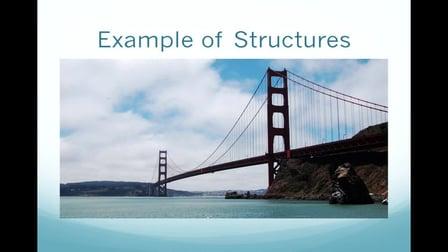
Finally it introduces various structural members like Trusses, Beams, Frames, Cables and Shafts. This class is essential to those who want to make Engineering Mechanics as favorite subject when appearing in examinations and interviews. I have found with my experience that student find this subject difficult and either leave it or spend too much time on it, which takes away time from preparation of other subjects. This course saves time of the student and explains all the concepts in short duration. So best of luck with Engineering Mechanics.

Project Description
Go to internet, and search for books on Engineering Mechanics, and Strength of Materials. Make a list of all the topics covered in these books. Search for these topics back on internet, and make a draft writeup on those topics. Do include in the write up difference between structures and mechanisms, solid deformable body and rigid body, internal force and external force, and degrees of freedom. Also learn to write 6 equilibrium equations, summation of forces about x axis, y axis and z axis, and summation of moments around x axis, y axis and z axis. Be sure of the difference between External force, Reaction force, and Internal force.


Go to Class
MOOC List is learner-supported. When you buy through links on our site, we may earn an affiliate commission.

Related Courses

Fundamentals of Engineering Exam Review (Coursera) Coursera
Georgia Institute of Technology

Fundamentals of Engineering Exam Review (Coursera)

The purpose of this course is to review the material covered in the Fundamentals of Engineering (FE) exam to enable the student to pass it. It will be presented in modules corresponding to the FE topics, particularly those in Civil and Mechanical Engineering. Each module will review main concepts, illustrate them with examples, and provide extensive practice problems.

Sep 7th 2026
5-12 Weeks
Mécanique Lagrangienne (Coursera) Coursera
École Polytechnique Fédérale de Lausanne

Mécanique Lagrangienne (Coursera)

Le formalisme de Lagrange permet une résolution efficace de problèmes complexes de mécanique. Il permet aussi d'apporter un éclairage plus fondamental sur les lois de conservation (théorème de Noether). A titre d'illustration de la méthode de Lagrange, on traitera le problème très important des oscillateurs harmoniques couplés, exprimé comme un problème de valeurs propres et de vecteurs propres. On termine avec un formalisme permettant d'analyser les résonances paramétriques, notion illustrée par l'expérience montrant la stabilité d'un pendule inversé forcé.

Sep 7th 2026
5-12 Weeks
Engineering Systems in Motion: Dynamics of Particles and Bodies in 2D Motion (Coursera) Coursera
Georgia Institute of Technology

Engineering Systems in Motion: Dynamics of Particles and Bodies in 2D Motion (Coursera)

This course is an introduction to the study of bodies in motion as applied to engineering systems and structures. We will study the dynamics of particle motion and bodies in rigid planar (2D) motion. This will consist of both the kinematics and kinetics of motion. Kinematics deals with the geometrical aspects of motion describing position, velocity, and acceleration, all as a function of time. Kinetics is the study of forces acting on these bodies and how it affects their motion.

Sep 7th 2026
5-12 Weeks
Ethics, Technology and Engineering (Coursera) Coursera
Eindhoven University of Technology

Ethics, Technology and Engineering (Coursera)

There is an increasing attention to ethics in engineering practice. Engineers are supposed not only to carry out their work competently and skilfully, but also to be aware of the broader ethical and social implications of engineering and to be able to reflect on these. According to the Engineering Criteria 2000 of the Accreditation Board for Engineering and Technology (ABET) in the US, engineers must have “an understanding of professional and ethical responsibility” and should "understand the impact of engineering solutions in a global and societal context.”

Aug 31st 2026
5-12 Weeks
Sistemas Digitales: De las puertas lógicas al procesador (Coursera) Coursera
Universitat Autònoma de Barcelona

Sistemas Digitales: De las puertas lógicas al procesador (Coursera)

En este curso aprenderemos los fundamentos del diseño de los circuitos digitales actuales, siguiendo una orientación eminentemente práctica. A diferencia de otros cursos más "clásicos" de Circuitos Digitales, nuestro interés se centrará más en el Sistema que en la Electrónica que lo sustenta. Este enfoque nos permitirá sentar las bases del diseño de Sistemas Digitales complejos.

Aug 31st 2026
5-12 Weeks
Applications in Engineering Mechanics (Coursera) Coursera
Georgia Institute of Technology

Applications in Engineering Mechanics (Coursera)

This course applies principles learned in my course “Introduction to Engineering Mechanics” to analyze real world engineering structures. You will need to have mastered the engineering fundamentals from that class in order to be successful in this course offering. This course addresses the modeling and analysis of static equilibrium problems with an emphasis on real world engineering systems and problem solving.

Sep 7th 2026
5-12 Weeks
Nanotechnology: A Maker’s Course (Coursera) Coursera
Duke University,University of North Carolina,North Carolina State University

Nanotechnology: A Maker’s Course (Coursera)

How can we create nano-structures that are 10,000 times smaller than the diameter of a human hair? How can we “see” at the nano-scale? Through instruction and lab demonstrations, in this course you will obtain a rich understanding of the capabilities of nanotechnology tools, and how to use this equipment for nano-scale fabrication and characterization.

Sep 7th 2026
5-12 Weeks
L'Art des Structures 2 : treillis, poutres, dalles et cadres (Coursera) Coursera
École Polytechnique Fédérale de Lausanne

L'Art des Structures 2 : treillis, poutres, dalles et cadres (Coursera)

Les structures en treillis, en poutre, en dalles et en cadre sont essentielles pour une grande partie des constructions modernes : immeubles pour l'habitation ou de bureaux, halles et usines, ponts, ou passerelles, voies de transport de l'énergie ou des télécommunications, stades et grandes toitures. Le cours L'Art des Structures 2 vous propose d'en découvrir le fonctionnement et les bases de leur dimensionnement.

Aug 31st 2026
5-12 Weeks
Ingeniería de Tráfico (Coursera) Coursera
Pontificia Universidad Católica de Chile

Ingeniería de Tráfico (Coursera)

El curso presenta en primer lugar las principales relaciones que caracterizan la circulación de vehículos y que dan pie a la teoría de circulación de vehículos sobre redes de transporte. Posteriormente se discutirán aspectos relativos al control de tráfico en intersecciones, sean estas de prioridad o semaforizadas. Finalmente, discutiremos sobre las características que presentan algunos modelos dinámicos de tráfico bastante utilizados en la actualidad.

Sep 7th 2026
4 Weeks
Self Awareness and the Effective Leader (Coursera) Coursera
Rice University

Self Awareness and the Effective Leader (Coursera)

Part of being an effective leader is learning how to play to your strengths and overcome characteristics that don't lend to good leadership practices. During the course, you will examine your own strengths and learn ways to use them in a leadership role. Learn to manage stress and solve problems creatively. Throughout the course, you will also build a tool kit of useful techniques that you can begin using right away in your engineering career.

Aug 31st 2026
5-12 Weeks
The Finite Element Method for Problems in Physics (Coursera) Coursera
University of Michigan

The Finite Element Method for Problems in Physics (Coursera)

This course is an introduction to the finite element method as applicable to a range of problems in physics and engineering sciences. The treatment is mathematical, but only for the purpose of clarifying the formulation. The emphasis is on coding up the formulations in a modern, open-source environment that can be expanded to other applications, subsequently.

Sep 7th 2026
13-24 Weeks
Materials Science: 10 Things Every Engineer Should Know (Coursera) Coursera
University of California, Davis

Materials Science: 10 Things Every Engineer Should Know (Coursera)

We explore “10 things” that range from the menu of materials available to engineers in their profession to the many mechanical and electrical properties of materials important to their use in various engineering fields. We also discuss the principles behind the manufacturing of those materials. By the end of the course, you will be able to: recognize the important aspects of the materials used in modern engineering applications; explain the underlying principle of materials science: “structure leads to properties,”; identify the role of thermally activated processes in many of these important “things” – as illustrated by the Arrhenius relationship; relate each of these topics to issues that have arisen (or potentially could arise) in your life and work.

Aug 31st 2026
5-12 Weeks