EdX

Engineering Design for a Circular Economy (edX)

Engineering Design for a Circular Economy (edX)

Discover and develop sustainable design and engineering methods to improve the reuse, repair, remanufacturing, and recycling of products for a circular economy. Products and equipment all around us are made of materials: look around you and you will see phones, computers, cars, and buildings. We face challenges in securing the supply of materials and the impact this has on the planet. Innovative product design can help us find solutions to these challenges. This course will explore new ways of designing products.

Class Deals by MOOC List - Click here and see EdX's Active Discounts, Deals, and Promo Codes.

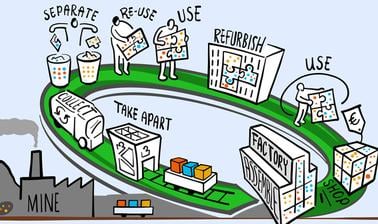
The design of products is an important aspect of a circular economy. The circular economy approach addresses material supply challenges by keeping materials in use much longer and eventually returning materials for new use. The principle is that waste must be minimized. Products will be designed to last longer. They will be easier to Reuse, Repair, and Remanufacture. The product will eventually be broken down and Recycled. This is Design for R and is the focus of this course.

Experts from leading European universities and research organizations will explain the latest strategies in product design. Current design approaches lead to waste, loss of value and loss of resources. You will learn about the innovative ways in which companies are creating value, whilst securing their supply chains, by integrating Design for R.
This course is suitable for all learners who have an interest in product design, innovative engineering, new business activity, entrepreneurship, sustainability, circular economy and everyone who thinks that the current way we do things today needs a radical rethink.
This course is part of the Sustainable Engineering Design Professional Certificate.

What you'll learn

  • Learn “ Design for R ” strategies: reuse, repair, remanufacturing, and recycling.
  • Integrate life-cycle design into your skillset and your company vision.
  • Understand the strategic importance of raw material supply and conservation.
  • Effectively balance value creation with industrial sustainability.
  • Improve your strategic design skills to make better decisions.

Prerequisites
Intended for design and engineering students and professionals. This course is aimed at students and working professionals with a basic background knowledge of design, engineering, and Circular Economy. If you want to learn the basics of Design for a Circular Economy we invite you to take a look at Circular Economy: An introduction before the start of this course. Previous knowledge of Circular Economy concepts is preferred but not necessary.

Syllabus

Week 1. Introduction: The materials challenge and the importance of product design for a Circular Economy. Focus on economic and social drivers and barriers to change.

Week 2.Design for Reuse: Towards the production of long-lasting products with reliable performance and minimum maintenance requirements. Product use intensification in the Sharing Economy.

Week 3. Design for Repair: Allows quick and efficient access to key components and connections. Making products fit for use again in a time- and resource-effective way.

Week 4.Design for Remanufacture: Re-manufactured products should look and perform as new. This implies a complex new system of reverse logistics, cleaning and conditioning facilities, as well as a shift in client and consumer mentality.

Week 5. Design for Recycle: Eventually most products will be broken down into individual materials. Choices such as the use of composites or chemical connections affects the recyclability and economic value of materials.

Week 6.Conclusion: Thinking in loops. Creating sustainable value through strategic product and business design for a Circular Economy.
Go to Class
MOOC List is learner-supported. When you buy through links on our site, we may earn an affiliate commission.

Related Courses

Circular Economy for a Sustainable Built Environment (edX) EdX
Delft University of Technology,DelftX

Circular Economy for a Sustainable Built Environment (edX)

Learn how the principles of the Circular Economy can be applied to the built environment ranging from products and buildings to metropolitan and regional development strategies. In this course you will become familiar with circularity as a systemic, multi-disciplinary approach, concerned with the different scale, from material to product, building, city, and region.

Self Paced
Self-Paced
Circular Strategies for Hospitals (edX) EdX
Delft University of Technology,DelftX

Circular Strategies for Hospitals (edX)

Learn to apply the principles of the circular economy in a hospital or healthcare organization to reduce waste and contribute to sustainable healthcare. Reducing medical waste is a worldwide challenge that calls for smarter solutions that can make healthcare more sustainable. This course helps hospital staff, management, users and buyers of medical products and decision-makers make the transition to a circular economy and therefore contribute to reducing waste streams and costs.

Self Paced
Self-Paced
Applied Sustainability Engineering (Coursera) Coursera
University of Colorado Boulder,Siemens

Applied Sustainability Engineering (Coursera)

Applied Sustainability Engineering, the second course in the "Applied Sustainability for Technical Managers" specialization discusses the techniques used by engineers and scientists to develop and assess the environmental impact of products and processes required to make those products. It begins with a discussion of different renewable energy technologies and their economics – highlighting how continued reductions in cost have made wind and solar power the least expensive way to generate electricity. It then addresses carbon footprints and how they are determined, applying a practical example where you determine your residential and transportation carbon footprints.

May 30th 2026
5-12 Weeks
Sustainability and the Circular Economy (Coursera) Coursera
University of Colorado Boulder,Siemens

Sustainability and the Circular Economy (Coursera)

As the world’s population continues to rise toward an expected 10 billion citizens by 2050, it is imperative that business practices change to ensure a high quality of life is possible for all of us, both human and non-human. Today’s learners are very aware of this. Moreover, they are highly motivated and have the extraordinary capacity to create a future that provides both economic success and a more enduring, resilient, and sustainable planet. If you are one of these learners, then Sustainability and the Circular Economy is a course for you.

Jun 8th 2026
5-12 Weeks
Sustainable Packaging in a Circular Economy (edX) EdX
Delft University of Technology,DelftX

Sustainable Packaging in a Circular Economy (edX)

Learn how to apply the principles of the circular economy to sustainable packaging systems. It has become almost impossible to imagine what our lives would be like without the many benefits of packaging - just think about the different packaging and single-use items you use on a daily basis. Yet as our global population grows in size and affluence, both our collective demand for packaging materials and the waste we generate as a result will increasedramatically.

Self Paced
Self-Paced
Decision Making in Engineering Design (edX) EdX
Purdue University,PurdueX

Decision Making in Engineering Design (edX)

In this course, you will learn the foundations of decision-making in the design of engineering products, processes, and systems. Decision making is an essential activity in all organizations and teams involved in engineering design and product development. Successful design requires the ability to make good decisions in the presence of risk and uncertainty, and an understanding of how customers and other stakeholders make decisions.

Jan 10th 2022
13-24 Weeks
Smart Cities (edX) EdX
University of Canterbury,UCx

Smart Cities (edX)

Explore how New Zealand is using technology and data to design sustainable smart cities. The Smart Cities course charts a journey across New Zealand to understand how smart cities are shaping up from Christchurch in the South to the capital city Wellington all the way to Hamilton in the North. You’ll learn from real live smart city projects such as LED lighting, solar powered waste management solutions and more allowing you to better comprehend how New Zealand is paving new paths to harness technology to create social change.

Self Paced
Self-Paced
Cellular Solids 1: Structures, Properties and Engineering Applications (edX) EdX
MIT,MITx

Cellular Solids 1: Structures, Properties and Engineering Applications (edX)

Learn how to model the mechanical properties of honeycombs and foams and to apply the models to material selection in engineering design. In this engineering course, we will explore the processing and structure of cellular solids as they are created from polymers, metals, ceramics, glasses and composites. We will derive models for the mechanical properties of honeycombs and foams, and we will discover how the unique properties of these materials can be exploited in applications such as lightweight structural panels, energy absorption devices, and thermal insulation.

No sessions available
5-12 Weeks
Design for Recycling of Electronics in a Circular Economy (edX) EdX
Delft University of Technology,DelftX

Design for Recycling of Electronics in a Circular Economy (edX)

Discover the latest developments in Design for Recycling (DfR) of electrical and electronic equipment (EEE) and the application of recycled plastics into new products. Electronic products bring countless benefits to society, but their production and waste treatment also lead to numerous negative environmental and economic impacts. Since E-waste is the world’s fastest growing waste stream, governments are setting ambitious targets to help this industry transition towards a circular economy.

Nov 10th 2021
4 Weeks
Built environment sustainability assessment (edX) EdX
Universitat Politècnica de València,UPValenciaX

Built environment sustainability assessment (edX)

The course introduces the basic elements and trends for performing a through built environment assessment and develops the tools for urban sustainability policy impact analysis. The course introduces the basic elements and trends for performing a through built environment assessment and develops the tools for urban sustainability policy impact analysis.

Self Paced
Self-Paced
Circular Strategies for MedTech Suppliers (edX) EdX
Delft University of Technology,DelftX

Circular Strategies for MedTech Suppliers (edX)

Apply theories, tools and best practices needed to design circular products or services for hospitals and other healthcare organizations. Developing or improving medical devices to ensure a continuous supply for an exponentially growing population is a critical factor in making healthcare more sustainable. This course will help you to make the transition towards a circular economy and create value in the healthcare industry on the supplier side.

Self Paced
Self-Paced
Circular Economy: An Introduction (edX) EdX
Delft University of Technology,DelftX

Circular Economy: An Introduction (edX)

Ready to make a difference? Learn how to contribute to a sustainable economic system by implementing novel business and design approaches! Our global society is not sustainable. We all know about the challenges we’re facing: waste, climate change, resource scarcity, loss of biodiversity. At the same time, we want to sustain our economies and offer opportunities for a growing world population. This course is about providing solutions we really believe in: a Circular Economy.

Self Paced
Self-Paced