EdX

El Antártico, un continente asombroso (edX)

El Antártico, un continente asombroso (edX)

En este curso en línea conocerás diferentes aspectos sobre el continente blanco, de la mano de un grupo de científicos que trabajaron allí. Se tratarán aspectos físicos, históricos, biológicos, ambientales y geopolíticos.

Class Deals by MOOC List - Click here and see EdX's Active Discounts, Deals, and Promo Codes.

Son muchos los aspectos en el que Antártida se revela de un modo diferente al resto del planeta, los que despiertan nuestro interés. Cada disciplina del conocimiento encuentra en este singular ámbito, una particularidad, ya sea esta la biología, la geología, la geofísica, la geodesia, su historia, y la particular presencia humana.

Es el continente de mayor altura media del planeta. Se trata de una gran meseta, cubierta mayoritariamente de hielo. El Polo Sur se encuentra en la gran meseta polar de 2835 metros de altura, en donde el espesor de la capa de hielo alcanza mas de 2700 msnm. Si los hielos que la cubren desaparecieran el continente emergería 900 metros por sobre los niveles actuales de su suelo.
Es el continente en el que se registran las temperaturas más bajas del planeta, con una mínima de casi -90° C.
En Antártida viven especies con particularidades como mamíferos que nadan o aves que no vuelan. Focas, elefantes, lobos, ballenas, y una gran variedad de pingüinos.
La configuración del campo magnético terrestre convierte al Antártico en una ventana abierta la física solar. Esta configuración del campo magnético, con sus líneas de fuerza entrantes en los polos, posibilitan el ingreso de partículas cargadas eléctricamente, o plasma, proveniente del sol. Esta es la causa de una serie de fenómenos propios de altas latitudes, como las grandes variaciones magnéticas, las perturbaciones ionosféricas y las auroras polares.
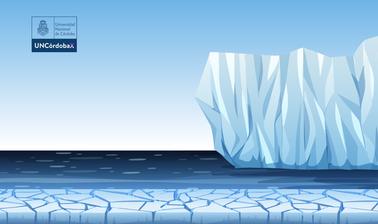
En este curso en línea, conocerás que El Antártico es además el mayor reservorio de agua dulce del planeta. Los icebergs son verdaderos depósitos flotantes de agua dulce.
Se identifican cinco polos, el geográfico, el magnético, el geomagnético, el polo de frío y el de inaccesibilidad relativa. En el curso de biología conocerás su significado y porque hay una línea en la que la brújula funciona al revés.
El problema del ozono.
El vórtice polar o corriente del jet polar, explica el confinamiento de la depresión estacional de ozono, diferente a la del polo Norte.
Antártida es el único continente sin población permanente y el único en donde no existe el concepto de espacio nacional, tal como lo conocemos. Se rige por un tratado ejemplar, el Tratado Antártico. El Comité Científico del Tratado Antártico (SCAR.), es su componente de ciencia y aprenderás como funciona esta norma singular.

What you'll learn

  • Los estudiantes explorarán en los diversos y característicos aspectos del lugar de la mano de científicos que trabajaron en la zona en diferentes áreas del conocimiento
  • Sobre los aspectos físicos, históricos, biológicos, ambientales y geopolíticos del lugar
  • Características del territorio. El Antártico es el mayor reservorio de agua dulce; se registran las temperaturas más bajas del planeta tierra, por debajo de los 90°C

Syllabus

Introducción: El Antártico
Unidad 1: Generalidades
Unidad 2: Aspectos Geofísicos generales.
Unidad 3: Campo Magnético y alta atmósfera
Unidad 4: Aspectos geológicos
Unidad 5: Aspectos biológicos
Unidad 6: Primeras exploraciones
Unidad 7: Presencia humana
Go to Class
MOOC List is learner-supported. When you buy through links on our site, we may earn an affiliate commission.

Related Courses

Retos de la Agricultura y la Alimentación en el Siglo XXI (edX) EdX
Universitat Politècnica de València,UPValenciaX

Retos de la Agricultura y la Alimentación en el Siglo XXI (edX)

Reflexionaremos sobre agricultura y alimentación en un planeta que tiene que alimentar a una población creciente con recursos limitados. El planeta se enfrenta al reto de alimentar a una población creciente en un escenario de limitación de recursos, mercados agroalimentarios imperfectos, crisis de alimentos, y población rural vulnerable. El curso invita a una reflexión sobre las alternativas de la agricultura y la alimentación, vistas como solución a los desafíos socio-económicos y ambientales, con énfasis en el papel de la agricultura familiar y en modos de producción sostenibles, en el marco de cadenas de valor más equilibradas.

No sessions available
5-12 Weeks
Fundamentals of Neuroscience, Part 1: The Electrical Properties of the Neuron (edX) EdX
HarvardX,Harvard University

Fundamentals of Neuroscience, Part 1: The Electrical Properties of the Neuron (edX)

Learn how electricity makes the neurons in your brain tick. Fundamentals of Neuroscience is a three-courseseries that explores the structure and function of the nervous system—from the inner workings of a single nerve cell to the staggering complexity of the brain and the social interactions they enable.

Self Paced
Self-Paced
BIM for Construction (edX) EdX
Purdue University,PurdueX

BIM for Construction (edX)

Learn how to couple BIM and traditional scheduling and cost-estimating tools to develop 4D, 5D, and nD models for effective construction applications. This course is the second of a sequence of interrelated courses on current computer applications in the construction industry. The emphasis of this course is the application of building information modeling (BIM) in construction.

Feb 13th 2022
5-12 Weeks
Sharks! (edX) EdX
University of Queensland,CornellX,Cornell University,UQx

Sharks! (edX)

Learn about the most fascinating animals on Earth, their sophisticated senses and how sharks and their relatives have impacted human history and culture. Did you know that you can track some sharks’ movements on Twitter? Or that the scales on their skin have influenced the way humans design boats, planes, and even swimsuits? Or that sharks have more senses than humans?

Jul 3rd 2023
4 Weeks
How We See the World: Visual Function and Eye Health (edX) EdX
The Hong Kong Polytechnic University,HKPolyUx

How We See the World: Visual Function and Eye Health (edX)

Develop your understanding of vision and discover how visual functions relate to your daily life. Learn and apply techniques to help you take better care of your eyes. How do we see the world? How do we see details at different viewing distances? How do we see in three dimensions? How do we see colour? How can we avoid getting cataracts or prevent short-sightedness? This course will help you develop your understanding of vision, how visual functions relate to your daily life, and how you can better take care of your eyes.

Jan 1st 2024
5-12 Weeks
Introduction to Bioethics (edX) EdX
Georgetown University,GeorgetownX

Introduction to Bioethics (edX)

Introduction to Bioethics explores some of the most difficult - and fascinating - moral challenges we face in health, medicine, and emerging technologies. Should we clone humans? Who owns our DNA? How much control should we have over how and when we die? When does medical treatment turn into medical enhancement — and should we care? Is rationing health care good, bad, necessary — or all of the above? This course will explore fundamental moral issues that arise in medicine, health, and biotechnology.

No sessions available
13-24 Weeks
Playing with Fire! (edX) EdX
The Hong Kong Polytechnic University,HKPolyUx

Playing with Fire! (edX)

‘Playing with Fire’ introduces the complex challenge fire hazard represents to human activities. While learning about fundamentals of fire science and how professionals deal with this hazard, you’ll learn things like why a candle flame has the shape it has and how fire fighters use fire to suppress fire.

Aug 1st 2022
5-12 Weeks
Antarctica in a Changing Climate (edX) EdX
University of Canterbury,UCx

Antarctica in a Changing Climate (edX)

Explores the exceptional aspects of the Antarctic climate and its ecosystems, looking at the current and future impacts of environmental change, including climate change. This course introduces participants to the ecological and physical characteristics of the Antarctic environment and Antarctic governance.

Self Paced
Self-Paced
Applied Quantum Computing II: Hardware (edX) EdX
Purdue University,PurdueX

Applied Quantum Computing II: Hardware (edX)

Learn how present-day material platforms are built to perform quantum information processing tasks. This course is part 2 of the series of Quantum computing courses, which covers aspects from fundamentals to present-day hardware platforms to quantum software and programming. The goal of part 2 is to provide the essential understanding of how the fundamental quantum phenomena discussed in part 1 can be realized in various material platforms and the underlying challenges faced by each platform.

Feb 12th 2024
5-12 Weeks
Small Organisms, Big Solutions: Microbiomes & Sustainability (edX) EdX
National University of Singapore,NUS

Small Organisms, Big Solutions: Microbiomes & Sustainability (edX)

The course is an introduction to microbiomes and sustainability. It argues that global microbiomes are fundamentally relevant to sustainability. Topics include principles of sustainability, sustainable development, microbiomes in humans and the environment, bioremediation, and bioretention.

Apr 20th 2022
4 Weeks