The Data Scientist's Toolbox (Coursera)

The Data Scientist's Toolbox (Coursera)

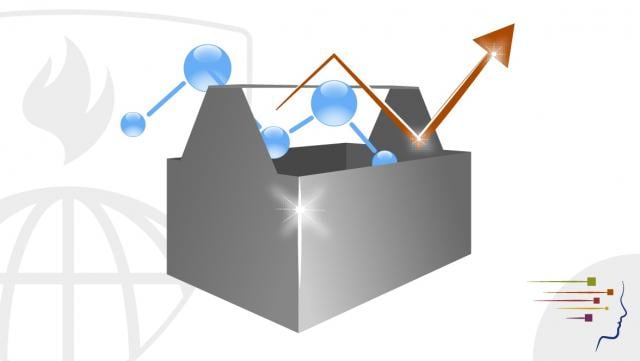
In this course you will get an introduction to the main tools and ideas in the data scientist's toolbox. The course gives an overview of the data, questions, and tools that data analysts and data scientists work with. There are two components to this course. The first is a conceptual introduction to the ideas behind turning data into actionable knowledge. The second is a practical introduction to the tools that will be used in the program like version control, markdown, git, GitHub, R, and RStudio.

Class Deals by MOOC List - Click here and see Coursera's Active Discounts, Deals, and Promo Codes.

Completing this course will count towards your learning in any of the following programs:

What You Will Learn

  • Set up R, R-Studio, Github and other useful tools
  • Understand the data, problems, and tools that data analysts use
  • Explain essential study design concepts
  • Create a Github repository

Syllabus

WEEK 1
Data Science Fundamentals
In this module, we'll introduce and define data science and data itself. We'll also go over some of the resources that data scientists use to get help when they're stuck.

WEEK 2
R and RStudio
In this module, we'll help you get up and running with both R and RStudio. Along the way, you'll learn some basics about both and why data scientists use them.

WEEK 3
Version Control and GitHub
During this module, you'll learn about version control and why it's so important to data scientists. You'll also learn how to use Git and GitHub to manage version control in data science projects.

WEEK 4
R Markdown, Scientific Thinking, and Big Data
During this final module, you'll learn to use R Markdown and get an introduction to three concepts that are incredibly important to every successful data scientist: asking good questions, experimental design, and big data.


Go to Class
MOOC List is learner-supported. When you buy through links on our site, we may earn an affiliate commission.

Related Courses

Matrix Methods (Coursera) Coursera
University of Minnesota

Matrix Methods (Coursera)

Mathematical Matrix Methods lie at the root of most methods of machine learning and data analysis of tabular data. Learn the basics of Matrix Methods, including matrix-matrix multiplication, solving linear equations, orthogonality, and best least squares approximation. Discover the Singular Value Decomposition that plays a fundamental role in dimensionality reduction, Principal Component Analysis, and noise reduction.

Aug 17th 2026
5-12 Weeks
Practical Machine Learning on H2O (Coursera) Coursera
H2O.ai

Practical Machine Learning on H2O (Coursera)

In this course, we will learn all the core techniques needed to make effective use of H2O. Even if you have no prior experience of machine learning, even if your math is weak, by the end of this course you will be able to make machine learning models using a variety of algorithms. We will be using linear models, random forest, GBMs and of course deep learning, as well as some unsupervised learning algorithms.

Aug 17th 2026
5-12 Weeks
Experimentation for Improvement (Coursera) Coursera
McMaster University

Experimentation for Improvement (Coursera)

We are always using experiments to improve our lives, our community, and our work. Are you doing it efficiently? Or are you (incorrectly) changing one thing at a time and hoping for the best? In this course, you will learn how to plan efficient experiments - testing with many variables. Our goal is to find the best results using only a few experiments. A key part of the course is how to optimize a system.

Aug 17th 2026
5-12 Weeks
Structural Equation Model and its Applications | 结构方程模型及其应用 (普通话) (Coursera) Coursera
The Chinese University of Hong Kong

Structural Equation Model and its Applications | 结构方程模型及其应用 (普通话) (Coursera)

在社会学、心理学、教育学、经济学、管理学、市场学等研究领域的数据分析中,结构方程建模是当前最前沿的统计方法中应用最广、研究最多的一个。它包含了方差分析、回归分析、路径分析和因子分析,弥补了传统回归分析和因子分析的不足,可以分析多因多果的联系、潜变量的关系,

Aug 17th 2026
5-12 Weeks
Reproducible Templates for Analysis and Dissemination (Coursera) Coursera
Emory University

Reproducible Templates for Analysis and Dissemination (Coursera)

This course will assist you with recreating work that a previous coworker completed, revisiting a project you abandoned some time ago, or simply reproducing a document with a consistent format and workflow. Incomplete information about how the work was done, where the files are, and which is the most recent version can give rise to many complications.

Aug 17th 2026
5-12 Weeks
Business Statistics and Analysis Capstone (Coursera) Coursera
Rice University

Business Statistics and Analysis Capstone (Coursera)

The Business Statistics and Analysis Capstone is an opportunity to apply various skills developed across the four courses in the specialization to a real life data. The Capstone, in collaboration with an industry partner uses publicly available ‘Housing Data’ to pose various questions typically a client would pose to a data analyst. Your job is to do the relevant statistical analysis and report your findings in response to the questions in a way that anyone can understand.

Aug 17th 2026
4 Weeks
Data Literacy – What is it and why does it matter? (Coursera) Coursera
University of Copenhagen,Sorbonne University,University of Warsaw,University of Milan,Charles University,4EU+ Alliance

Data Literacy – What is it and why does it matter? (Coursera)

You might already know that data is not neutral. Our values and assumptions are influenced by the data surrounding us - the data we create, the data we collect, and the data we share with each other. Economic needs, social structures, or algorithmic biases can have profound consequences for the way we collect and use data. Most often, the result is an increase of inequity in the world. Data also changes the way we interact. It shapes our thoughts, our feelings, our preferences and actions.

Aug 17th 2026
3 Weeks
Fundamentos de Excel para Negocios (Coursera) Coursera
Universidad Austral

Fundamentos de Excel para Negocios (Coursera)

Cuando finalices este curso habrás logrado un gran número de habilidades como introducir información, ordenarla, manipularla, realizar cálculos de diversa índole (matemáticos, trigonométricos, estadísticos, financieros, ingenieriles, probabilísticos), extraer conclusiones, trabajar con fechas y horas, construir gráficos, imprimir reportes y muchas más.

Aug 17th 2026
5-12 Weeks
Introduction to Genomic Technologies (Coursera) Coursera
Johns Hopkins University

Introduction to Genomic Technologies (Coursera)

This course introduces you to the basic biology of modern genomics and the experimental tools that we use to measure it. We'll introduce the Central Dogma of Molecular Biology and cover how next-generation sequencing can be used to measure DNA, RNA, and epigenetic patterns. You'll also get an introduction to the key concepts in computing and data science that you'll need to understand how data from next-generation sequencing experiments are generated and analyzed.

Aug 17th 2026
4 Weeks