EdX

Compilers (edX)

Offered by StanfordOnline,
Compilers (edX)

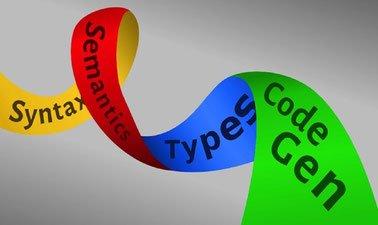
This self-paced course will discuss the major ideas used today in the implementation of programming language compilers, including lexical analysis, parsing, syntax-directed translation, abstract syntax trees, types and type checking, intermediate languages, dataflow analysis, program optimization, code generation, and runtime systems.

Class Deals by MOOC List - Click here and see EdX's Active Discounts, Deals, and Promo Codes.

As a result, you will learn how a program written in a high-level language designed for humans is systematically translated into a program written in low-level assembly more suited to machines. Along the way we will also touch on how programming languages are designed, programming language semantics, and why there are so many different kinds of programming languages.
The course lectures will be presented in short videos. To help you master the material, there will be in-lecture questions to answer, quizzes, and two exams: a midterm and a final. There will also be homework in the form of exercises that ask you to show a sequence of logical steps needed to derive a specific result, such as the sequence of steps a type checker would perform to type check a piece of code, or the sequence of steps a parser would perform to parse an input string. This checking technology is the result of ongoing research at Stanford into developing innovative tools for education, and we're excited to be the first course ever to make it available to students.
An optional course project is to write a complete compiler for COOL, the Classroom Object Oriented Language. COOL has the essential features of a realistic programming language, but is small and simple enough that it can be implemented in a few thousand lines of code. Students who choose to do the project can implement it in either C++ or Java.

What you'll learn
Everything that computers do is the result of some program, and all of the millions of programs in the world are written in one of the many thousands of programming languages that have been developed since the 1950’s. Designing and implementing a programming language turns out to be difficult; some of the best minds in computer science have thought about the problems involved and contributed beautiful and deep results. Learning something about compilers will show you the interplay of theory and practice in computer science, especially how powerful general ideas combined with engineering insight can lead to practical solutions to very hard problems. Knowing how a compiler works will also make you a better programmer and increase your ability to learn new programming languages quickly.

Go to Class
MOOC List is learner-supported. When you buy through links on our site, we may earn an affiliate commission.

Related Courses

Learn Imba (Coursera) Coursera
Scrimba

Learn Imba (Coursera)

In this class, you'll dive into Imba, the programming language used to build scrimba.com. Imba, a compile-to-JavaScript language, packs a punch with nifty features for whipping up web apps, including built-in tags and styles. We'll cover the ABCs of Imba syntax and work on creating a Dopamine Box app. By the finish line, you'll be armed with the skills to construct your very own web app UI using Imba.

Oct 12th 2026
1 Week
Estruturas de dados Python (Coursera) Coursera
University of Michigan

Estruturas de dados Python (Coursera)

Este curso apresentará as estruturas de dados centrais da linguagem de programação Python. Vamos superar os fundamentos da programação de procedimentos e explorar como podemos usar as estruturas de dados integradas do Python, como listas, dicionários e tuplas, para realizar análises de dados cada vez mais complexas. Este curso cobrirá os capítulos 6 a 10 do livro “Python para Todos”. Este curso aborda o Python 3.

Oct 5th 2026
5-12 Weeks
Computer Science: Programming with a Purpose (Coursera) Coursera
Princeton University

Computer Science: Programming with a Purpose (Coursera)

The basis for education in the last millennium was “reading, writing, and arithmetic;” now it is reading, writing, and computing. Learning to program is an essential part of the education of every student, not just in the sciences and engineering, but in the arts, social sciences, and humanities, as well. Beyond direct applications, it is the first step in understanding the nature of computer science’s undeniable impact on the modern world.

Oct 5th 2026
5-12 Weeks
Mobile Application Experiences (edX) EdX
MIT,MITx

Mobile Application Experiences (edX)

Learn to create a novel mobile application in this MIT course - from research to design, usability, implementation and field evaluation. How do you design a mobile app that truly changes people's lives? How can you understand how a new service is being used, both quantitatively and qualitatively? How can you use all of the rich sensing and I/O capabilities of mobile devices to create experiences that go far beyond what's possible on a traditional computer?

No session available
5-12 Weeks
Introduction to Complex Analysis (Coursera) Coursera
Wesleyan University

Introduction to Complex Analysis (Coursera)

This course provides an introduction to complex analysis which is the theory of complex functions of a complex variable. We will start by introducing the complex plane, along with the algebra and geometry of complex numbers, and then we will make our way via differentiation, integration, complex dynamics, power series representation and Laurent series into territories at the edge of what is known today.

Oct 12th 2026
5-12 Weeks
Road safety in the Caribbean region: institutions and data management (edX) EdX
Inter-American Development Bank - IDB,IDBx

Road safety in the Caribbean region: institutions and data management (edX)

Learn about the current state of road safety in our region, its main challenges, and areas of action. Can you imagine being able to contrast your opinions and experiences with people like Lieutenant Colonel, Enrique, from Ecuador, or other practicing public managers and representatives of Civil Society organizations from all over the region? In this course, you will have that opportunity, and also, access to videos of international specialists from various organizations (IDB, PAHO / WHO, WRI, LatinNCAP among others); readings; real cases from the region; recommendations; practical activities and discussion forums.

Self Paced
Self-Paced
Introducción a Java (Coursera) Coursera
Universidad Nacional Autónoma de México

Introducción a Java (Coursera)

Me llamo Elisa Viso y una de mis pasiones es la de programar y enseñar a programar. El lenguaje Java es uno de los que más me ha gustado en mis 45 años que llevo programando. Si bien te podrá parecer un poco complicado empezar a programar en Java, una vez que cubras los conceptos básicos verás qué rápido se avanza. Java, como todos los lenguajes de programación bien hechos, te dejan hacer cualquier cosa (algunas de ellas con más trabajo que en otros lenguajes y otras casi directamente de cómo piensas la solución al problema).

Oct 5th 2026
5-12 Weeks