FUN

Chimiometrie, chapitre 1/2: les méthodes non supervisées (FUN)

Offered by Agreenium,
Chimiometrie, chapitre 1/2: les méthodes non supervisées (FUN)

Peut-on estimer la composition chimique d'un échantillon en quelques secondes et sans le toucher ? Identifier son origine ? Oui ! C'est possible, en réalisant l'acquisition d'un spectre de l'échantillon et son traitement avec des outils de chimiométrie.

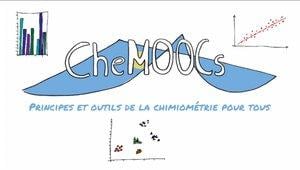
Chemoocs est destiné à vous rendre autonome en chimiométrie. Mais le contenu est dense! C'est pourquoi le mooc a été divisé en deux chapitres. Le présent chapitre, le premier, porte sur les méthodes non supervisées. Vous aurez quelques mois pour assimiler son contenu. Ensuite, le second chapitre, pour lequel il faudra vous re-inscrire sur FUN, portera sur les méthodes supervisées et la validation de méthodes analytiques. Le teaser ci-dessus donne plus de détails sur le contenu.

Chemoocs est orienté vers les applications de spectrométrie proche infrarouge, les plus répandues. Toutefois, la chimiométrie est ouverte à d'autres domaines spectraux : moyen infrarouge, ultraviolet, visible, fluorescence ou Raman, ainsi qu'à bien d'autres applications non spectrales. Donc pourquoi pas dans votre domaine ?
Vous appliquerez vos connaissances en réalisant nos exercices d'application grâce au logiciel ChemFlow, gratuit et accessible via un simple navigateur internet depuis un ordinateur ou un smartphone. ChemFlow a été concu pour être aussi convivial et intuitif que possible. Ainsi, il ne nécessite aucune connaissance en programmation.
A la fin de ce mooc, vous aurez acquis le savoir-faire nécessaire pour traiter vos propres données.
Bienvenue dans le monde fascinant de la chimiométrie.

Plan du cours

Semaine 0 :

  • Présentation du mooc
  • Prise en main de la plateforme FUN
  • Découverte du logiciel ChemFlow
  • Introduction à la chimiométrie avec quelques définitions

Semaine 1 :

  • Statistiques simples
  • ACP (1/2)

Semaine 2 :

  • ACP (2/2)
  • Prétraitements (1/2)

Semaine 3 :

  • Classification non supervisée
  • Prétraitements (2/2)

Semaine 4 :

  • Décomposition spectrale (démélange)
  • Analyse en composantes indépendantes
  • Données N-way: méthode PARAFAC

Semaine 5 :

  • Données multiblocs: introduction
  • Méthode multiblocs, méthode ACOM

Semaine 6 :

  • Méthode multiblocs, méthode ACCPS
  • Méthode multiblocs, méthode STATIS

Go to Class
MOOC List is learner-supported. When you buy through links on our site, we may earn an affiliate commission.

Related Courses

General Chemistry: Concept Development and Application (Coursera) Coursera
Rice University

General Chemistry: Concept Development and Application (Coursera)

This course will cover the topics of a full year, two semester General Chemistry course. We will use a free on-line textbook, Concept Development Studies in Chemistry, available via Rice’s Connexions project. The fundamental concepts in the course will be introduced via the Concept Development Approach developed at Rice University. In this approach, we will develop the concepts you need to know from experimental observations and scientific reasoning rather than simply telling you the concepts and then asking you to simply memorize or apply them.

Aug 10th 2026
5-12 Weeks
Nanotechnology and Nanosensors, Part 2 (Coursera) Coursera
Technion - Israel Institute of Technology

Nanotechnology and Nanosensors, Part 2 (Coursera)

Learn about novel sensing tools that make use of nanotechnology to screen, detect and monitor various events in personal or professional life. Together, we will lay the groundwork for infinite innovative applications, starting from diagnosis and treatments of diseases, continuing with quality control of goods and environmental aspects, and ending with monitoring security issues.

Aug 10th 2026
5-12 Weeks
Fondamentaux pour le Big Data (FUN) FUN
Institut Mines-Telecom

Fondamentaux pour le Big Data (FUN)

Le MOOC « Fondamentaux pour le big data » permet d'acquérir efficacement le niveau prérequis en informatique et en statistiques pour suivre des formations dans le domaine du big data. Le big data offre de nouvelles opportunités d’emplois au sein des entreprises et des administrations. De nombreuses formations préparant à ces opportunités de métiers existent. Le suivi de ces formations nécessite des connaissances de base en statistiques et en informatique que ce MOOC vous propose d’acquérir dans les domaines de l’analyse, algèbre, probabilités, statistiques, programmation Python et bases de données.

No sessions available
5-12 Weeks
Probability - The Science of Uncertainty and Data (edX) EdX
MIT,MITx

Probability - The Science of Uncertainty and Data (edX)

Build foundational knowledge of data science with this introduction to probabilistic models, including random processes and the basic elements of statistical inference. The world is full of uncertainty: accidents, storms, unruly financial markets, noisy communications. The world is also full of data. Probabilistic modeling and the related field of statistical inference are the keys to analyzing data and making scientifically sound predictions.

Sep 1st 2026
13-24 Weeks
Fundamentals of Statistics (edX) EdX
MIT,MITx

Fundamentals of Statistics (edX)

Develop a deep understanding of the principles that underpin statistical inference: estimation, hypothesis testing and prediction. Statistics is the science of turning data into insights and ultimately decisions. Behind recent advances in machine learning, data science and artificial intelligence are fundamental statistical principles. The purpose of this class is to develop and understand these core ideas on firm mathematical grounds starting from the construction of estimators and tests, as well as an analysis of their asymptotic performance.

Aug 26th 2026
13-24 Weeks
A Crash Course in Causality: Inferring Causal Effects from Observational Data (Coursera) Coursera
University of Pennsylvania

A Crash Course in Causality: Inferring Causal Effects from Observational Data (Coursera)

We have all heard the phrase “correlation does not equal causation.” What, then, does equal causation? This course aims to answer that question and more! Over a period of 5 weeks, you will learn how causal effects are defined, what assumptions about your data and models are necessary, and how to implement and interpret some popular statistical methods. Learners will have the opportunity to apply these methods to example data in R (free statistical software environment).

Aug 17th 2026
5-12 Weeks
Mastering bitumen for better roads and innovative applications (Coursera) Coursera
École des Ponts ParisTech

Mastering bitumen for better roads and innovative applications (Coursera)

During the four coming weeks, best experts in bitumen will bring you their knowledge and experience to build a strong understanding of today’s realities and new perspectives on the future of bitumen. Total is the European leader on bitumen markets. Innovation has always been the key to sustainability and durability in the products they develop. Their main objective here is to share technical knowledge and experience to insure bitumen are being used in the most effective and efficient ways for their different applications in road works.

Aug 10th 2026
4 Weeks
Introduction to Physical Chemistry (Coursera) Coursera
University of Manchester

Introduction to Physical Chemistry (Coursera)

Chemical reactions underpin the production of pretty much everything in our modern world. But, what is the driving force behind reactions? Why do some reactions occur over geological time scales whilst others are so fast that we need femtosecond-pulsed lasers to study them? Ultimately, what is going on at the atomic level? Discover the answers to such fundamental questions and more on this course in introductory physical chemistry.

Aug 24th 2026
5-12 Weeks