Chemistry (Coursera)

Chemistry (Coursera)

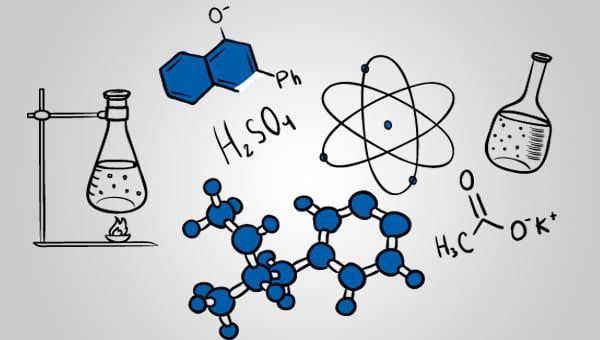
This course is designed to cover subjects in advanced high school chemistry courses, correlating to the standard topics as established by the American Chemical Society. This course is a precursor to the Advanced Chemistry Coursera course. Areas that are covered include atomic structure, periodic trends, compounds, reactions and stoichiometry, bonding, and thermochemistry.

Class Deals by MOOC List - Click here and see Coursera's Active Discounts, Deals, and Promo Codes.

Syllabus

WEEK 1
We will learn about the components inside the atom and look especially at the electrons. The electron structure determines the properties of the elements. So, by the end of this series of lessons, you will know for each elements where the electrons are located in the atom.

WEEK 2
Once we understand the electronic structure, we will be able determine how the periodic table can be used to compare the elements according to atomic size and various energies. We will conclude by seeing how these trends can be used to predict chemical properties of the elements.

WEEK 3
Now that we know the structure of an atom, we can explore how atoms combine to form either molecular or ionic compounds. Then we will learn the rules of nomenclature that ensure that a compound is named according to IUPAC rules. We will end this unit by looking at quantitative relationships for compounds including the molar mass of and mass percent of an element in a compound.

WEEK 4
We will explore how compounds react with one another to form new substances and then write balanced chemical equations to represent what is happening in a reaction. We will explore several different types of reactions including precipitation, acid-base, oxidation-reduction, and combustion reaction.

WEEK 5
This unit will delve into the quantitative relationships we can determine from a balanced chemical equation to determine the relative amounts of substances needed to react or the amount of products formed. We will also explore limiting reagents and percent yield to address practical aspects of chemical reactions because there may be leftover reactants and/or incomplete formation of products.

WEEK 6
This unit looks more in depth at molecular compounds to see how they are bonded together by looking at Lewis structures. These structures provide information about the types of bonds (single, double, or triple) as well as the connectivity of atoms. By knowing the Lewis structure, we can also predict the three-dimensional geometry of an individual molecule.

WEEK 7
In this unit, we will learn about thermochemistry, which is the study of the thermal energy transfer (heat) in chemical reactions. We will learn how these measurements of heat are made via calorimetry. Then, learn to calculate heat transfer using various methods.
Go to Class
MOOC List is learner-supported. When you buy through links on our site, we may earn an affiliate commission.

Related Courses

Thermodynamique : applications (Coursera) Coursera
École Polytechnique Fédérale de Lausanne

Thermodynamique : applications (Coursera)

Ce cours complète le MOOC « Thermodynamique : fondements » qui vous permettra de mettre en application les concepts fondamentaux de la thermodynamique. Pour atteindre cet objectif, le Professeur J.-Ph. Ansermet de l’Ecole Polytechnique Fédérale de Lausanne s’est entouré d’experts et de spécialistes des différents domaines d’application provenant de diverses institutions partenaires du réseau RESCIF. Vous pourrez ainsi voir l’usage de la thermodynamique en chimie, en ingénierie et en physique.

Aug 3rd 2026
5-12 Weeks
Chemical Engineering Thermodynamics 2 (Coursera) Coursera
Korea Advanced Institute of Science and Technology - KAIST

Chemical Engineering Thermodynamics 2 (Coursera)

An appreciation of thermodynamics is required to become a chemical and biomolecular engineer. Thermodynamics can assess the viability of a process and is one of the curriculum's most essential topics. The principles are utilized in following engineering courses (kinetics, mass transfer, design, materials) and are applicable to numerous engineering disciplines. The increased emphasis on energy usage and transformation as a result of rising demand, diminishing supply, and global warming necessitates that the engineers who will tackle these issues have a firm grasp of thermodynamics.

Aug 3rd 2026
5-12 Weeks
Quantum Mechanics (Coursera) Coursera
University of Colorado Boulder

Quantum Mechanics (Coursera)

Course 2 of Statistical Thermodynamics presents an introduction to quantum mechanics at a level appropriate for those with mechanical or aerospace engineering backgrounds. Using a postulatory approach that describes the steps to follow, the Schrodinger wave equation is derived and simple solutions obtained that illustrate atomic and molecular structural behavior. More realistic behavior is also explored along with modern quantum chemistry numerical solution methods for solving the wave equation.

Aug 3rd 2026
3 Weeks
Nanotechnology and Nanosensors, Part 1 (Coursera) Coursera
Technion - Israel Institute of Technology

Nanotechnology and Nanosensors, Part 1 (Coursera)

Nanotechnology and nanosensors are broad, interdisciplinary areas that encompass (bio)chemistry, physics, biology, materials science, electrical engineering and more. The present course will provide a survey on some of the fundamental principles behind nanotechnology and nanomaterials and their vital role in novel sensing properties and applications. The course will discuss interesting interdisciplinary scientific and engineering knowledge at the nanoscale to understand fundamental physical differences at the nanosensors.

Aug 10th 2026
5-12 Weeks
Nanotechnology and Nanosensors, Part 2 (Coursera) Coursera
Technion - Israel Institute of Technology

Nanotechnology and Nanosensors, Part 2 (Coursera)

Learn about novel sensing tools that make use of nanotechnology to screen, detect and monitor various events in personal or professional life. Together, we will lay the groundwork for infinite innovative applications, starting from diagnosis and treatments of diseases, continuing with quality control of goods and environmental aspects, and ending with monitoring security issues.

Aug 10th 2026
5-12 Weeks
Chemical Biology (Coursera) Coursera
University of Geneva

Chemical Biology (Coursera)

Chemical biology is a burgeoning field that has rapidly risen to prominence. This surge of interest has been fuelled by chemical biology’s applicability to understanding critical processes in live cells or model organisms in real time. This success has arisen because chemical biology straddles a nexus between chemistry, biology, and physics. Thus, chemical biology can harness rapid chemistry to observe or perturb biological processes, that are in turn reported using physical assays, all in an otherwise unperturbed living entity. Although its boundaries are endless, the multidisciplinary nature of chemical biology can make the field seem daunting; we beg to differ! Here, we deconstruct chemical biology into its core components, and repackage the material.

Aug 3rd 2026
5-12 Weeks
Beer Quality: Freshness (Coursera) Coursera
University of California, Davis

Beer Quality: Freshness (Coursera)

In this third course of the Beer Quality Series on beer freshness, led by distinguished professor Charles Bamforth, Ph.D, you will learn about beer flavor preconceptions, expectations, and causes of flavor instability. You'll also learn about the science of flavor change and the study and process impacts of flavor stability. In addition, you will review light instability and how it can lead to skunking.

Jul 27th 2026
4 Weeks
La Química de las Reacciones (Coursera) Coursera
Universidad Autónoma Metropolitana

La Química de las Reacciones (Coursera)

En este curso aprenderás los conocimientos básicos de reacciones químicas, lo cual te permitirá tener una mejor comprensión del estudio de la química, así como de la naturaleza. En general la mayoría de la gente le tiene miedo a la palabra química; sin embargo, debido a que la química es una ciencia central es necesario comprenderla y hacerla nuestra amiga.

Aug 10th 2026
4 Weeks
Beer Quality: Flavor (Coursera) Coursera
University of California, Davis

Beer Quality: Flavor (Coursera)

In this second course of the Beer Quality Series, you will learn about factors influencing the perception of flavor and the molecules that influence flavor. We also review methods of evaluating and measuring flavor, as well as methods of modifying flavor.

Jul 27th 2026
4 Weeks
Iniciándome en la Química (Coursera) Coursera
Universidad Autónoma Metropolitana

Iniciándome en la Química (Coursera)

En este curso aprenderás los conocimientos básicos de química general que te permitirán tener una mejor comprensión del estudio de la química, así como de la naturaleza. A lo largo del curso aprenderás la clasificación de la materia y sus propiedades, las teorías atómicas, la clasificación periódica, los tipos de enlaces y nomenclatura inorgánica.

Aug 17th 2026
4 Weeks