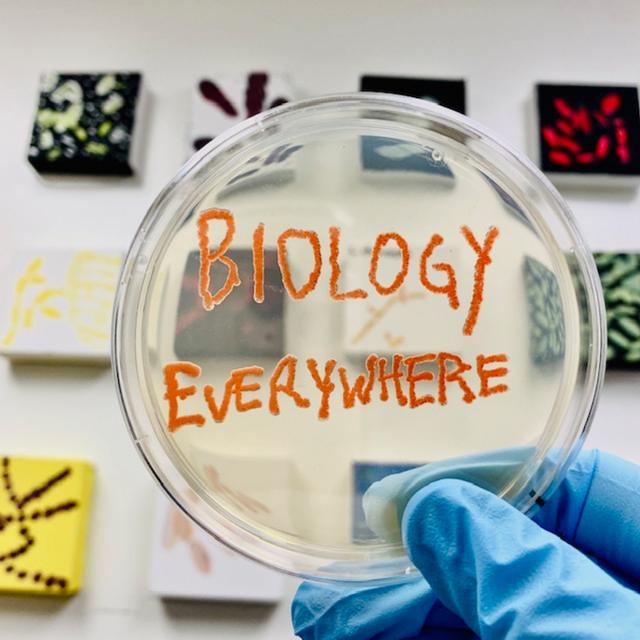
Biology Everywhere Foundations (Coursera)

Biology Everywhere Foundations (Coursera)

In this course, we will explore the nature of science and biology. We will discuss what the “biology everywhere” philosophy means and the history of the “biology everywhere” project. We will also discuss what science (and biology) are as a discipline of inquiry and how chemistry is foundational to understanding biology.

Class Deals by MOOC List - Click here and see Coursera's Active Discounts, Deals, and Promo Codes.

What You Will Learn

  • Describe the biology everywhere philosophy.
  • Explain how the process of science works and identify common misconceptions.
  • Explain and critique the criteria for identifying living and non-living entities.
  • Explain the relationship between chemistry and biology.

Course 1 of 4 in the Biology Everywhere Specialization

Syllabus

WEEK 1
Why biology everywhere?
In this module, we'll explore the principles behind biology everywhere and Dr. Peffer's motivation for writing Biology Everywhere:How the science of life matters to everyday life and the creation of this Coursera specialization.

WEEK 2
...because Science
In this module, we'll discuss the foundations of what science is (and isn't)

WEEK 3
What is life and consequently biology?
In this module we'll discuss what it means to be alive.

WEEK 4
Chemical basis of biology
Chemistry is foundational to understanding biology. In this module, we'll explore the chemical basis of biology.
Go to Class
MOOC List is learner-supported. When you buy through links on our site, we may earn an affiliate commission.

Related Courses

Public Involvement in Research (Coursera) Coursera
Imperial College London

Public Involvement in Research (Coursera)

This course focuses on participatory approaches in research, known as 'public involvement' in the UK. You'll specifically, consider why citizens and patients would be involved in research and explore participatory approaches across and within the research cycle in more detail, diving into questions such as: What kinds of participation can be undertaken at each of the 7 stages of the cycle? How can you utilise participation in research? What examples of using participatory approaches exist in research?

Jun 3rd 2026
4 Weeks
Primeros Auxilios Psicológicos (PAP) (Coursera) Coursera
Universitat Autònoma de Barcelona

Primeros Auxilios Psicológicos (PAP) (Coursera)

Este curso on-demand (ABIERTO, se puede cursar en cualquier momento), impartido en castellano por la Universidad Autónoma de Barcelona y el Centro de Crisis de Barcelona, está destinado a entrenar en la aplicación de primeros auxilios psicológicos (PAP) a personas afectadas por situaciones altamente estresantes, abarcando tanto emergencias cotidianas (incidentes críticos estadísticamente frecuentes que afectan de manera muy intensa: un accidente de tráfico, una hospitalización, una agresión o la muerte traumática o repentina de una persona, etc.) como emergencias comunitarias y/o masivas (sucesos infrecuentes, que afectan a muchas personas o a una comunidad entera y que sobrepasan con mucho lo que sucede habitualmente en ella: una catástrofe natural, un accidente ferroviario o aéreo o un atentado).

Jun 1st 2026
5-12 Weeks
Classical papers in molecular genetics (Coursera) Coursera
University of Geneva

Classical papers in molecular genetics (Coursera)

You have all heard about the DNA double helix and genes. Many of you know that mutations occur randomly, that the DNA sequence is read by successive groups of three bases (the codons), that many genes encode enzymes, and that gene expression can be regulated. These concepts were proposed on the basis of astute genetic experiments, as well as often on biochemical results. The original articles were these concepts appeared are however not frequently part of the normal curriculum of biologists, biochemists and medical students.

Jun 1st 2026
5-12 Weeks
Evolution: A Course for Educators (Coursera) Coursera
American Museum of Natural History

Evolution: A Course for Educators (Coursera)

How are all of the species living on Earth today related? How does understanding evolutionary science contribute to our well-being? In this course, participants will learn about evolutionary relationships, population genetics, and natural and artificial selection. Participants will explore evolutionary science and learn how to integrate it into their classrooms.

Jun 1st 2026
4 Weeks
Advanced Neurobiology I (Coursera) Coursera
Peking University

Advanced Neurobiology I (Coursera)

Hello everyone! Welcome to advanced neurobiology! Neuroscience is a wonderful branch of science on how our brain perceives the external world, how our brain thinks, how our brain responds to the outside of the world, and how during disease or aging the neuronal connections deteriorate. We’re trying to understand the molecular, cellular nature and the circuitry arrangement of how nervous system works.

Jun 1st 2026
5-12 Weeks
MRI Fundamentals (Coursera) Coursera
Korea Advanced Institute of Science and Technology - KAIST

MRI Fundamentals (Coursera)

Welcome! In this course learners will develop expertise in basic magnetic resonance imaging (MRI) physics and principles and gain knowledge of many different data acquisition strategies in MRI. In particular, learners will get to know what is magnetic resonance phenomenon, how magnetic resonance signals are generated, how an image can be formulated using MRI, how soft tissue contrast can change with imaging parameters.

Jun 1st 2026
5-12 Weeks