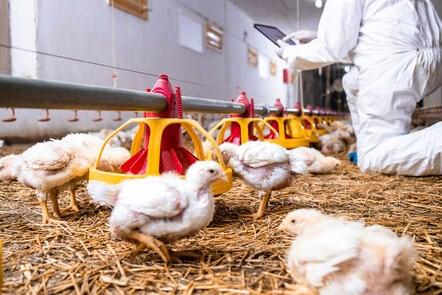
Biosecurity Compliance in European Poultry Farms (FutureLearn)

Biosecurity Compliance in European Poultry Farms (FutureLearn)

Learn how to implement biosecurity measures at all stages of poultry production from leading experts in European poultry farming. On this four-week course from the University of Padova, you’ll survey biosecurity measures at all stages of poultry production, and discuss how we can enhance compliance across Europe.

Class Deals by MOOC List - Click here and see FutureLearn's Active Discounts, Deals, and Promo Codes.

Contribute to making poultry farming safer and more sustainable
Biosecurity measures are crucial to prevent the introduction and spread of pathogens between poultry farms. Effective biosecurity helps to guarantee the health and the welfare of birds, as well as the quality and safety of poultry products.

Learn from leading European experts
Your course leaders are a team of expert researchers specialising in European poultry farming and biosecurity. They’ll provide step-by-step guidance on actions farms can take to enhance biosecurity.
You’ll compare and contrast levels of biosecurity compliance in different European countries, exploring how standards could be improved across the continent.

Examine biosecurity measures at each stage of the production cycle
Your next step is to understand the various biosecurity measures recommended prior to and at every stage of the production cycle.
You’ll master a wide range of essential processes, including vector control, waste management, and cleaning and disinfection.

Take a closer look at biosecurity in egg production
In the final week of the course, you’ll focus on the specific challenges of biosecurity in egg production. You’ll note the similarities and differences between egg and poultry farming, and learn how to safely handle hatching and table eggs.
You’ll finish the course armed with the training you need to make European poultry farming cleaner, safer, and more sustainable.

Syllabus

Week 1: Introduction to biosecurity in poultry farming in Europe
Week 2: Biosecurity at each step of the poultry production: before starting the cycle
Week 3: Biosecurity along the productive cycle
Week 4: Biosecurity of eggs

What will you achieve?
By the end of the course, you‘ll be able to...

  • Describe the role of biosecurity and the importance of its compliance in poultry farms
  • Justify the adoption of biosecurity practices in poultry production and in specific categories (i.e., broiler, broiler free range, layer, layer free range, turkey, duck, breeder, hatchery)
  • Compare the poultry production chain of the seven countries involved in the project (i.e., Italy, Netherlands, Spain, Poland, Hungary, France and Belgium);

Who is the course for?
This course is designed for anyone working on or interested in poultry farms across Europe.
It will also be useful for students of veterinary medicine or animal sciences who want to learn more about the specific challenges of biosecurity in poultry farming.

Go to Class
MOOC List is learner-supported. When you buy through links on our site, we may earn an affiliate commission.

Related Courses

Health and Wellbeing in the Ancient World (FutureLearn) FutureLearn
The Open University

Health and Wellbeing in the Ancient World (FutureLearn)

Use literary and archaeological evidence to see how ancient Greeks and Romans approached health, well-being and societal issues. What did being healthy in ancient Rome or Greece look like? How can we tell what well-being meant in ancient times? This online course will help you investigate these questions, using both literary and archaeological evidence, to uncover details of real life in ancient societies.

Self Paced
5-12 Weeks
Babies in Mind: Why the Parent's Mind Matters (FutureLearn) FutureLearn
The University of Warwick

Babies in Mind: Why the Parent's Mind Matters (FutureLearn)

Find out how parents and caregivers influence children’s minds, from conception through infancy, with this free online course. This course will explore how the mind of the parent influences the developing mind of the child, from conception through infancy and into later life. We will take you on a journey that begins in pregnancy, exploring the importance of the ability of the mother-to-be to think about her baby while still in utero, alongside the impact of emotions such as anxiety and depression.

Self Paced
4 Weeks
Biossegurança – Laboratórios de DST, AIDS e Hepatites Virais (TELELAB) TELELAB
Universidade Federal de Santa Catarina - UFSC

Biossegurança – Laboratórios de DST, AIDS e Hepatites Virais (TELELAB)

O curso de biossegurança propõe tratar de questões referentes à atenção e boas práticas de segurança no ambiente de laboratório, considerando identificação e utilização dos equipamentos e procedimentos de maneira que permita atender as reais necessidades na intervenção, prevenção e cuidado nas rotinas do trabalho em ambiente de laboratório.

Self Paced
Self-Paced
Dysphagia: Swallowing Difficulties and Medicines (FutureLearn) FutureLearn
University of East Anglia

Dysphagia: Swallowing Difficulties and Medicines (FutureLearn)

This course will enhance the knowledge of any person involved in the administration of medicines to patients with dysphagia. The course offers an opportunity to network with other learners and with the creators of the course through discussions, graphs and social networking features and to share knowledge with other learners and professionals.

Self Paced
5-12 Weeks
Medical Humanity: Engaging Patients and Communities in Healthcare (FutureLearn) FutureLearn
Taipei Medical University

Medical Humanity: Engaging Patients and Communities in Healthcare (FutureLearn)

Find out how and why you should engage patients and communities in the development of new healthcare technology and treatments. The development of healthcare treatments has given people hope to fight diseases. However, humans are born to be afraid of advanced technologies. As such, it is critical that medical professionals have the skills to explain the benefits of treatments to patients and, ideally, involve them in the development of new treatments in the first place.

Self Paced
3 Weeks
Introduction to Translational Research: Connecting Scientists and Medical Doctors (FutureLearn) FutureLearn
Taipei Medical University

Introduction to Translational Research: Connecting Scientists and Medical Doctors (FutureLearn)

Understand the emerging discipline of translational medicine and the process of taking research from ‘benchside’ to ‘bedside'. Translational medicine, also known as translational science or translational research, is a new, growing discipline in medicine that aims to ensure research flows from ‘benchside’ to ‘bedside’.

Self Paced
5-12 Weeks
Poultry Health (FutureLearn) FutureLearn
The University of Nottingham,British Hen Welfare Trust

Poultry Health (FutureLearn)

Get technically and scientifically accurate information on how to care for non-commercial poultry. Identify the clinical features of diseased birds and when they need treatment. On this veterinary course, you’ll get expert advice on how to recognise when poultry are unwell, and the options available to you for treatment.

May 16th 2022
5-12 Weeks
Clinical Supervision with Confidence (FutureLearn) FutureLearn
University of East Anglia

Clinical Supervision with Confidence (FutureLearn)

Supervise undergraduate and postgraduate learners effectively with this online course for clinical and educational supervisors. This online course will help you become a more effective clinical supervisor or educator. It is mapped to competences within the Academy of Medical Educators’ framework for professional development, as used by the General Medical Council and Health Education England.

Self Paced
2 Weeks
Understanding Autism (FutureLearn) FutureLearn
University of Kent

Understanding Autism (FutureLearn)

Understand more about autism, including diagnosis, the autistic spectrum and life with autism, with this online course. First identified over 70 years ago, autism is a lifelong developmental disability affecting how a person communicates with and relates to others, and how they make sense of the world. It is a spectrum condition; all people on the spectrum share certain difficulties, but their condition will affect them in different ways.

Self Paced
4 Weeks
Heart Health: A Beginner's Guide to Cardiovascular Disease (FutureLearn) FutureLearn
University of Reading

Heart Health: A Beginner's Guide to Cardiovascular Disease (FutureLearn)

Learn more about how your heart works, the causes of heart disease and how to keep your heart healthy with this free online course. Learn how to keep your heart healthy. Your heart beats around 100,000 times a day, pumping blood around your body to deliver oxygen and nutrients, while taking away waste products. When your heart is unhealthy, it can’t perform this vital task so effectively.

Self Paced
4 Weeks