Approximation Methods (Coursera)

Approximation Methods (Coursera)

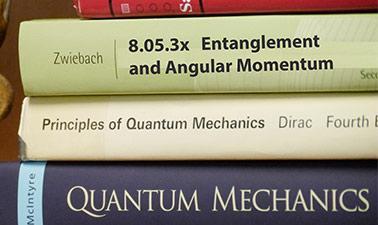
This course introduces the quantum mechanical concept of angular momentum operator and its relationship with rotation operator. It then presents the angular momentum operators, their eigenvalues and eigenfunctions. Finally, it covers the theory of angular momentum addition.

Class Deals by MOOC List - Click here and see Coursera's Active Discounts, Deals, and Promo Codes.

This course can also be taken for academic credit as ECEA xxxx, part of CU Boulder’s Master of Science in Electrical Engineering degree.
At the end of this course learners will be able to:

  1. describe and analyze angular momentum states using quantum mechanically defined angular momentum operators,
  2. solve angular momentum eigenvalue equations and
  3. add angular momenta quantum mechanically.

What You Will Learn

  • Distinguish non-degenerate and degenerate cases and use appropriate methods.
  • Perform calculations using the time-independent perturbation theory.
  • Describe absorption and stimulated emission processes.
  • Obtain approximate solutions using the variational method.

Course 3 of 3 in the Quantum Mechanics for Engineers Specialization

Syllabus

WEEK 1
Time-independent Perturbation Theory
In this module we will introduce the course on approximation methods commonly used in quantum mechanics and then discuss time-independent perturbation theory. We will first discuss non-degenerate perturbation theory and derive useful formulas for the first- and second-order corrections. We will then discuss degenerate perturbation theory. We will also discuss specific examples where the various perturbation methods are used - Stark effect, fine structure and Zeeman effect.

WEEK 2
Time-dependent Perturbation Theory
In this module, we will introduce interaction picture and derive time evolution equations. After discussing a simple but illuminating example of two-state system, we develop time-dependent perturbation theory and discuss the probability of transitions between quantum states induced by external perturbation.

WEEK 3
Other Approximation Methods
This module covers several non-perturbative approximation methods. They are the tight binding method, variational method and the use of finite basis set.
Go to Class
MOOC List is learner-supported. When you buy through links on our site, we may earn an affiliate commission.

Related Courses

Mécanique du point matériel (Coursera) Coursera
École Polytechnique Fédérale de Lausanne

Mécanique du point matériel (Coursera)

Pour illustrer les concepts introduits dans la première partie, on traite ici des problèmes pour lesquels le système mécanique peut être considéré comme un point matériel. Cette partie couvre notamment les problèmes à traiter en coordonnées cylindriques ou sphériques, le problème des orbites des planètes et les référentiels accélérés.

May 18th 2026
5-12 Weeks
Understanding Modern Physics III: Simplicity and Complexity (Coursera) Coursera
The Hong Kong University of Science and Technology - HKUST

Understanding Modern Physics III: Simplicity and Complexity (Coursera)

The 20th century was known as the century of physics. In the past 120 years, concepts such as space, time, energy, entropy and particles were understood to much deeper levels. New paradigms of thinking such as relativity and quantum mechanics emerged. This course is the third course in the Understanding Modern Physics series, which covers an introduction to action principle, fundamental particle physics, entropy & information and complexity.

May 18th 2026
4 Weeks
Astrophysics: The Violent Universe (edX) EdX
Australian National University - ANU,ANUx

Astrophysics: The Violent Universe (edX)

Explore the deadliest places in the universe, from black holes to supernovae. Interested in exploring the deadliest and most mysterious parts of our universe? Or, investigating black holes, which warp the very fabric of space-time around them? We will look at what we know about these objects, and also at the many unsolved mysteries that surround them. We will also study white-dwarf stars and neutron stars, where the mind-bending laws of quantum mechanics collide with relativity. And, examine dwarf novae, classical novae, supernovae and even hypernovae: the most violent explosions in the cosmos.

Self Paced
Self-Paced
Quantum Mechanics for Scientists and Engineers 2 (Stanford Online) Lagunita Stanford Online
Stanford University

Quantum Mechanics for Scientists and Engineers 2 (Stanford Online)

This course covers key topics in the use of quantum mechanics in many modern applications in science and technology, introduces core advanced concepts such as spin, identical particles, the quantum mechanics of light, the basics of quantum information, and the interpretation of quantum mechanics, and covers the major ways in which quantum mechanics is written and used in modern practice. It follows on directly from the QMSE-01 "Quantum Mechanics for Scientists and Engineers" course and is also accessible to others who have studied some quantum mechanics at the equivalent of a first junior or senior college-level physics quantum mechanics course.

No sessions available
5-12 Weeks
Quantum Mechanics (Coursera) Coursera
University of Colorado Boulder

Quantum Mechanics (Coursera)

Course 2 of Statistical Thermodynamics presents an introduction to quantum mechanics at a level appropriate for those with mechanical or aerospace engineering backgrounds. Using a postulatory approach that describes the steps to follow, the Schrodinger wave equation is derived and simple solutions obtained that illustrate atomic and molecular structural behavior. More realistic behavior is also explored along with modern quantum chemistry numerical solution methods for solving the wave equation.

Jun 8th 2026
3 Weeks
Attitude Control with Momentum Exchange Devices (Coursera) Coursera
University of Colorado Boulder

Attitude Control with Momentum Exchange Devices (Coursera)

This course is part 1 of the specialization Advanced Spacecraft Dynamics and Control. It is a direct continuation of the Coursera specialization Spacecraft Dynamics and Control. This first course focuses on nonlinear attitude feedback control using a range of angular momentum devices. The course provides a comprehensive review of prerequisite material. Next it develops equations of motion of a spacecraft with momentum exchange devices such as reaction wheels (RWs), control momentum gyroscopes (CMGs) and variable speed control moment gyroscopes (VSCMGs).

Jun 8th 2026
5-12 Weeks
The Introduction to Quantum Computing (Coursera) Coursera
Saint Petersburg State University

The Introduction to Quantum Computing (Coursera)

"Quantum Computing" is among those terms that are widely discussed but often poorly understood. The reasons of this state of affairs may be numerous, but possibly the most significant among them is that it is a relatively new scientific area, and it's clear interpretations are not yet widely spread. The main obstacle here is the word "quantum", which refers to quantum mechanics - one of the most counter-intuitive ways to describe our world.

Aug 8th 2022
5-12 Weeks
The Einstein Revolution (edX) EdX
HarvardX,Harvard University

The Einstein Revolution (edX)

Traces Albert Einstein’s engagement with relativity, quantum mechanics, Nazism, nuclear weapons, philosophy, the arts, and technology. Albert Einstein has become the icon of modern science. Following his scientific, cultural, philosophical, and political trajectory, this course aims to track the changing role of physics in the 20th and 21st centuries.

Self Paced
Self-Paced