Vector Calculus for Engineers (Coursera)

Vector Calculus for Engineers (Coursera)

Vector Calculus for Engineers covers both basic theory and applications. In the first week we learn about scalar and vector fields, in the second week about differentiating fields, in the third week about multidimensional integration and curvilinear coordinate systems. The fourth week covers line and surface integrals, and the fifth week covers the fundamental theorems of vector calculus, including the gradient theorem, the divergence theorem and Stokes’ theorem. These theorems are needed in core engineering subjects such as Electromagnetism and Fluid Mechanics.

Class Deals by MOOC List - Click here and see Coursera's Active Discounts, Deals, and Promo Codes.

Instead of Vector Calculus, some universities might call this course Multivariable or Multivariate Calculus or Calculus 3. Two semesters of single variable calculus (differentiation and integration) are a prerequisite.
The course is organized into 42 short lecture videos, with a few problems to solve following each video. And after each substantial topic, there is a short practice quiz. Solutions to the problems and practice quizzes can be found in instructor-provided lecture notes. There are a total of four weeks to the course, and at the end of each week there is an assessed quiz.
Course 3 of 5 in the Mathematics for Engineers Specialization.

What You Will Learn

  • Vectors, the dot product and cross product
  • The gradient, divergence, curl, and Laplacian
  • Multivariable integration, polar, cylindrical and spherical coordinates
  • Line integrals, surface integrals, the gradient theorem, the divergence theorem and Stokes' theorem

Syllabus

WEEK 1
Vectors
A vector is a mathematical construct that has both length and direction. We will define vectors and learn how to add and subtract them, and how to multiply them using the scalar and vector products (dot and cross products). We will use vectors to learn some analytical geometry of lines and planes, and learn about the Kronecker delta and the Levi-Civita symbol to prove vector identities. The important concepts of scalar and vector fields will be introduced.

WEEK 2
Differentiation
Scalar and vector fields can be differentiated. We define the partial derivative and derive the method of least squares as a minimization problem. We learn how to use the chain rule for a function of several variables, and derive the triple product rule used in chemical engineering. From the del differential operator, we define the gradient, divergence, curl and Laplacian. We learn some useful vector calculus identities and how to derive them using the Kronecker delta and Levi-Civita symbol. Vector identities are then used to derive the electromagnetic wave equation from Maxwell's equation in free space. Electromagnetic waves form the basis for all modern communication technologies.

WEEK 3
Integration and Curvilinear Coordinates
Scalar and vector fields can be integrated. We learn about double and triple integrals, and line integrals and surface integrals. Curvilinear coordinates, namely polar coordinates in two dimensions, and cylindrical and spherical coordinates in three dimensions, are used to simplify problems with cylindrical or spherical symmetry. We learn how to change variables in multidimensional integrals using the Jacobian of the transformation.

WEEK 4
Line and Surface Integrals
Scalar or vector fields can be integrated on curves or surfaces. We learn how to take the line integral of a scalar field and use line integrals to compute arc lengths. We then learn how to take line integrals of vector fields by taking the dot product of the vector field with tangent unit vectors to the curve. Consideration of the line integral of a force field results in the work-energy theorem. Next, we learn how to take the surface integral of a scalar field and compute surface areas. We then learn how to take the surface integral of a vector field by taking the dot product of the vector field with the normal unit vector to the surface. The surface integral of a velocity field is used to define the mass flux of a fluid through the surface.
WEEK 5
Fundamental Theorems
The fundamental theorem of calculus links integration with differentiation. Here, we learn the related fundamental theorems of vector calculus. These include the gradient theorem, the divergence theorem, and Stokes' theorem. We show how these theorems are used to derive continuity equations, derive the law of conservation of energy, define the divergence and curl in coordinate-free form, and convert the integral version of Maxwell's equations into their more aesthetically pleasing differential form.

Go to Class
MOOC List is learner-supported. When you buy through links on our site, we may earn an affiliate commission.

Related Courses

Mathematical Biostatistics Boot Camp 1 (Coursera) Coursera
Johns Hopkins University

Mathematical Biostatistics Boot Camp 1 (Coursera)

This class presents the fundamental probability and statistical concepts used in elementary data analysis. It will be taught at an introductory level for students with junior or senior college-level mathematical training including a working knowledge of calculus. A small amount of linear algebra and programming are useful for the class, but not required.

Aug 17th 2026
4 Weeks
Precalculus: Mathematical Modeling (Coursera) Coursera
Johns Hopkins University

Precalculus: Mathematical Modeling (Coursera)

This course helps to build the foundational material to use mathematics as a tool to model, understand, and interpret the world around us. This is done through studying functions, their properties, and applications to data analysis. Concepts of precalculus provide the set of tools for the beginning student to begin their scientific career, preparing them for future science and calculus courses. This course is designed for all students, not just those interested in further mathematics courses.

Aug 10th 2026
4 Weeks
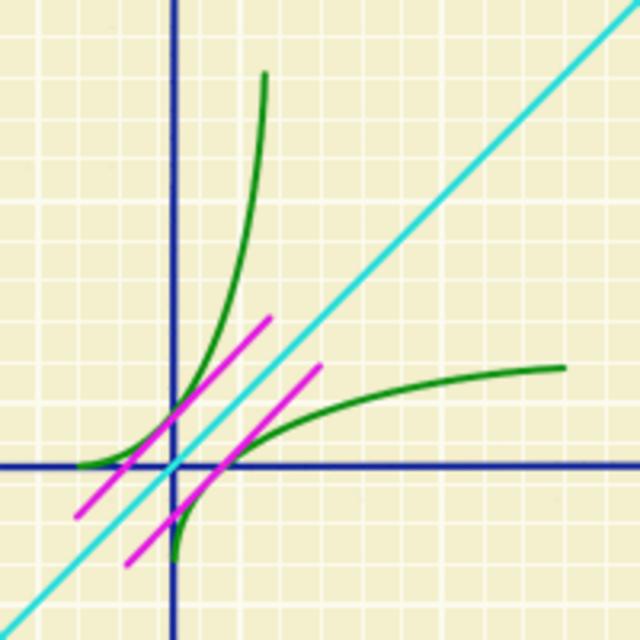
Mathematics for Machine Learning: Multivariate Calculus (Coursera) Coursera
Imperial College London

Mathematics for Machine Learning: Multivariate Calculus (Coursera)

This course offers a brief introduction to the multivariate calculus required to build many common machine learning techniques. We start at the very beginning with a refresher on the “rise over run” formulation of a slope, before converting this to the formal definition of the gradient of a function. We then start to build up a set of tools for making calculus easier and faster. Next, we learn how to calculate vectors that point up hill on multidimensional surfaces and even put this into action using an interactive game.

Aug 10th 2026
5-12 Weeks
Initiation à la théorie des distributions (Coursera) Coursera
École Polytechnique

Initiation à la théorie des distributions (Coursera)

Une fonction discontinue peut-elle être solution d'une équation différentielle? Comment définir rigoureusement la masse de Dirac (une "fonction" d'intégrale un, nulle partout sauf en un point) et ses dérivées? Peut-on définir une notion de "dérivée d'ordre fractionnaire"? Cette initiation aux distributions répond à ces questions - et à bien d'autres.

Aug 10th 2026
5-12 Weeks
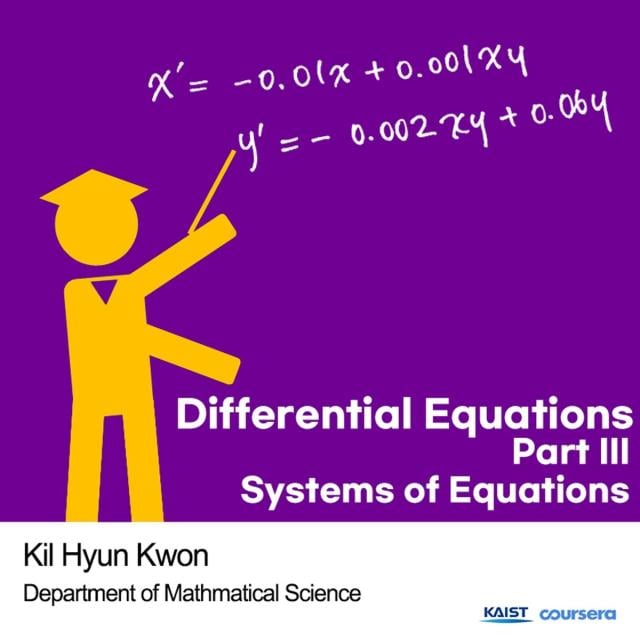
Differential Equations Part III Systems of Equations (Coursera) Coursera
Korea Advanced Institute of Science and Technology - KAIST

Differential Equations Part III Systems of Equations (Coursera)

This introductory courses on (Ordinary) Differential Equations are mainly for the people, who need differential equations mostly for the practical use in their own fields. So we try to provide basic terminologies, concepts, and methods of solving various types of differential equations as well as a rudimentary but indispensable knowledge of the underlying theory and some related applications.

Aug 10th 2026
5-12 Weeks
Analytic Combinatorics (Coursera) Coursera
Princeton University

Analytic Combinatorics (Coursera)

Analytic Combinatorics teaches a calculus that enables precise quantitative predictions of large combinatorial structures. This course introduces the symbolic method to derive functional relations among ordinary, exponential, and multivariate generating functions, and methods in complex analysis for deriving accurate asymptotics from the GF equations. All the features of this course are available for free. It does not offer a certificate upon completion.

Aug 10th 2026
5-12 Weeks
English for Science, Technology, Engineering, and Mathematics (Coursera) Coursera
University of Pennsylvania

English for Science, Technology, Engineering, and Mathematics (Coursera)

Welcome to English for Science, Technology, Engineering, and Mathematics, a course created by the University of Pennsylvania, and funded by the U.S. Department of State Bureau of Educational and Cultural Affairs, Office of English Language Programs. This course is designed for non-native English speakers who are interested in improving their English skills in the sciences. In this course, you will explore some of the most innovative areas of scientific study, while expanding your vocabulary and the language skills needed to share scientific information within your community.

Aug 10th 2026
5-12 Weeks
Constructivism and Mathematics, Science, and Technology Education (Coursera) Coursera
University of Illinois at Urbana-Champaign

Constructivism and Mathematics, Science, and Technology Education (Coursera)

This course is designed to help participants examine the implications of constructivism for learning and teaching in science, mathematics, and technology focused areas. Course readings, discussions, and assignments will examine constructivist views of learning, research on students' ideas and idea-based interactions, research on instructional approaches taking student ideas into account, and challenges in implementing constructivist perspectives in instruction.

Aug 17th 2026
5-12 Weeks
Precalculus: Periodic Functions (Coursera) Coursera
Johns Hopkins University

Precalculus: Periodic Functions (Coursera)

This course helps to build the foundational material to use mathematics as a tool to model, understand, and interpret the world around us. This is done through studying functions, their properties, and applications to data analysis. Concepts of precalculus provide the set of tools for the beginning student to begin their scientific career, preparing them for future science and calculus courses. This course is designed for all students, not just those interested in further mathematics courses.

Aug 10th 2026
5-12 Weeks