Spacecraft Relative Motion Control (Coursera)

Spacecraft Relative Motion Control (Coursera)

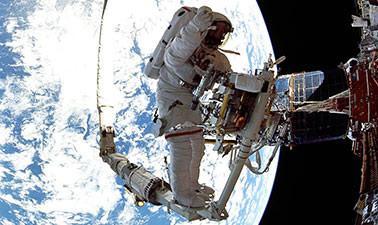
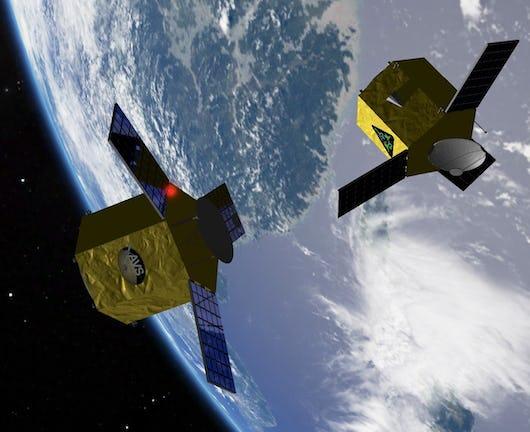
Spacecraft relative motion control solutions stabilize the spacecraft relative to another spacecraft. This is useful control the approach prior to docking, to circumnavigate while inspect the target object, or to remain in a bounded vicinity about the target. This course covers the basics of nonlinear control theory to apply Lyapunov's direct method to the relative motion control problem.

Class Deals by MOOC List - Click here and see Coursera's Active Discounts, Deals, and Promo Codes.

Feedback control strategies using inertial coordinates, differential orbit elements and Hill frame coordinates are studied. Reference relative motions are considered that are either naturally occurring or require a feed-forward control component.
After this course, you will be able to...

  • Develop nonlinear relative motion control strategies
  • Discuss the stability guarantees of these control solutions
  • Numerically simulate the relative motion control solutions
  • Create reference motions that are natural and don't require control effort when the tracking errors have converged
  • Study the impact of uncertain dynamics and control errors.

Please note: this is an advanced course, best suited for working engineers or students with college-level knowledge in mathematics and physics.
This course is part of the Spacecraft Formation Relative Orbits Specialization

What you'll learn

  • numerically simulate spacecraft relative motion
  • Analyze relative motion stability
  • Develop relative motion feedback control solutions

Syllabus

Basics of Nonlinear Control using Lyapunov's Principle
Module 1
The basics of nonlinear stability of dynamical systems is reviewed. A range of stability definitions are reviewed. The general methodology to develop feedback controls using Lyapunov's princple is presented.

Relative Motion Feedback Control
Module 2
Develop feedback control strategies to drive a spacecraft towards a desired relative trajectory.
Go to Class
MOOC List is learner-supported. When you buy through links on our site, we may earn an affiliate commission.

Related Courses

Cómo autoconstruir tu vivienda (Coursera) Coursera
Universidad Nacional Autónoma de México

Cómo autoconstruir tu vivienda (Coursera)

Aprenderás las bases y los procedimientos precisos paso a paso para que puedas llevar a cabo la autoconstrucción de una vivienda básica, segura y económica para ti y tu familia; también te será de gran utilidad si estás buscando aprender a reparar, mejorar la estructura de tu vivienda e incluso si buscas autoemplearte.

Oct 12th 2026
4 Weeks
Introduction to Acoustics (Part 2) (Coursera) Coursera
Korea Advanced Institute of Science and Technology - KAIST

Introduction to Acoustics (Part 2) (Coursera)

Learners might have learned the basic concepts of the acoustics from the ‘Introduction to Acoustics (Part 1).’ Now it is time to apply to the real situation and develop their own acoustical application. Learners will analyze the radiation, scattering, and diffraction phenomenon with the Kirchhoff –Helmholtz Equation. Then learners will design their own reverberation room or ducts that fulfill the condition they have set up.

Oct 5th 2026
5-12 Weeks
Conceptos y Herramientas para la Física Universitaria (Coursera) Coursera
Tecnológico de Monterrey

Conceptos y Herramientas para la Física Universitaria (Coursera)

Este curso provee al estudiante con conceptos y herramientas matemáticas para modelar problemas en física, que al aplicar podrá enfrentar con éxito los cursos de física universitarios. Así pues, la filosofía de este curso consiste en cubrir temas conceptuales relativos a la Física y desarrollar tu capacidad de aprender y aplicarlos en tu vida profesional.

Oct 12th 2026
5-12 Weeks
Machine Design Part I (Coursera) Coursera
Georgia Institute of Technology

Machine Design Part I (Coursera)

“Machine Design Part I” is the first course in an in-depth three course series of “Machine Design.” The “Machine Design” Coursera series covers fundamental mechanical design topics, such as static and fatigue failure theories, the analysis of shafts, fasteners, and gears, and the design of mechanical systems such as gearboxes. Throughout this series of courses we will examine a number of exciting design case studies, including the material selection of a total hip implant, the design and testing of the wing on the 777 aircraft, and the impact of dynamic loads on the design of an bolted pressure vessel. In this first course, you will learn robust analysis techniques to predict and validate design performance and life.

Oct 12th 2026
5-12 Weeks
Kinetics: Studying Spacecraft Motion (Coursera) Coursera
University of Colorado Boulder

Kinetics: Studying Spacecraft Motion (Coursera)

As they tumble through space, objects like spacecraft move in dynamical ways. Understanding and predicting the equations that represent that motion is critical to the safety and efficacy of spacecraft mission development. Kinetics: Modeling the Motions of Spacecraft trains your skills in topics like rigid body angular momentum and kinetic energy expression shown in a coordinate frame agnostic manner, single and dual rigid body systems tumbling without the forces of external torque, how differential gravity across a rigid body is approximated to the first order to study disturbances in both the attitude and orbital motion, and how these systems change when general momentum exchange devices are introduced.

Sep 28th 2026
4 Weeks
Particle Dynamics (Coursera) Coursera
Korea Advanced Institute of Science and Technology - KAIST

Particle Dynamics (Coursera)

This course teaches dynamics, one of the basic mechanics subjects of Mechanical Engineering. Students would be able to organize their knowledge about force and motion, work-energy, impulse-momentum in view of Newton's 2nd law and its integration over time and displacement. The Engineering Dynamics consists of two parts: particle dynamics and rigid body dynamics.

Oct 12th 2026
13-24 Weeks
From the Big Bang to Dark Energy (Coursera) Coursera
The University of Tokyo

From the Big Bang to Dark Energy (Coursera)

We have learned a lot recently about how the Universe evolved in 13.7 billion years since the Big Bang. More than 80% of matter in the Universe is mysterious Dark Matter, which made stars and galaxies to form. The newly discovered Higgs-boson became frozen into the Universe a trillionth of a second after the Big Bang and brought order to the Universe.

Oct 5th 2026
4 Weeks
Material Behavior (Coursera) Coursera
Georgia Institute of Technology

Material Behavior (Coursera)

Have you ever wondered why ceramics are hard and brittle while metals tend to be ductile? Why some materials conduct heat or electricity while others are insulators? Why adding just a small amount of carbon to iron results in an alloy that is so much stronger than the base metal? In this course, you will learn how a material’s properties are determined by the microstructure of the material, which is in turn determined by composition and the processing that the material has undergone.

Oct 5th 2026
5-12 Weeks
Emergent Phenomena in Science and Everyday Life (Coursera) Coursera
University of California, Irvine

Emergent Phenomena in Science and Everyday Life (Coursera)

Before the advent of quantum mechanics in the early 20th century, most scientists believed that it should be possible to predict the behavior of any object in the universe simply by understanding the behavior of its constituent parts. For instance, if one could write down the equations of motion for every atom in a system, it should be possible to solve those equations (with the aid of a sufficiently large computing device) and make accurate predictions about that system’s future.

Oct 12th 2026
5-12 Weeks
Thermodynamique : fondements (Coursera) Coursera
École Polytechnique Fédérale de Lausanne

Thermodynamique : fondements (Coursera)

Ce cours vous apportera une compréhension des concepts fondamentaux de la thermodynamique du point de vue de la physique, de la chimie et de l’ingénierie. Il est scindé un deux MOOCs. Dans la première partie, le Professeur J.-Ph. Ansermet de l’EPFL et son collaborateur le Dr. Sylvain Bréchet ont rassemblé en quatre leçons tous les principes fondamentaux de la thermodynamique. La deuxième partie du MOOC illustre l’approche thermodynamique par une série d’applications présentées par des spécialistes provenant de diverses institutions partenaires du réseau RESCIF.

Oct 12th 2026
4 Weeks