Astrobiology: Exploring Other Worlds (Coursera)

Offered by University of Arizona,
Astrobiology: Exploring Other Worlds (Coursera)

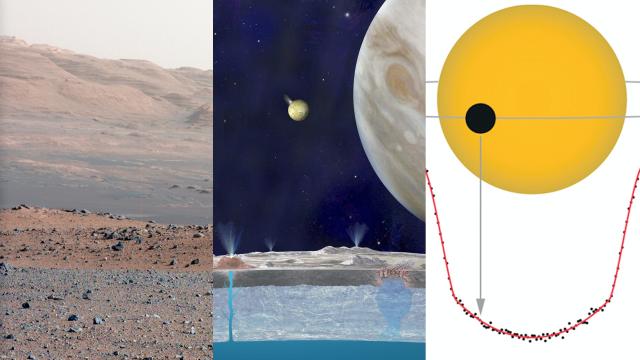
How are astronomers approaching their search for life in the universe? What have we learned from the surge of exoplanets discoveries? How likely is it that Earth does not host the only life in the Universe? In this course we explore the field of astrobiology, an emerging multidisciplinary field. Progress in astrobiology is driven by telescopes on the ground and in space, and by new insights on how life emerged on Earth and its diversity.

Class Deals by MOOC List - Click here and see Coursera's Active Discounts, Deals, and Promo Codes.

The topics in this course range from the science of how exoplanets are detected, to the chemistry that supports the argument that the ingredients for life are common in the Universe.
We will follow the analyses of experts in chemistry, astronomy, geology and archaeology to build a strong foundation of understanding. By the final assignment, students will be equipped with the knowledge necessary to identify what makes a planet habitable, and how likely it is that life exists there. Students will graduate from this course informed about one of the most exciting fields in all of science, and ready to discuss the current exoplanet news stories and discoveries.

Syllabus

WEEK 1: Planets in the Solar System and Beyond
WEEK 2: Hunting for Exoplanets
WEEK 3: Habitability
WEEK 4: Life
WEEK 5: Emerging Complex Life and Intelligence
WEEK 6: SETI and Cosmic Companionship

Go to Class
MOOC List is learner-supported. When you buy through links on our site, we may earn an affiliate commission.

Related Courses

Moons (FutureLearn) FutureLearn
The Open University

Moons (FutureLearn)

Explore the many moons of our Solar System. Find out what makes them special and ask whether we send humans to our Moon again. Discover the amazing diversity of moons in our Solar System. There are lots of moons in our Solar System. The Earth is the only planet with just a single moon. Some are bigger than ours. Many are much smaller. Some moons have ongoing volcanic eruptions. Others have rivers of liquid methane. A small handful may even be home to primitive life. This online course will allow you to explore the rich diversity of moons in our Solar System.

Self Paced
5-12 Weeks
Journey of the Universe: The Unfolding of Life (Coursera) Coursera
Yale University

Journey of the Universe: The Unfolding of Life (Coursera)

Journey of the Universe weaves together the discoveries of the evolutionary sciences together with humanities such as history, philosophy, art, and religion. The course draws on the Emmy-award winning film, Journey of the Universe, and the book from Yale University Press. Journey explores cosmic evolution as a creative process based on connection, interdependence, and emergence. It examines a range of dynamic interactions in the unfolding of galaxies, Earth, life, and human communities. It investigates ways in which we understand evolutionary processes and the implications for humans and our ecological future.

Aug 17th 2026
5-12 Weeks
The Science of the Solar System (Coursera) Coursera
Caltech

The Science of the Solar System (Coursera)

Learn about the science behind the current exploration of the solar system in this free class. Use principles from physics, chemistry, biology, and geology to understand the latest from Mars, comprehend the outer solar system, ponder planets outside our solar system, and search for habitability in our neighborhood and beyond. This course is generally taught at an advanced level assuming a prior knowledge of undergraduate math and physics, but the majority of the concepts and lectures can be understood without these prerequisites.

Jun 22nd 2026
5-12 Weeks
Mysteries Of The Universe (FutureLearn) FutureLearn
National Tsing Hua University

Mysteries Of The Universe (FutureLearn)

Discover how more than ninety per cent of the universe is a mystery, and expand your knowledge of cosmology and astronomy. Investigate the most mysterious and fascinating aspects of the universe The more we learn about how the universe works, the more we realise how much we don’t know. What is a black hole? What is dark energy? Will the universe eventually collapse in on itself? And how does the Earth fit into all this?

Self Paced
5-12 Weeks
Greatest Unsolved Mysteries of the Universe (edX) EdX
Australian National University - ANU,ANUx

Greatest Unsolved Mysteries of the Universe (edX)

Exploring the biggest mysteries of modern astrophysics. Despite spectacular recent progress, there is still a lot we don't know about our universe. We don't know why the Big Bang happened. We don't know what most of the universe is made of. We don't know whether there is life in space. We don't know how planets form, how black holes get so big, or where the first stars have gone. This course will take you through nine of the greatest unsolved problems of modern astrophysics.

Self Paced
Self-Paced
Emergence of Life (Coursera) Coursera
University of Illinois at Urbana-Champaign

Emergence of Life (Coursera)

How did life emerge on Earth? How have life and Earth co-evolved through geological time? Is life elsewhere in the universe? Take a look through the 4-billion-year history of life on Earth through the lens of the modern Tree of Life. This course will evaluate the entire history of life on Earth within the context of our cutting-edge understanding of the Tree of Life. This includes the pioneering work of Professor Carl Woese on the University of Illinois Urbana-Champaign campus which revolutionized our understanding with a new "Tree of Life."

Aug 10th 2026
5-12 Weeks
Big History - From the Big Bang until Today (Coursera) Coursera
University of Amsterdam

Big History - From the Big Bang until Today (Coursera)

Welcome to this Big History course! In this course, renowned scientists and scholars from the University of Amsterdam and beyond will take you on a journey from the Big Bang until today while addressing key questions in their fields. After completing this journey you will have developed a better understanding of how you and everything around you became the way they are today.

Aug 3rd 2026
4 Weeks
The Discovery of the Higgs Boson (FutureLearn) FutureLearn
University of Edinburgh

The Discovery of the Higgs Boson (FutureLearn)

Should we be excited about the Higgs boson? Find out more about particle physics and understanding the universe. The discovery of a new fundamental particle at the Large Hadron Collider (LHC), CERN is the latest step in a long quest seeking to answer one of physics’ most enduring questions: why do particles have mass? The experiments’ much anticipated success confirms predictions made decades earlier by Peter Higgs and others, and offers a glimpse into a universe of physics beyond the Standard Model.

Self Paced
5-12 Weeks