Robotic Mapping and Trajectory Generation (Coursera)

Robotic Mapping and Trajectory Generation (Coursera)

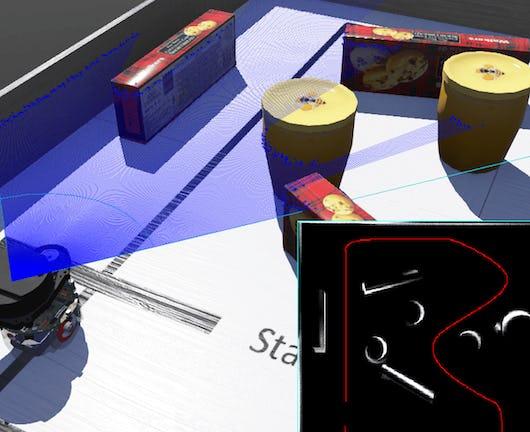
In this second course of the Introduction to Robotics specialization, "Robotic Mapping and Trajectory Generation", you will learn how to perform basic inverse kinematics of (non-)holonomic systems using a feedback control approach. You will also learn how to process multi-dimensional sensor signals such as laser range scanners for mapping. Additionally, you will apply the overarching focus of mechanisms and sensors as sources of uncertainty and gain techniques to how to model and control them.

Class Deals by MOOC List - Click here and see Coursera's Active Discounts, Deals, and Promo Codes.

It is recommended that you complete the first course of this specialization, “Introduction to Robotics: Basic Behaviors”, before beginning this one.
This course is part of the Introduction to Robotics with Webots Specialization.

What you'll learn

  • Use basic feedback control techniques for inverse kinematics of (non-)Holonomic mechanisms.

Apply coordinate transforms to multi-dimensional sensor signals.
Understand basic probabilistic representations to deal with uncertainty from measurement noise.

Syllabus

Advanced Sensor: Range finders and Homogeneous transforms
Module 1
Welcome to Week 1 of the course. You will get started by being introduced to the class of "range finder" devices, which have important applications in mapping, as well as the concept of homogeneous transforms to perform coordinate transformations.

Mapping: Basic Representations
Module 2
In this week, you will begin to understand basic discrete map representations and their implementation.

Mapping: Probabilistic Representations and Configuration Space
Module 3
This week introduces simple ways to encode obstacles in terms of probability, the concept of "configuration space", and a simple algorithm for collision checking.

Inverse Kinematics: Trajectory Following
Module 4
In this week you will learn to define a robot trajectory based on a series of waypoints and implement a basic proportional controller in Webots to navigate in a 2D environment.

Implementing Mapping and Trajectory Generation
Module 5
In this module you will transfer your mapping and trajectory following skills to a commercial robotic platform in a kitchen environment, introducing you to additional constraints of sensor integration on a real robotic platform.

Go to Class
MOOC List is learner-supported. When you buy through links on our site, we may earn an affiliate commission.

Related Courses

Machine Learning for Data Analysis (Coursera) Coursera
Wesleyan University

Machine Learning for Data Analysis (Coursera)

Are you interested in predicting future outcomes using your data? This course helps you do just that! Machine learning is the process of developing, testing, and applying predictive algorithms to achieve this goal. Make sure to familiarize yourself with course 3 of this specialization before diving into these machine learning concepts. Building on Course 3, which introduces students to integral supervised machine learning concepts, this course will provide an overview of many additional concepts, techniques, and algorithms in machine learning, from basic classification to decision trees and clustering.

Jun 15th 2026
4 Weeks
Using SAS Viya REST APIs with Python and R (Coursera) Coursera
SAS

Using SAS Viya REST APIs with Python and R (Coursera)

SAS Viya is an in-memory distributed environment used to analyze big data quickly and efficiently. In this course, you’ll learn how to use the SAS Viya APIs to take control of SAS Cloud Analytic Services from a Jupyter Notebook using R or Python. You’ll learn to upload data into the cloud, analyze data, and create predictive models with SAS Viya using familiar open source functionality via the SWAT package -- the SAS Scripting Wrapper for Analytics Transfer.

Jun 15th 2026
4 Weeks
Using Machine Learning in Trading and Finance (Coursera) Coursera
New York Institute of Finance,Google Cloud

Using Machine Learning in Trading and Finance (Coursera)

This course provides the foundation for developing advanced trading strategies using machine learning techniques. In this course, you’ll review the key components that are common to every trading strategy, no matter how complex. You’ll be introduced to multiple trading strategies including quantitative trading, pairs trading, and momentum trading.

Jun 19th 2026
4 Weeks
Data Collection and Processing with Python (Coursera) Coursera
University of Michigan

Data Collection and Processing with Python (Coursera)

This course teaches you to fetch and process data from services on the Internet. It covers Python list comprehensions and provides opportunities to practice extracting from and processing deeply nested data. You'll also learn how to use the Python requests module to interact with REST APIs and what to look for in documentation of those APIs. For the final project, you will construct a “tag recommender” for the flickr photo sharing site.

Jun 15th 2026
3 Weeks
Algorithmic Thinking (Part 1) (Coursera) Coursera
Rice University

Algorithmic Thinking (Part 1) (Coursera)

Experienced Computer Scientists analyze and solve computational problems at a level of abstraction that is beyond that of any particular programming language. This two-part class is designed to train students in the mathematical concepts and process of "Algorithmic Thinking", allowing them to build simpler, more efficient solutions to computational problems.

Jun 15th 2026
4 Weeks
Audio Signal Processing for Music Applications (Coursera) Coursera
Stanford University,Universitat Pompeu Fabra

Audio Signal Processing for Music Applications (Coursera)

In this course you will learn about audio signal processing methodologies that are specific for music and of use in real applications. We focus on the spectral processing techniques of relevance for the description and transformation of sounds, developing the basic theoretical and practical knowledge with which to analyze, synthesize, transform and describe audio signals in the context of music applications.

Jun 15th 2026
5-12 Weeks
An Introduction to Interactive Programming in Python (Part 2) (Coursera) Coursera
Rice University

An Introduction to Interactive Programming in Python (Part 2) (Coursera)

This two-part course is designed to help students with very little or no computing background learn the basics of building simple interactive applications. Our language of choice, Python, is an easy-to learn, high-level computer language that is used in many of the computational courses offered on Coursera. To make learning Python easy, we have developed a new browser-based programming environment that makes developing interactive applications in Python simple.

Jun 15th 2026
4 Weeks
Python Functions, Files, and Dictionaries (Coursera) Coursera
University of Michigan

Python Functions, Files, and Dictionaries (Coursera)

This course introduces the dictionary data structure and user-defined functions. You’ll learn about local and global variables, optional and keyword parameter-passing, named functions and lambda expressions. You’ll also learn about Python’s sorted function and how to control the order in which it sorts by passing in another function as an input.

Jun 15th 2026
5-12 Weeks
Machine Learning Foundations: A Case Study Approach (Coursera) Coursera
University of Washington

Machine Learning Foundations: A Case Study Approach (Coursera)

Do you have data and wonder what it can tell you? Do you need a deeper understanding of the core ways in which machine learning can improve your business? Do you want to be able to converse with specialists about anything from regression and classification to deep learning and recommender systems? In this course, you will get hands-on experience with machine learning from a series of practical case-studies.

Jun 15th 2026
5-12 Weeks
Programming for Everybody (Getting Started with Python) (Coursera) Coursera
University of Michigan

Programming for Everybody (Getting Started with Python) (Coursera)

This course aims to teach everyone the basics of programming computers using Python. We cover the basics of how one constructs a program from a series of simple instructions in Python. The course has no pre-requisites and avoids all but the simplest mathematics. Anyone with moderate computer experience should be able to master the materials in this course.

Jun 15th 2026
5-12 Weeks