Programming for Everyone : Working with Data (Coursera)

Programming for Everyone : Working with Data (Coursera)

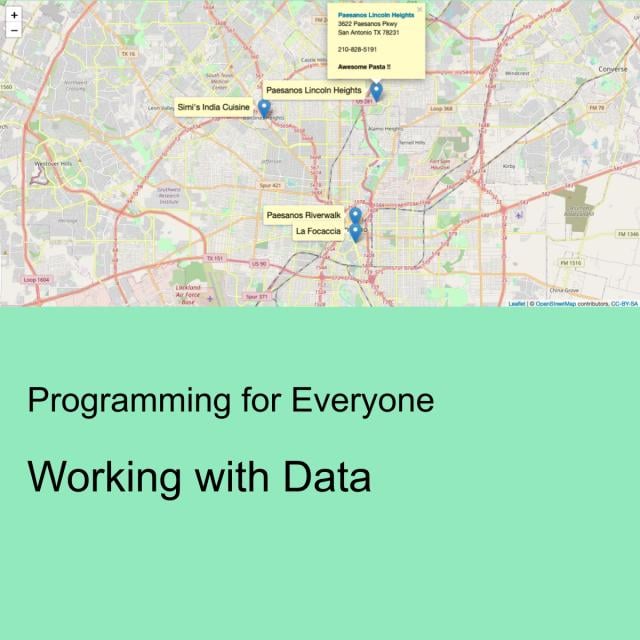
In this 3rd Guided Project in the "Programming for Everyone" series, we will learn how to work with data. We will learn about the dplyr package and how to use it to process data. We will subsequently update the app that we created in the 2nd Guided Project in this "Programming for Everyone" series to add support for multiple cities. Finally, we will see how to create tabular graphics with data using the "gt" package.

Class Deals by MOOC List - Click here and see Coursera's Active Discounts, Deals, and Promo Codes.

In this Guided Project, you will:

  • Learn how to organize data using dataframes and process data in a dataframe.
  • Use dplyr package to process data in dataframes
  • Learn about Shiny App Layout and Shiny Widgets

Learn step-by-step

  1. Guided Project Introduction
  2. Introduction to Dataframes in R
  3. Working with Dataframes
  4. Using dplyr Package for processing data
  5. Web App Layouts in Shiny
  6. Adding a drop down
  7. Update Server Function
  8. Deploying our App
  9. Additional Material and Wrapu
Go to Class
MOOC List is learner-supported. When you buy through links on our site, we may earn an affiliate commission.

Related Courses

Basic Modeling for Discrete Optimization (Coursera) Coursera
University of Melbourne,The Chinese University of Hong Kong

Basic Modeling for Discrete Optimization (Coursera)

Optimization is a common form of decision making, and is ubiquitous in our society. Its applications range from solving Sudoku puzzles to arranging seating in a wedding banquet. The same technology can schedule planes and their crews, coordinate the production of steel, and organize the transportation of iron ore from the mines to the ports. Good decisions in manpower and material resources management also allow corporations to improve profit by millions of dollars.

Aug 17th 2026
4 Weeks
Applications in Engineering Mechanics (Coursera) Coursera
Georgia Institute of Technology

Applications in Engineering Mechanics (Coursera)

This course applies principles learned in my course “Introduction to Engineering Mechanics” to analyze real world engineering structures. You will need to have mastered the engineering fundamentals from that class in order to be successful in this course offering. This course addresses the modeling and analysis of static equilibrium problems with an emphasis on real world engineering systems and problem solving.

Aug 10th 2026
5-12 Weeks
Data Literacy – What is it and why does it matter? (Coursera) Coursera
University of Copenhagen,Sorbonne University,University of Warsaw,University of Milan,Charles University,4EU+ Alliance

Data Literacy – What is it and why does it matter? (Coursera)

You might already know that data is not neutral. Our values and assumptions are influenced by the data surrounding us - the data we create, the data we collect, and the data we share with each other. Economic needs, social structures, or algorithmic biases can have profound consequences for the way we collect and use data. Most often, the result is an increase of inequity in the world. Data also changes the way we interact. It shapes our thoughts, our feelings, our preferences and actions.

Aug 17th 2026
3 Weeks
Learn JavaScript (Coursera) Coursera
Scrimba

Learn JavaScript (Coursera)

This is perhaps the most interactive JavaScript course ever recorded. It contains 140+ coding challenges, meaning that you will finally build that ever-so-important JavaScript muscle memory. You will solve the challenges directly in the browser thanks to Scrimba's interactive video technology, so there's not setup needed. Say goodbye to "tutorial hell" and get ready to start feeling your JavaScript superpowers grow exponentially.

Aug 17th 2026
4 Weeks
COBOL Programming with VSCode (Coursera) Coursera
IBM

COBOL Programming with VSCode (Coursera)

Professor Tak Auyeung of American River College, said it beautifully, “A programming language is not a fashion statement” it is used for a purpose. Whether it is to add new features, modify logic, create APIs to integrate it into other applications, or implement modern development practices, businesses around the world need application developers who know COBOL.

Aug 17th 2026
3 Weeks
Data to Advance Population Health: Global Perspectives (Coursera) Coursera
Johns Hopkins University

Data to Advance Population Health: Global Perspectives (Coursera)

In this course, you will learn about methodologies that support the successful data use to strengthen public health programs and policies. Experts from around the world will define and explain what population-level data is, introduce the data-generation-to-use cycle, and explain other considerations for successful data use for population health. You will also learn about how health services data can be used to inform population-level decision-making, and the application of a gender and equity lens towards these data systems to ensure they are responsive to the needs of populations. Our overarching goal for this course is to support and improve the use of data to inform policy.

Aug 17th 2026
4 Weeks
Introduction to Open Source Application Development (Coursera) Coursera
Illinois Tech

Introduction to Open Source Application Development (Coursera)

This course introduces basic concepts of systems programming using a modern open source language. You will learn to apply basic programming concepts toward solving problems, writing pseudocode, working with and effectively using basic data types, abstract data types, control structures, code modularization and arrays. You will learn to detect errors, work with variables and loops, and discover how functions, methods, and operators work with different data types. You will also be introduced to the object paradigm including classes, inheritance, and polymorphism.

Aug 17th 2026
5-12 Weeks
Julia Scientific Programming (Coursera) Coursera
University of Cape Town

Julia Scientific Programming (Coursera)

This four-module course introduces users to Julia as a first language. Julia is a high-level, high-performance dynamic programming language developed specifically for scientific computing. This language will be particularly useful for applications in physics, chemistry, astronomy, engineering, data science, bioinformatics and many more.

Aug 17th 2026
4 Weeks
Build a Modern Computer from First Principles: Nand to Tetris Part II (project-centered course) (Coursera) Coursera
Hebrew University of Jerusalem

Build a Modern Computer from First Principles: Nand to Tetris Part II (project-centered course) (Coursera)

In this project-centered course you will build a modern software hierarchy, designed to enable the translation and execution of object-based, high-level languages on a bare-bone computer hardware platform. In particular, you will implement a virtual machine and a compiler for a simple, Java-like programming language, and you will develop a basic operating system that closes gaps between the high-level language and the underlying hardware platform.

Aug 17th 2026
5-12 Weeks
Laboratório de Programação Orientada a Objetos - Parte 2 (Coursera) Coursera
Universidade de São Paulo, Brasil

Laboratório de Programação Orientada a Objetos - Parte 2 (Coursera)

Esta é a segunda parte do curso avançado de Programação Orientada a Objetos oferecido pelo Departamento de Ciência da Computação do IME-USP. O curso é voltado para profissionais ou estudantes interessados em Desenvolvimento de Software Avançado e que já dominam uma linguagem de programação e já conhecem os fundamentos básicos da orientação a objetos.

Aug 17th 2026
5-12 Weeks
Introduction to Software, Programming, and Databases (Coursera) Coursera
IBM

Introduction to Software, Programming, and Databases (Coursera)

There are many types of software and understanding software can be overwhelming. This course aims to help you understand more about the types of software and how to manage software from an information technology (IT) perspective. This course will help you understand the basics of software, cloud computing, web browsers, development and concepts of software, programming languages, and database basics.

Aug 17th 2026
5-12 Weeks