Paleontology: Theropod Dinosaurs and the Origin of Birds (Coursera)

Offered by University of Alberta,
Paleontology: Theropod Dinosaurs and the Origin of Birds (Coursera)

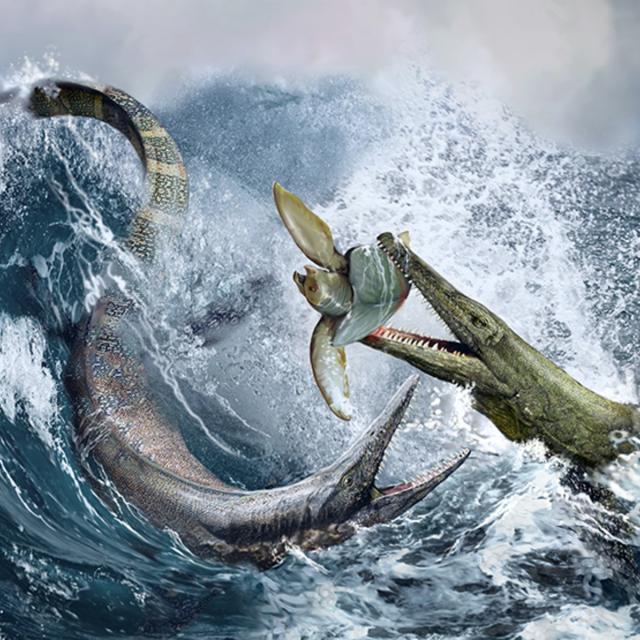
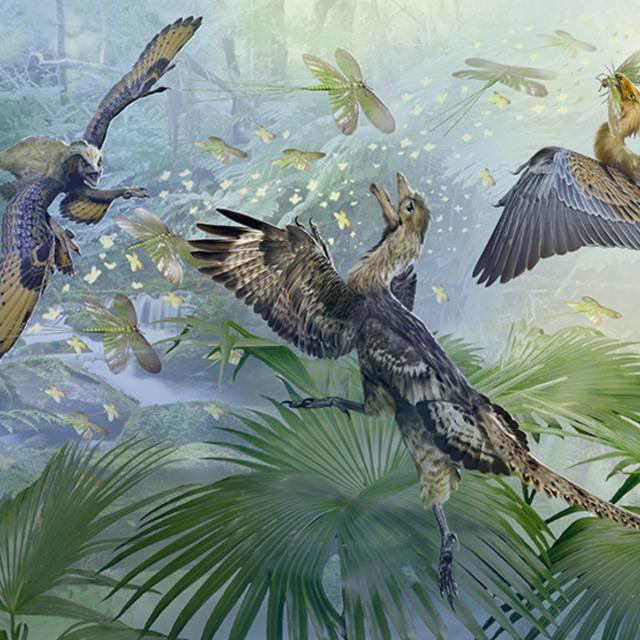
Paleontology: Theropod Dinosaurs and the Origin of Birds is a five-lesson course teaching a comprehensive overview of the origins of birds. This course examines the anatomy, diversity, and evolution of theropod dinosaurs in relation to the origin of birds. Students explore various hypotheses for the origin of flight.

Class Deals by MOOC List - Click here and see Coursera's Active Discounts, Deals, and Promo Codes.

Syllabus

WEEK 1
Bird Anatomy
In Lesson 1, we explore the anatomy and adaptations of birds, and meet the Victorian scientists who first suspected the link between the terrible lizards and modern birds. In order to fly, birds have undergone a series of anatomical specializations that distinguishes them from other vertebrates. However, many of the most striking and anatomically unusual traits of birds originated over 230 million years ago with the very first theropod dinosaurs. Just a quick note before you get started: 'Palaios' is the Greek word for 'ancient', so palaeontology or paleontology is the study of ancient life. Both spellings are correct, with palaeontology used in Britain, and paleontology more common in the US.

WEEK 2
Survey of Non-Avian Theropods
In the wake of the Permian mass extinction, the prehistoric world was ripe for the taking. All the world’s landmass was consolidated into the single supercontinent: Pangaea. With no seas standing in their way, new terrestrial animal lineages were able to exploit new habitats all across the globe. Archosaurs, meaning ‘ruling reptiles’, came to dominate Triassic ecosystems. However, dinosaurian archosaurs were not the top predators. Instead, crurotarsans sat undisputed at the top of the food chain. The first theropods were small, but agile carnivores, and although they started out as the Darwinian equivalent of the mail room clerks, by the next geological period (the Jurassic), they were large and in charge. In Lesson 2, we will introduce you to some of the earliest theropods, and explore the anatomical secrets to their survival and eventual success. We will also meet the largest land predators of all time.

WEEK 3
Coelurosaurs I
In the previous lesson, we explored how the various theropod lineages adapted to their role as apex predators. In this lesson, we will explore a new group of theropods, as much characterized by their speed and agility as their predatory prowess. The coelurosaurs were the most successful and diverse of all the theropods, and included herbivores, the smallest of all dinosaurs, and, of course, the mighty tyrannosaurs.

WEEK 4
Coelurosaurs II
Dinosaurs had long been thought of as overgrown reptiles; cold blooded, swamp bound, with meagre intelligence and little to no social complexity. The ‘Dinosaur Renaissance’ was a revolution in palaeontological thinking that entirely transformed that traditional image of dinosaurs. In Lesson 4, we will see how new research and discoveries over the past fifty years have shaped our modern image of dinosaurs into one of energetic, intelligent animals, that likely displayed many of the complex social behaviours witnessed in modern birds. You’ll also meet the deinonychosaurs, A.K.A. ‘the raptors’, and you will learn the leading theories for how one group of dinosaurs learned to fly.

WEEK 5
The Avian World
66 million years ago, an asteroid the larger than Mt. Everest collided with the earth and brought about the extinction of the dinosaurs…except birds! Now that you’re familiar with some of their larger Mesozoic ancestors and their bird-like features, it’s time to meet the avian lineage proper. With the evolution of flight, birds could exploit habitats and resources that were literally unreachable by other animals. The evolution of birds has been one of diversification. Flightlessness has evolved numerous times, as have specializations for insectivory, swimming, and predation. Although theropods may no longer dominate the land, they still rule the skies.
Go to Class
MOOC List is learner-supported. When you buy through links on our site, we may earn an affiliate commission.

Related Courses

Epidemics - the Dynamics of Infectious Diseases (Coursera) Coursera
Pennsylvania State University

Epidemics - the Dynamics of Infectious Diseases (Coursera)

Not so long ago, it was almost guaranteed that you would die of an infectious disease. In fact, had you been born just 150 years ago, your chances of dying of an infectious disease before you've reached the tender age of 5 would have been extremely high. Since then, science has come a long way in understanding infectious diseases - what they are, how they spread, and how they can be prevented. But diseases like HIV/AIDS, Malaria, Tuberculosis, or the flu are still major killers worldwide, and novel emerging diseases are a constant threat to public health. In addition, the bugs are evolving. Antibiotics, our most potent weapon against bacterial infections, are losing their power because the bacteria are becoming resistant. In this course, we'll explore the major themes of infectious diseases dynamics.

May 25th 2026
5-12 Weeks
Animals, Self, and Society (Coursera) Coursera
University of Colorado Boulder

Animals, Self, and Society (Coursera)

This course explores how animals and people are situated within the web of structures and connections known as “society.” Module 1 considers some of the key symbolic roles that animals play in society by investigating the practice of “thinking with animals.” We investigate how people construct different meanings of animals and the implications these meanings have for both animals and humans. You will gain first-hand experience of this by analyzing how animals are represented in the media.

Jun 1st 2026
4 Weeks
Finding Hidden Messages in DNA (Bioinformatics I) (Coursera) Coursera
University of California, San Diego

Finding Hidden Messages in DNA (Bioinformatics I) (Coursera)

This course begins a series of classes illustrating the power of computing in modern biology. Please join us on the frontier of bioinformatics to look for hidden messages in DNA without ever needing to put on a lab coat. In the first half of the course, we investigate DNA replication, and ask the question, where in the genome does DNA replication begin? We will see that we can answer this question for many bacteria using only some straightforward algorithms to look for hidden messages in the genome.

May 25th 2026
5-12 Weeks
Evolution: A Course for Educators (Coursera) Coursera
American Museum of Natural History

Evolution: A Course for Educators (Coursera)

How are all of the species living on Earth today related? How does understanding evolutionary science contribute to our well-being? In this course, participants will learn about evolutionary relationships, population genetics, and natural and artificial selection. Participants will explore evolutionary science and learn how to integrate it into their classrooms.

Jun 1st 2026
4 Weeks
Sex from Molecules to Elephants (Coursera) Coursera
Hebrew University of Jerusalem

Sex from Molecules to Elephants (Coursera)

Sexual reproduction can be defined as the sort of reproduction by which each organism arises from the fusion of two cells. This generally implies, with some exceptions, that each organism has two parents. This description might sound trivial it is however not at all. Before the appearance of sex, organisms reproduced solely by division. One cell divided into two cells, no partners, no fusion, just simple cell division.

Jun 1st 2026
5-12 Weeks
Genetics and Society: A Course for Educators (Coursera) Coursera
American Museum of Natural History

Genetics and Society: A Course for Educators (Coursera)

How have advances in genetics affected society? What do we need to know to make ethical decisions about genetic technologies? This course includes the study of cloning, genetic enhancement, and ownership of genetic information. Course participants will acquire the tools to explore the ethics of modern genetics and learn how to integrate these issues into their classrooms.

Jun 1st 2026
4 Weeks
The Big Stuff: Evolution and Ecology (Coursera) Coursera
University of Colorado Boulder

The Big Stuff: Evolution and Ecology (Coursera)

In this course, we will explore how evolution works to generate new species, the wide variety of life on earth. We will also touch on the importance of biodiversity for the overall health of our planet, and for our well being as humans. Then we will discuss ecology and the interconnectedness of life and touch on one big ecological issue in today’s society, conservation.

Jun 1st 2026
4 Weeks
Biology Everywhere Foundations (Coursera) Coursera
University of Colorado Boulder

Biology Everywhere Foundations (Coursera)

In this course, we will explore the nature of science and biology. We will discuss what the “biology everywhere” philosophy means and the history of the “biology everywhere” project. We will also discuss what science (and biology) are as a discipline of inquiry and how chemistry is foundational to understanding biology.

Jun 1st 2026
4 Weeks