Основы микроэкономики (Microeconomics Principles) (Coursera)

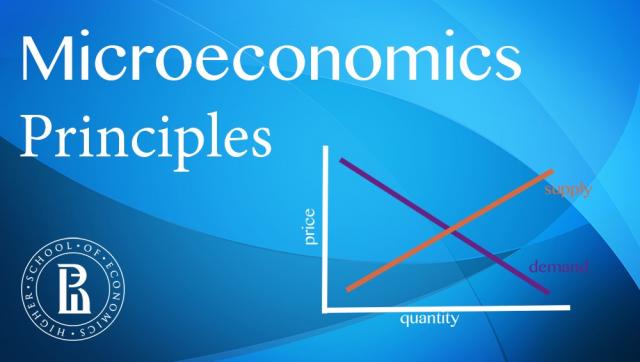
Основы микроэкономики (Microeconomics Principles) (Coursera)

Самое сложное экономическое событие сводится, в конечном счёте, к действиям отдельных людей и фирм. Микроэкономика показывает, как можно эти действия анализировать – как люди выбирают, что потреблять, а фирмы – что производить.

Class Deals by MOOC List - Click here and see Coursera's Active Discounts, Deals, and Promo Codes.

В базовом курсе микроэкономики рассказывается об основных инструментах экономического анализа, которые позволяют изучать наиболее важные закономерности в поведении людей и фирм. У людей есть предпочтения относительно товаров и бюджетные ограничения, у фирм – производственные возможности и спрос на их продукцию со стороны людей. В результате взаимодействия людей и фирм складываются рынки, на которых определяется цена – важнейший канал передачи информации.
Чтобы информации было больше, существуют рынки, на которых продаются и покупаются товары и услуги. Потребитель никогда не купит нужный ему товар, если не узнает, где и как его можно купить. Производитель не станет его изготавливать, если не будет уверен, что найдется покупатель, который его приобретет. Каждый человек и каждая фирма обладает какими-то сведениями – прежде всего о себе самом, о своих вкусах, интересах, потребностях и возможностях. Однако информации у всех становится во много раз больше, когда субъекты начинают взаимодействовать – производят и потребляют, продают, покупают и меняются. Поведение людей и фирм на рынках – основной предмет изучения в курсе микроэкономики.

Go to Class
MOOC List is learner-supported. When you buy through links on our site, we may earn an affiliate commission.

Related Courses

Firm Level Economics: Consumer and Producer Behavior (Coursera) Coursera
University of Illinois at Urbana-Champaign

Firm Level Economics: Consumer and Producer Behavior (Coursera)

All goods and services are subject to scarcity at some level. Scarcity means that society must develop some allocation mechanism – rules to determine who gets what. Over recorded history, these allocation rules were usually command based – the king or the emperor would decide. In contemporary times, most countries have turned to market based allocation systems. In markets, prices act as rationing devices, encouraging or discouraging production and encouraging or discouraging consumption in such a way as to find an equilibrium allocation of resources.

Aug 10th 2026
4 Weeks
Cost and Economics in Pricing Strategy (Coursera) Coursera
University of Virginia,Boston Consulting Group - BCG

Cost and Economics in Pricing Strategy (Coursera)

How much should you charge for your products and services? Traditionally, businesses have answered this question based on the cost to produce or provide their goods and services. This course shows you the economic factors behind pricing based on cost and the pros and cons of a cost-based pricing approach. Developed at the Darden School of Business at the University of Virginia, and led by top-ranked Darden faculty and Boston Consulting Group global pricing experts, the course provides the practical and research-based models and methods you need to set prices that maximize your profits.

Aug 17th 2026
4 Weeks
Economics of Money and Banking (Coursera) Coursera
Columbia University

Economics of Money and Banking (Coursera)

The last three or four decades have seen a remarkable evolution in the institutions that comprise the modern monetary system. The financial crisis of 2007-2009 is a wakeup call that we need a similar evolution in the analytical apparatus and theories that we use to understand that system. Produced and sponsored by the Institute for New Economic Thinking, this course is an attempt to begin the process of new economic thinking by reviving and updating some forgotten traditions in monetary thought that have become newly relevant.

Aug 31st 2026
13-24 Weeks
Introduction to Economic Theories (Coursera) Coursera
Erasmus University Rotterdam

Introduction to Economic Theories (Coursera)

Wondering why economists have not predicted serious financial crises? Shocked by economic assumptions of human behavior as self-centered and focusing only on what can be measured? Asking yourself if there are no sensible economic alternatives to free markets? Then you are at the right place to learn economics! This is the first online course that teaches economics from a pluralist perspective. Economic pluralism means that a plurality of theoretical and methodological viewpoints is regarded as valuable in itself and is simply the best way in which economics can make progress in understanding the world.

Aug 31st 2026
5-12 Weeks
The Economics of Health Care Delivery (Coursera) Coursera
University of Pennsylvania

The Economics of Health Care Delivery (Coursera)

In this course, you’ll learn about the key components of health care, and the economics behind their principles and pricing strategies. Professors Ezekiel Emanuel of Penn Medicine and Guy David of the Wharton School have designed this course to help you understand the complex structure of the health care system and health insurance. Through study and analysis of providers and insurance through an economic lens, you’ll learn how basic economic principles apply to both principles and payment methods.

Aug 10th 2026
4 Weeks
Principles of Economics: Macroeconomics - The Big Picture (Coursera) Coursera
Rice University

Principles of Economics: Macroeconomics - The Big Picture (Coursera)

Take a trip with me in this the third and final course of this Economics 100 Specialization which is a direct adaptation from one of my courses I teach at Rice University. Specifically, in this course we're going to be focusing on Macroeconomics. What is Macroeconomics you might be asking? Well, you've come to the right place! We're going to be going over the big picture of economics- which is examining the measures we use to gauge the health of national economies and study the theories and policies aimed at improving economic health. In a nutshell, how can we use economics to make the world a better place?

Aug 17th 2026
5-12 Weeks
Data Literacy Capstone – Evaluating Research (Coursera) Coursera
Johns Hopkins University

Data Literacy Capstone – Evaluating Research (Coursera)

This is the final course in the Data Literacy Specialization. In this capstone course, you'll apply the skills and knowledge you have acquired in the specialization to the critical evaluation of an original quantitative analysis. The project will first require you to identify and read a piece of high-quality, original, quantitative research on a topic of your choosing. You’ll then interpret and evaluate the findings as well as the methodological approach. As part of the project, you’ll also review other students’ submissions. By the end of the project, you should be empowered to be a critical consumer and user of quantitative research.

Aug 10th 2026
3 Weeks
Understanding economic policymaking (Coursera) Coursera
IE Business School

Understanding economic policymaking (Coursera)

This course will employ a non-technical approach to analyze how governments use policy to influence a country's economy. Upon completing the course you should be able to discuss national debts and deficits, examine fiscal and monetary policy and their appropriateness to the situation of an economy, and anticipate the results of fiscal and monetary policies and structural reform on a country.

Aug 17th 2026
5-12 Weeks
Social and Economic Networks: Models and Analysis (Coursera) Coursera
Stanford University

Social and Economic Networks: Models and Analysis (Coursera)

Learn how to model social and economic networks and their impact on human behavior. How do networks form, why do they exhibit certain patterns, and how does their structure impact diffusion, learning, and other behaviors? We will bring together models and techniques from economics, sociology, math, physics, statistics and computer science to answer these questions.

Aug 31st 2026
5-12 Weeks
The Economics of AI (Coursera) Coursera
University of Virginia

The Economics of AI (Coursera)

The course introduces you to cutting-edge research in the economics of AI and the implications for economic growth and labor markets. We start by analyzing the nature of intelligence and information theory. Then we connect our analysis to modeling production and technological change in economics, and how these processes are affected by AI. Next we turn to how technological change drives aggregate economic growth, covering a range of scenarios including a potential growth singularity.

Aug 11th 2026
5-12 Weeks
What are the Chances? Probability and Uncertainty in Statistics (Coursera) Coursera
Johns Hopkins University

What are the Chances? Probability and Uncertainty in Statistics (Coursera)

This course focuses on how analysts can measure and describe the confidence they have in their findings. The course begins with an overview of the key probability rules and concepts that govern the calculation of uncertainty measures. We’ll then apply these ideas to variables (which are the building blocks of statistics) and their associated probability distributions. The second half of the course will delve into the computation and interpretation of uncertainty. We’ll discuss how to conduct a hypothesis test using both test statistics and confidence intervals. Finally, we’ll consider the role of hypothesis testing in a regression context, including what we can and cannot learn from the statistical significance of a coefficient. By the end of the course, you should be able to discuss statistical findings in probabilistic terms and interpret the uncertainty of a particular estimate.

Aug 10th 2026
4 Weeks