Microcontroller and Industrial Applications (Coursera)

Offered by L&T EduTech,
Microcontroller and Industrial Applications (Coursera)

Today, there exists a changing paradigm for every organization towards Digital Transformation in alignment with rapid growth of Industrial Automation. As automation impacts the business-returns directly, every organization, be it Designing, Manufacturing, Assembling or Logistics sector, sincerely is getting transformed as Digital Industries. One of the key elements underneath this transformation is, the evaluation of multi-featured, high speed, tiny microcontrollers. The global Microcontroller market estimate is with 7.6% CAGR during 2021-2023.This in turn is creating a large job space for Engineering community in the next decade in Digital Transformation domain. The major objective of this course is to equip learners towards such job space of Engineers.

Class Deals by MOOC List - Click here and see Coursera's Active Discounts, Deals, and Promo Codes.

Thus, this course on ‘Microcontrollers and Industrial Applications’ has been designed with a clear vision and roadmap with fundamentals of Microcontrollers, methodologies for Designing microcontrollers, exploratory skill in Application-specific embedded boards and real time industrial applications. The concepts of the course are weaved with perfect demonstrations through digital platform along with use cases, which provide complete learner engagement. The course also provides an experiential knowledge and skill about embedded development boards and Integrated Development Environment (IDE) tool. The learners will be guided with a multi-purpose development boards which are preferred in Industrial applications. The pedagogy followed in the course is making learners to get a good insight about the demos and their creativity will be kindled. The in-course discussion prompt of the course, promote the learner to develop creative embedded solution for real-world applications.
This course is part of the Intelligent Digital Factories Specialization.

Syllabus

8-bit Microcontrollers Architecture
The module describes about : The need for Microcontrollers in real-life applications; Overview of 8051 Microcontroller; The detailed Pin diagram and hardware architecture of 8051 Microcontroller; The memory models and I/O provisions in 8051 Microcontroller; A simulator sample for 8051 Microcontroller.

Programming of Microcontrollers
The module describes about: Memory interfacing models; Timers and Counters features in 8051 Microcontroller; Serial I/O interfacing options in 8051 Microcontroller; Interrupt features of 8051 and Instruction Set Architecture options of Data transfer and Logical instructions applicable in 8051 Microcontroller.

Programming of Microcontrollers and Timers, counters
The module elaborates about: Arithmetic and conditional operations in 8051; Subroutine models in 8051 Microcontroller; Programming of interrupts, Timers and Counters in 8051; I/O Ports programming models of 8051.

Applications and Programmable Peripheral Interface
The module elaborates about: External I/O like Keyboards, displays etc., in 8051; Typical ADC interfaces in 8051 Microcontroller; Serial I/O connectors in 8051; 8255 PPI configuration in 8051.

Exploring Arduino UNO and ESP8266 Applications
The module elaborates about: Hardware Development boards Arduino UNO and ESP 8266; Arduino IDE and its features; Development of different applications like SPMS, Inventory control and Air Quality Monitoring using above boards.

Deployment of ESP32 Microcontroller for Industrial Applications
The module elaborates about: Hardware Development boards ESP 32; Development of applications like line follower, Obstacle sensing, Object counting using ESP32.

Go to Class
MOOC List is learner-supported. When you buy through links on our site, we may earn an affiliate commission.

Related Courses

Perspectives in Digital Transformation: Agribusiness (Coursera) Coursera
Inter-American Development Bank - IDB

Perspectives in Digital Transformation: Agribusiness (Coursera)

In this course, you will be learn how to apply the best practices that have been tested by global companies to make the most of the potentialities of digital transformation and its application to your business. Discover what the level of digital maturity is for your organization by identifying current trends in digital transformation, the use of technologies, and the impact on sustainability in the agribusiness sector in Latin America.

Oct 12th 2026
3 Weeks
Kotlin for Java Developers (Coursera) Coursera
JetBrains

Kotlin for Java Developers (Coursera)

The Kotlin programming language is a modern language that gives you more power for your everyday tasks. Kotlin is concise, safe, pragmatic, and focused on interoperability with Java code. It can be used almost everywhere Java is used today: for server-side development, Android apps, and much more. This course aims to share with you the power and the beauty of Kotlin.

Oct 12th 2026
5-12 Weeks
Principles of Computing (Part 2) (Coursera) Coursera
Rice University

Principles of Computing (Part 2) (Coursera)

This two-part course introduces the basic mathematical and programming principles that underlie much of Computer Science. Understanding these principles is crucial to the process of creating efficient and well-structured solutions for computational problems. To get hands-on experience working with these concepts, we will use the Python programming language. The main focus of the class will be weekly mini-projects that build upon the mathematical and programming principles that are taught in the class.

Oct 5th 2026
4 Weeks
An Introduction to Interactive Programming in Python (Part 1) (Coursera) Coursera
Rice University

An Introduction to Interactive Programming in Python (Part 1) (Coursera)

This two-part course is designed to help students with very little or no computing background learn the basics of building simple interactive applications. Our language of choice, Python, is an easy-to learn, high-level computer language that is used in many of the computational courses offered on Coursera. To make learning Python easy, we have developed a new browser-based programming environment that makes developing interactive applications in Python simple.

Oct 5th 2026
5-12 Weeks
Programming Languages, Part A (Coursera) Coursera
University of Washington

Programming Languages, Part A (Coursera)

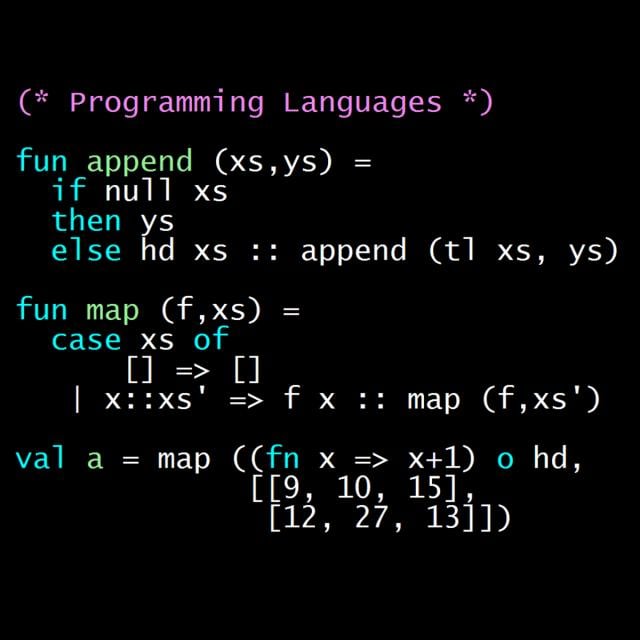
This course is an introduction to the basic concepts of programming languages, with a strong emphasis on functional programming. The course uses the languages ML, Racket, and Ruby as vehicles for teaching the concepts, but the real intent is to teach enough about how any language “fits together” to make you more effective programming in any language -- and in learning new ones.

Oct 5th 2026
5-12 Weeks
Digital Signal Processing 4: Applications (Coursera) Coursera
École Polytechnique Fédérale de Lausanne

Digital Signal Processing 4: Applications (Coursera)

Digital Signal Processing is the branch of engineering that, in the space of just a few decades, has enabled unprecedented levels of interpersonal communication and of on-demand entertainment. By reworking the principles of electronics, telecommunication and computer science into a unifying paradigm, DSP is a the heart of the digital revolution that brought us CDs, DVDs, MP3 players, mobile phones and countless other devices.

Oct 12th 2026
3 Weeks
Big Data Analysis with Scala and Spark (Coursera) Coursera
École Polytechnique Fédérale de Lausanne

Big Data Analysis with Scala and Spark (Coursera)

Manipulating big data distributed over a cluster using functional concepts is rampant in industry, and is arguably one of the first widespread industrial uses of functional ideas. This is evidenced by the popularity of MapReduce and Hadoop, and most recently Apache Spark, a fast, in-memory distributed collections framework written in Scala. In this course, we'll see how the data parallel paradigm can be extended to the distributed case, using Spark throughout.

Oct 12th 2026
4 Weeks
Introducción a la programación en Python I: Aprendiendo a programar con Python (Coursera) Coursera
Pontificia Universidad Católica de Chile

Introducción a la programación en Python I: Aprendiendo a programar con Python (Coursera)

Decía Steve Jobs que “todo el mundo debería aprender a programar un ordenador porque esto te ayuda a pensar”. Hoy en día la programación es una herramienta fundamental para el desarrollo de la tecnología moderna. Este curso te introduce en el mundo de la programación en el lenguaje Python.

Oct 5th 2026
5-12 Weeks