Functional Program Design in Scala (Scala 2 version) (Coursera)

Functional Program Design in Scala (Scala 2 version) (Coursera)

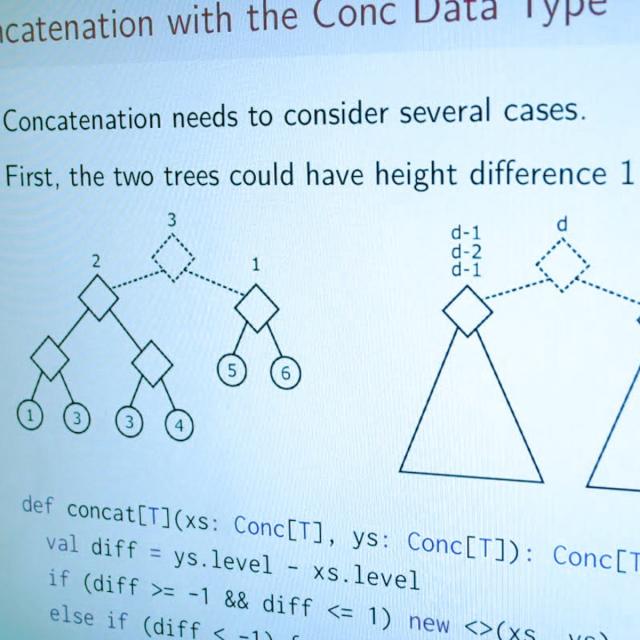
In this course you will learn how to apply the functional programming style in the design of larger Scala applications. You'll get to know important new functional programming concepts, from lazy evaluation to structuring your libraries using monads. We'll work on larger and more involved examples, from state space exploration to random testing to discrete circuit simulators. You’ll also learn some best practices on how to write good Scala code in the real world. Finally, you will learn how to leverage the ability of the compiler to infer values from types.

Class Deals by MOOC List - Click here and see Coursera's Active Discounts, Deals, and Promo Codes.

Several parts of this course deal with the question how functional programming interacts with mutable state. We will explore the consequences of combining functions and state. We will also look at purely functional alternatives to mutable state, using infinite data structures or functional reactive programming.
Recommended background: You should have at least one year programming experience. Proficiency with Java or C# is ideal, but experience with other languages such as C/C++, Python, Javascript or Ruby is also sufficient. You should have some familiarity with using the command line. This course is intended to be taken after Functional Programming Principles in Scala (Scala 2 version)

What You Will Learn

  • Recognize and apply design principles of functional programs
  • Design functional libraries and their APIs
  • Write simple functional reactive applications
  • Understand reasoning techniques for programs that combine functions and state

Syllabus

WEEK 1
For Expressions and Monads
We'll start by revisiting some concepts that we have learned from Principles of Functional Programming in Scala; collections, pattern matching, and functions. We'll then touch on for-comprehensions, a powerful way in Scala to traverse a list, process it, and return a new list. We'll see how to do queries with for-comprehensions as well as how the for-comprehension is "desugared" into calls to higher-order functions by the Scala compiler. Finally, we'll discuss what monads are, and how to verify that the monad laws are satisfied for a number of examples.

WEEK 2
Lazy Evaluation
This week we'll revisit performance issues caused by combinatorial search, and we'll discover an important concept in functional programming that can address these issues: laziness. We'll also learn a little bit about proofs on trees; in particular, we'll see how to extend structural induction to trees.

WEEK 3
Type-Directed Programming
This week, we’ll learn how to make the compiler write programs for us! We’ll see how the compiler can summon program fragments based on their type and how this mechanism can be used to implement a new form of polymorphism (type classes).

WEEK 4
Functions and State
This week, we'll learn about state and side-effects. Through a rich example, we'll learn programming patterns for managing state in larger programs. We'll also learn about for-loops and while-loops in Scala.

WEEK 5
Timely Effects
This week we'll learn a number of important programming patterns via examples, starting with the observer pattern, and then going on to functional reactive programming.
Go to Class
MOOC List is learner-supported. When you buy through links on our site, we may earn an affiliate commission.

Related Courses

Object Oriented Programming in Java (Coursera) Coursera
University of California, San Diego

Object Oriented Programming in Java (Coursera)

Welcome to our course on Object Oriented Programming in Java using data visualization. People come to this course with many different goals -- and we are really excited to work with all of you! Some of you want to be professional software developers, others want to improve your programming skills to implement that cool personal project that you’ve been thinking about, while others of you might not yet know why you’re here and are trying to figure out what this course is all about.

Jun 8th 2026
5-12 Weeks
Programming Mobile Applications for Android Handheld Systems: Part 1 (Coursera) Coursera
University of Maryland, College Park

Programming Mobile Applications for Android Handheld Systems: Part 1 (Coursera)

This course introduces you to the design and implementation of Android applications for mobile devices. You will develop an app from scratch, assuming a basic knowledge of Java, and learn how to set up Android Studio, work with various Activities and create simple user interfaces to make your apps run smoothly.

Jun 8th 2026
5-12 Weeks
Using Python to Interact with the Operating System (Coursera) Coursera
Google

Using Python to Interact with the Operating System (Coursera)

By the end of this course, you’ll be able to manipulate files and processes on your computer’s operating system. You’ll also have learned about regular expressions -- a very powerful tool for processing text files -- and you’ll get practice using the Linux command line on a virtual machine. And, this might feel like a stretch right now, but you’ll also write a program that processes a bunch of errors in an actual log file and then generates a summary file. That’s a super useful skill for IT Specialists to know.

Jun 9th 2026
5-12 Weeks
Advanced Data Structures in Java (Coursera) Coursera
University of California, San Diego

Advanced Data Structures in Java (Coursera)

How does Google Maps plan the best route for getting around town given current traffic conditions? How does an internet router forward packets of network traffic to minimize delay? How does an aid group allocate resources to its affiliated local partners? To solve such problems, we first represent the key pieces of data in a complex data structure. In this course, you’ll learn about data structures, like graphs, that are fundamental for working with structured real world data.

Jun 8th 2026
5-12 Weeks
Introduction to Web Development (Coursera) Coursera
University of California, Davis

Introduction to Web Development (Coursera)

This course is designed to start you on a path toward future studies in web development and design, no matter how little experience or technical knowledge you currently have. The web is a very big place, and if you are the typical internet user, you probably visit several websites every day, whether for business, entertainment or education. But have you ever wondered how these websites actually work? How are they built? How do browsers, computers, and mobile devices interact with the web? What skills are necessary to build a website? With almost 1 billion websites now on the internet, the answers to these questions could be your first step toward a better understanding of the internet and developing a new set of internet skills.

Jun 8th 2026
5-12 Weeks
Interfacing with the Arduino (Coursera) Coursera
University of California, Irvine

Interfacing with the Arduino (Coursera)

Arduino senses the environment by receiving inputs from add-on devices such as sensors, and can control the world around it by adjusting lights, motors, and other actuators. In this class you will learn how and when to use the different types of sensors and how to connect them to the Arduino. Since the external world uses continuous or analog signals and the hardware is digital you will learn how these signals are converted back-and-forth and how this must be considered as you program your device. You'll also learn about the use of Arduino-specific shields and the shields software libraries to interface with the real world.

Jun 8th 2026
4 Weeks
Cloud Computing Concepts, Part 1 (Coursera) Coursera
University of Illinois at Urbana-Champaign

Cloud Computing Concepts, Part 1 (Coursera)

Cloud computing systems today, whether open-source or used inside companies, are built using a common set of core techniques, algorithms, and design philosophies—all centered around distributed systems. Learn about such fundamental distributed computing "concepts" for cloud computing. Some of these concepts include: clouds, MapReduce, key-value/NoSQL stores, classical distributed algorithms, widely-used distributed algorithms, scalability, trending areas, and much, much more!

Jun 8th 2026
5-12 Weeks
Data Structures and Performance (Coursera) Coursera
University of California, San Diego

Data Structures and Performance (Coursera)

How do Java programs deal with vast quantities of data? Many of the data structures and algorithms that work with introductory toy examples break when applications process real, large data sets. Efficiency is critical, but how do we achieve it, and how do we even measure it? This is an intermediate Java course. We recommend this course to learners who have previous experience in software development or a background in computer science, and in particular, we recommend that you have taken the first course in this specialization (which also requires some previous experience with Java).

Jun 8th 2026
5-12 Weeks
Intermediate Object-Oriented Programming for Unity Games (Coursera) Coursera
University of Colorado System

Intermediate Object-Oriented Programming for Unity Games (Coursera)

This course is the third course in the specialization about learning how to develop video games using the C# programming language and the Unity game engine on Windows or Mac. Why use C# and Unity instead of some other language and game engine? Well, C# is a really good language for learning how to program and then programming professionally. Also, the Unity game engine is very popular with indie game developers; Unity games were downloaded 16,000,000,000 times in 2016! Finally, C# is one of the programming languages you can use in the Unity environment.

Jun 8th 2026
4 Weeks
Programming Mobile Applications for Android Handheld Systems: Part 2 (Coursera) Coursera
University of Maryland, College Park

Programming Mobile Applications for Android Handheld Systems: Part 2 (Coursera)

This course introduces you to the design and implementation of Android applications for mobile devices. You will build upon concepts from the prior course, including handling notifications, using multimedia and graphics and incorporating touch and gestures into your apps.

Jun 8th 2026
5-12 Weeks
Interactivity with JavaScript (Coursera) Coursera
University of Michigan

Interactivity with JavaScript (Coursera)

If you want to take your website to the next level, the ability to incorporate interactivity is a must. But adding some of these types of capabilities requires a stronger programming language than HTML5 or CSS3, and JavaScript can provide just what you need. With just a basic understanding of the language, you can create a page that will react to common events such as page loads, mouse clicks & movements, and even keyboard input.

Jun 8th 2026
4 Weeks
The Raspberry Pi Platform and Python Programming for the Raspberry Pi (Coursera) Coursera
University of California, Irvine

The Raspberry Pi Platform and Python Programming for the Raspberry Pi (Coursera)

The Raspberry Pi is a small, affordable single-board computer that you will use to design and develop fun and practical IoT devices while learning programming and computer hardware. In addition, you will learn how to set up up the Raspberry Pi environment, get a Linux operating system running, and write and execute some basic Python code on the Raspberry Pi. You will also learn how to use Python-based IDE (integrated development environments) for the Raspberry Pi and how to trace and debug Python code on the device.

Jun 8th 2026
4 Weeks