Mathematics for computer vision (Coursera)

Mathematics for computer vision (Coursera)

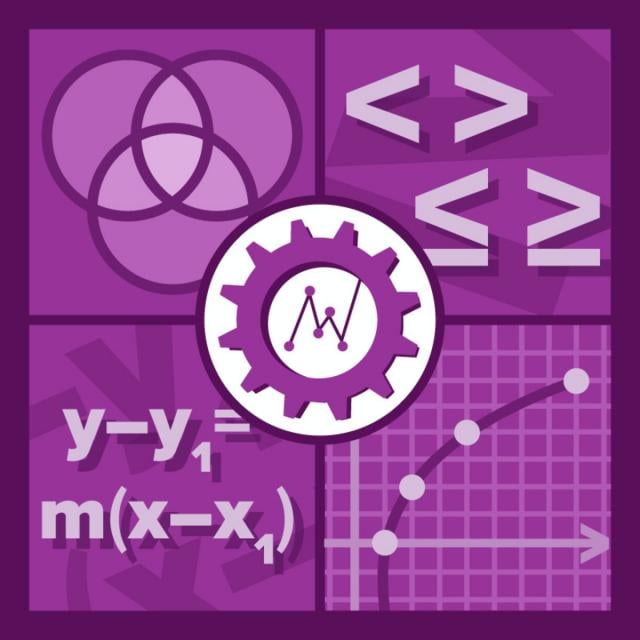
The course is devoted to the systematization of the mathematical background of the students necessary for the successful mastering of educational disciplines in the field of computer vision. The course includes sections of mathematical analysis, probability theory, linear algebra.

Class Deals by MOOC List - Click here and see Coursera's Active Discounts, Deals, and Promo Codes.

Aim of the course:
• Systematization of the mathematical background
• Preparation for the use of mathematical knowledge in the professional activities of a specialist in the field of
computer vision.
Practical Learning Outcomes expected:
• Mastering practical skills in mathematics
• The solution of mathematical problems that are encountered in the practical work of a specialist in the field of computer vision.

Course 1 of 3 in the Basics in computer vision Specialization

Syllabus

WEEK 1
Vectors
In this module we provide you with the most important concepts about vectors and vector spaces which are widely used in the area of machine learning and computer vision.

WEEK 2
Matrices
Matrices play key role in various computer vision algorithms. In this section we show different operations on matrices and also give the information about different theoretical features of matrices that are necessary for the practical use.

WEEK 3
Functions
This module contains the fundamental concepts about functions, such as continuity, differentiation and integration. They are extremely important for various machine learning methods, for example, in training procedures (optimization of parameters).

WEEK 4
Project week

Go to Class
MOOC List is learner-supported. When you buy through links on our site, we may earn an affiliate commission.

Related Courses

English for Science, Technology, Engineering, and Mathematics (Coursera) Coursera
University of Pennsylvania

English for Science, Technology, Engineering, and Mathematics (Coursera)

Welcome to English for Science, Technology, Engineering, and Mathematics, a course created by the University of Pennsylvania, and funded by the U.S. Department of State Bureau of Educational and Cultural Affairs, Office of English Language Programs. This course is designed for non-native English speakers who are interested in improving their English skills in the sciences. In this course, you will explore some of the most innovative areas of scientific study, while expanding your vocabulary and the language skills needed to share scientific information within your community.

Jun 1st 2026
5-12 Weeks
Mathematics for Machine Learning: Multivariate Calculus (Coursera) Coursera
Imperial College London

Mathematics for Machine Learning: Multivariate Calculus (Coursera)

This course offers a brief introduction to the multivariate calculus required to build many common machine learning techniques. We start at the very beginning with a refresher on the “rise over run” formulation of a slope, before converting this to the formal definition of the gradient of a function. We then start to build up a set of tools for making calculus easier and faster. Next, we learn how to calculate vectors that point up hill on multidimensional surfaces and even put this into action using an interactive game.

Jun 1st 2026
5-12 Weeks
Object Localization with TensorFlow (Coursera) Coursera
Coursera Project Network

Object Localization with TensorFlow (Coursera)

Welcome to this 2 hour long guided project on creating and training an Object Localization model with TensorFlow. In this guided project, we are going to use TensorFlow's Keras API to create a convolutional neural network which will be trained to classify as well as localize emojis in images. Localization, in this context, means the position of the emojis in the images. This means that the network will have one input and two outputs.

Jun 1st 2026
Self-Paced
Combinatorics and Probability (Coursera) Coursera
University of California, San Diego,Higher School of Economics - HSE University

Combinatorics and Probability (Coursera)

Counting is one of the basic mathematically related tasks we encounter on a day to day basis. The main question here is the following. If we need to count something, can we do anything better than just counting all objects one by one? Do we need to create a list of all phone numbers to ensure that there are enough phone numbers for everyone? Is there a way to tell that our algorithm will run in a reasonable time before implementing and actually running it? All these questions are addressed by a mathematical field called Combinatorics.

Jun 1st 2026
5-12 Weeks
Computer Vision in Microsoft Azure (Coursera) Coursera
Microsoft

Computer Vision in Microsoft Azure (Coursera)

In Microsoft Azure, the Computer Vision cognitive service uses pre-trained models to analyze images, enabling software developers to easily build applications"see" the world and make sense of it. This ability to process images is the key to creating software that can emulate human visual perception. In this course, you'll explore some of these capabilities as you learn how to use the Computer Vision service to analyze images.

Jun 1st 2026
3 Weeks
Calculus through Data & Modeling: Limits & Derivatives (Coursera) Coursera
Johns Hopkins University

Calculus through Data & Modeling: Limits & Derivatives (Coursera)

This first course on concepts of single variable calculus will introduce the notions of limits of a function to define the derivative of a function. In mathematics, the derivative measures the sensitivity to change of the function. For example, the derivative of the position of a moving object with respect to time is the object's velocity: this measures how quickly the position of the object changes when time advances. This fundamental notion will be applied through the modelling and analysis of data.

Jun 1st 2026
5-12 Weeks
Introduction to Computer Vision with Watson and OpenCV (Coursera) Coursera
IBM

Introduction to Computer Vision with Watson and OpenCV (Coursera)

Computer Vision is one of the most exciting fields in Machine Learning and AI. It has applications in many industries such as self-driving cars, robotics, augmented reality, face detection in law enforcement agencies. In this beginner-friendly course you will understand about computer vision, and will learn about its various applications across many industries.

Jun 1st 2026
4 Weeks
Álgebra Básica (Coursera) Coursera
Universidad Nacional Autónoma de México

Álgebra Básica (Coursera)

Galileo dijo: "El Universo está escrito en lenguaje matemático y los caracteres son triángulos, círculos y otras figuras geométricas, sin las que es humanamente imposible entender una sola palabra". Para entender el Universo, es necesario plantear leyes que expliquen su comportamiento, como pueden ser las leyes de la gravedad, la propagación del calor, el electromagnetismo, la reproducción celular, el crecimiento poblacional, la propagación de las enfermedades, la variación de los precios de las acciones en la bolsa de valores, el comportamiento de las masas ante un conflicto, etcétera.

Jun 1st 2026
5-12 Weeks
Precalculus: Periodic Functions (Coursera) Coursera
Johns Hopkins University

Precalculus: Periodic Functions (Coursera)

This course helps to build the foundational material to use mathematics as a tool to model, understand, and interpret the world around us. This is done through studying functions, their properties, and applications to data analysis. Concepts of precalculus provide the set of tools for the beginning student to begin their scientific career, preparing them for future science and calculus courses. This course is designed for all students, not just those interested in further mathematics courses.

Jun 1st 2026
5-12 Weeks
Mindware: Critical Thinking for the Information Age (Coursera) Coursera
University of Michigan

Mindware: Critical Thinking for the Information Age (Coursera)

Most professions these days require more than general intelligence. They require in addition the ability to collect, analyze and think about data. Personal life is enriched when these same skills are applied to problems in everyday life involving judgment and choice. This course presents basic concepts from statistics, probability, scientific methodology, cognitive psychology and cost-benefit theory and shows how they can be applied to everything from picking one product over another to critiquing media accounts of scientific research. Concepts are defined briefly and breezily and then applied to many examples drawn from business, the media and everyday life.

Jun 1st 2026
4 Weeks
In the footsteps of Zika… approaching the unknown (Coursera) Coursera
University of Geneva

In the footsteps of Zika… approaching the unknown (Coursera)

Welcome to this on-demand MOOC “In the footsteps of Zika… approaching the unknown”. This MOOC has been produced by Université de Genève Institut Pasteur, Université Paris Descartes and Centre Virchow-Villermé. With the help of the intervention of faculty members and international experts, we will explore together the recent Zika phenomenon, a previously rare benign virus that recently turned unexpectedly into the limelight when on the 1st of February 2016 it was declared by the WHO as a Public Health Emergency of International Concern.

Jun 1st 2026
5-12 Weeks
Cálculo Diferencial e Integral unidos por el Teorema Fundamental del Cálculo (Coursera) Coursera
Tecnológico de Monterrey

Cálculo Diferencial e Integral unidos por el Teorema Fundamental del Cálculo (Coursera)

Los cursos de Cálculo Diferencial y Cálculo Integral tradicionalmente se ofrecen separados y respetando ese orden. El primero estudia la derivada, y el segundo, la integral, siendo este momento en el que aparece el Teorema Fundamental del Cálculo (TFC) para establecer la relación entre ambos conceptos. En el presente curso vamos a hacer una diferencia: introduciremos la derivada y la integral como conceptos relacionados desde un principio.

Jun 1st 2026
5-12 Weeks