Introduction to Ancient Egypt and Its Civilization (Coursera)

Introduction to Ancient Egypt and Its Civilization (Coursera)

Colossal pyramids, imposing temples, golden treasures, enigmatic hieroglyphs, powerful pharaohs, strange gods, and mysterious mummies are features of Ancient Egyptian culture that have fascinated people over the millennia. The Bible refers to its gods, rulers, and pyramids. Neighboring cultures in the ancient Near East and Mediterranean wrote about its god-like kings and its seemingly endless supply of gold. The Greeks and Romans describe aspects of Egypt's culture and history.

Class Deals by MOOC List - Click here and see Coursera's Active Discounts, Deals, and Promo Codes.

As the 19th century began, the Napoleonic campaign in Egypt highlighted the wonders of this ancient land, and public interest soared. Not long after, Champollion deciphered Egypt's hieroglyphs and paved the way for other scholars to reveal that Egyptian texts dealt with medicine, dentistry, veterinary practices, mathematics, literature, and accounting, and many other topics. Then, early in the 20th century, Howard Carter discovered the tomb of Tutankhamun and its fabulous contents. Exhibitions of this treasure a few decades later resulted in the world's first blockbuster, and its revival in the 21st century has kept interest alive.
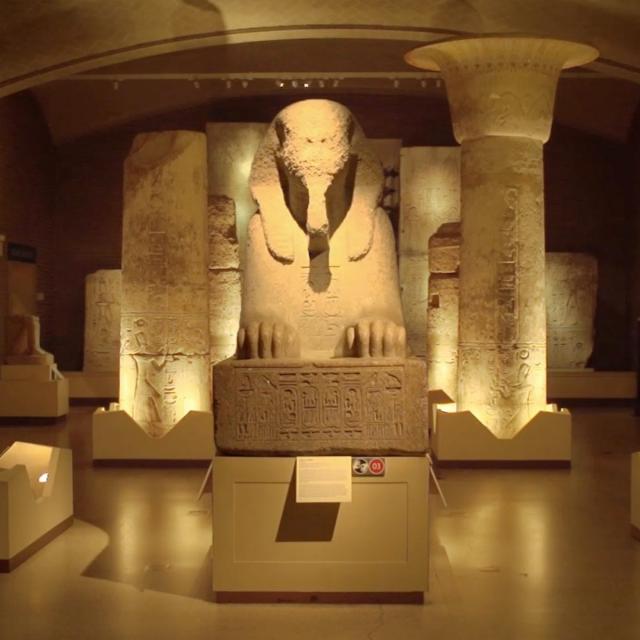
Join Dr. David Silverman, Professor of Egyptology at Penn, Curator in Charge of the Egyptian Section of the Penn Museum, and curator of the Tutankhamun exhibitions on a guided tour of the mysteries and wonders of this ancient land. He has developed this online course and set it in the galleries of the world famous Penn Museum. He uses many original Egyptian artifacts to illustrate his lectures as he guides students as they make their own discovery of this fascinating culture.

Syllabus

WEEK 1: Welcome to the Course
This module includes a discussion thread to introduce yourself, and suggested readings and resources.
WEEK 2: History and Chronology
WEEK 3: The Pharaoh and Kingship
WEEK 4: Gods and Goddesses
WEEK 5: The Pyramids and the Sphinx
WEEK 6: Mummies and Mummification
Go to Class
MOOC List is learner-supported. When you buy through links on our site, we may earn an affiliate commission.

Related Courses

Organising an Empire: The Assyrian Way (Coursera) Coursera
Ludwig-Maximilians-Universität München

Organising an Empire: The Assyrian Way (Coursera)

Discover the mighty kingdom of Assyria, which came to be the world’s first great empire three thousand years ago. From the 9th to the 7th centuries BC, during the imperial phase of Assyria’s long history, modern day northern Iraq was the central region of a state reaching from the Mediterranean Sea to the Persian Gulf, and incorporating what is now Iraq, Syria, and Lebanon, as well as half of Israel, and wide parts of south-eastern Turkey, and Western Iran.

Oct 5th 2026
5-12 Weeks
The Modern and the Postmodern (Part 2) (Coursera) Coursera
Wesleyan University

The Modern and the Postmodern (Part 2) (Coursera)

This course examines how the idea of "the modern" develops at the end of the 18th century in European philosophy and literature, and how being modern (or progressive, or hip) became one of the crucial criteria for understanding and evaluating cultural change. Are we still in modernity, or have we moved beyond the modern to the postmodern?

Oct 5th 2026
5-12 Weeks
Reimagining Blackness and Architecture (Coursera) Coursera
The Museum of Modern Art

Reimagining Blackness and Architecture (Coursera)

Architecture structures our daily lives. It shapes our homes, streets, neighborhoods, cities and more. But who gets to create and occupy these spaces? In the United States, a long history of anti-Black racism has created spatial inequalities that are built into the physical environment and erased the stories of Black architects and communities. Reimagining Blackness and Architecture explores the relationship between architecture and Blackness as an identity and a lived experience.

Oct 5th 2026
5-12 Weeks
Understanding China, 1700-2000: A Data Analytic Approach, Part 1 (Coursera) Coursera
The Hong Kong University of Science and Technology - HKUST

Understanding China, 1700-2000: A Data Analytic Approach, Part 1 (Coursera)

The purpose of this course is to summarize new directions in Chinese history and social science produced by the creation and analysis of big historical datasets based on newly opened Chinese archival holdings, and to organize this knowledge in a framework that encourages learning about China in comparative perspective. Our course demonstrates how a new scholarship of discovery is redefining what is singular about modern China and modern Chinese history.

Sep 28th 2026
5-12 Weeks
Film, Images & Historical Interpretation in the 20th Century: The Camera Never Lies (Coursera) Coursera
University of London,Royal Holloway, University of London

Film, Images & Historical Interpretation in the 20th Century: The Camera Never Lies (Coursera)

This course is a short taster on the topic of the use of Images, Film, and their use in historical interpretation in the 20th century. It is primarily provided for those who have a general interest in history that draws on photojournalism as primary evidence, and films based on historical events.

Oct 5th 2026
5-12 Weeks
Introduction to Typography (Coursera) Coursera
California Institute of the Arts

Introduction to Typography (Coursera)

Typography is the art of manipulating the visual form of language to enrich and control its meaning. It’s an essential area of skill and knowledge for graphic designers. Typography predates modern graphic design by around 500 years; it is rich in rules, conventions, and esoteric terminology—but it remains an exciting space for invention and expression.

Sep 21st 2026
4 Weeks
The Bible's Prehistory, Purpose, and Political Future (Coursera) Coursera
Emory University

The Bible's Prehistory, Purpose, and Political Future (Coursera)

With its walls razed to ground by Babylon’s armies, Jerusalem joined a long line of ancient vanquished cities—from Ur and Nineveh and Persepolis to Babylon itself. While some recovered from the destruction, others did not. But none responded to political catastrophe by fashioning the kind of elaborate and enduring monument to their own downfall that we find in the Bible. Most conquered populations viewed their subjugation as a source of shame. They consigned it to oblivion, opting instead to extol the golden ages of the past. The biblical authors in contrast reacted to loss by composing extensive writings that acknowledge collective failure, reflect deeply upon its causes, and discover thereby a ground for collective hope.

Sep 21st 2026
5-12 Weeks
Words Spun Out of Images: Visual and Literary Culture in Nineteenth Century Japan (Coursera) Coursera
The University of Tokyo

Words Spun Out of Images: Visual and Literary Culture in Nineteenth Century Japan (Coursera)

In their ambition to capture “real life,” Japanese painters, poets, novelists and photographers of the nineteenth century collaborated in ways seldom explored by their European contemporaries. This course offers learners the chance to encounter and appreciate behavior, moral standards and some of the material conditions surrounding Japanese artists in the nineteenth century, in order to renew our assumptions about what artistic “realism” is and what it meant.

Oct 5th 2026
4 Weeks
Seeing Through Photographs (Coursera) Coursera
The Museum of Modern Art

Seeing Through Photographs (Coursera)

Although taking, sharing, and viewing photographs has become second nature for many of us, our regular engagement with images does not necessarily make us visually literate. This course aims to address the gap between seeing and truly understanding photographs by introducing a diversity of ideas, approaches, and technologies that inform their making. In this course you will look closely at 100 photographs from the collection of The Museum of Modern Art, going behind the scenes of the Museum and into artist studios through original films and audio interviews.

Sep 21st 2026
5-12 Weeks
Tesoros de la Física y sus Descubridores I (Coursera) Coursera
Universidad de los Andes

Tesoros de la Física y sus Descubridores I (Coursera)

¿Sabes cómo vuelan los aviones, tan pesados y no se caen mientras vuelan? ¿Sabes que viajamos por el espacio sobre el planeta Tierra que se traslada y gira muy rápido y no lo percibimos? ¿O acaso, notas efectos de su movimiento? ¿Cuál es nuestro lugar en el universo? ¿Podemos viajar en el tiempo? ¡Preguntas, muchas preguntas! Con espíritu de descubridores nuestra curiosidad nos motiva a buscar respuestas, a explorar nuestro entorno, a entrar a lo desconocido y hallar nuevo conocimiento.

Sep 28th 2026
5-12 Weeks
Intellectual Change in Early China: Warring States and Han (Coursera) Coursera
The Chinese University of Hong Kong

Intellectual Change in Early China: Warring States and Han (Coursera)

This sequence of four courses will propose a multi-disciplinary approach to the study of Chinese cultural history conceived of as a succession of modes of rationality (philosophical, bureaucratic, and economic). The focus will be on the moments of paradigm shift from one mode of rationality to another. For each of these moments, cultural facts and artifacts—thought, literature, ritual—will be examined in relationship to changing social, political, and economic systems.

Oct 5th 2026
5-12 Weeks