Introdução ao Controle de Sistemas (Coursera)

Introdução ao Controle de Sistemas (Coursera)

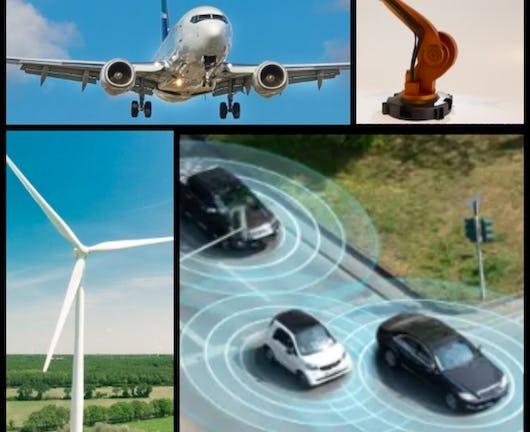
Este curso apresenta os principais conceitos do controle de sistemas e mostra suas vantagens e importância para a sociedade moderna. Você vai entender o que é o controle de sistemas e como o controle com realimentação funciona, e passará a perceber a sua presença em diversas situações em seu dia-a-dia, na natureza, no corpo humano e em diversos dispositivos, desde os mais simples até os mais complexos.

Class Deals by MOOC List - Click here and see Coursera's Active Discounts, Deals, and Promo Codes.

Você vai perceber a necessidade de modelos teóricos para a análise e o projeto do controle de sistemas e aprenderá como verificar se um sistema atende a determinados requisitos de desempenho. Você também aprenderá como projetar um controle simples de modo a obter o melhor desempenho possível de um sistema de controle. Este é apenas o primeiro passo em direção a um vasto campo do conhecimento e lhe dará a base e a segurança necessárias para avançar em seus estudos no maravilhoso mundo do controle de sistemas.

Syllabus

WEEK 1
A necessidade de modelos teóricos
O que é Sistema? Exemplos de Sistemas. O que é Controle? Análise e Projeto. Controle em Malha Aberta e em Malha Fechada. Exemplo de Controle com Realimentação. Modelos Matemáticos.

WEEK 2
A Função de Transferência
Transformada de Laplace. Função de Transferência, Calculando a saída do sistema.

WEEK 3
Estabilidade e Erro em Regime
Estabilidade. Critério de Routh-Hurwitz. Vantagens da Realimentação. Erro em Regime.

WEEK 4
Resposta ao Degrau e Projeto Proporcional
Resposta ao Degrau. Requisitos da Resposta ao Degrau. Parametrização de Sistema de Segunda Ordem. Projeto de Controle Proporcional.

Go to Class
MOOC List is learner-supported. When you buy through links on our site, we may earn an affiliate commission.

Related Courses

Control automático: La tecnología invisible (Coursera) Coursera
Universidad Nacional Autónoma de México

Control automático: La tecnología invisible (Coursera)

A lo largo de la historia, el ser humano se ha empeñado en construir dispositivos que le hagan más cómodo su día a día. Además, siempre ha estado interesado en que éstos lleven a cabo la tarea por sí mismos, sin necesidad de una supervisión continua. En nuestros días, muchos dispositivos llevan a cabo tareas como por arte de magia; pareciera que piensan o que adivinan nuestros deseos, que nunca se pueden equivocar o que su precisión y velocidad no puede ser superada. Los sistemas de control son una parte crucial de este funcionamiento.

Sep 28th 2026
3 Weeks
Organizational Design: Creating Competitive Advantage (edX) EdX
Indian Institute of Management, Bangalore,IIMBx

Organizational Design: Creating Competitive Advantage (edX)

Learn how to design control systems, decision-making processes and a culture that enables value creation and the development of sustainable competitive advantage. In order to sustain themselves, organizations need to compete for scarce resources both in input and output markets. Because of this organizations need to create some kind of competitive advantage.

This course is archived
5-12 Weeks
Dynamic Systems & Controls (saylor.org) Saylor Academy
Saylor.org

Dynamic Systems & Controls (saylor.org)

The study of dynamic systems focuses on the behavior of physical systems as well as the physics of individual components and the interactions between them. Control systems are designed to enable dynamic systems to respond in a specific manner. In this course, we will learn about the mathematical modeling, analysis, and control of physical systems that are in rest, in motion, or acted upon by a force.

Legacy Course
Self-Paced
Dynamics and Control (edX) EdX
Universitat Politècnica de València,UPValenciaX

Dynamics and Control (edX)

This is an interactive course about the basic concepts of Systems, Control and their impact in all the human activities. First, the basic concepts of systems, dynamics, structure and control are introduced. Then, looking at many examples in Nature and human made devices, we will realize that the dynamic behavior of most systems can be modified by adding a control system. Later we will see how knowing how to evaluate the dynamic behavior of a system and measure its performance will provide the tools to design new controlled systems fulfilling some requirements.

Self Paced
Self-Paced
Digital Signal Processing 4: Applications (Coursera) Coursera
École Polytechnique Fédérale de Lausanne

Digital Signal Processing 4: Applications (Coursera)

Digital Signal Processing is the branch of engineering that, in the space of just a few decades, has enabled unprecedented levels of interpersonal communication and of on-demand entertainment. By reworking the principles of electronics, telecommunication and computer science into a unifying paradigm, DSP is a the heart of the digital revolution that brought us CDs, DVDs, MP3 players, mobile phones and countless other devices.

Oct 12th 2026
3 Weeks
Rigid Body Dynamics (Coursera) Coursera
Korea Advanced Institute of Science and Technology - KAIST

Rigid Body Dynamics (Coursera)

This course teaches dynamics, one of the basic mechanics subjects of Mechanical Engineering. Students would be able to organize their knowledge about force and motion, work-energy, impulse-momentum in view of Newton's 2nd law and its integration over time and displacement. The Engineering Dynamics consists of two parts: particle dynamics and rigid body dynamics. This is the second part of the dynamics: rigid body dynamics.

Oct 12th 2026
13-24 Weeks
Requirements Writing (Coursera) Coursera
UNSW Sydney - University of New South Wales

Requirements Writing (Coursera)

Welcome to "Requirements Writing". As the title indicates, over the next four weeks, we will be looking at the important task of writing of text-based requirement statements. The course takes you step by step through the rules for writing requirements statements in accordance with the "Guide for Writing Requirements" published by the International Council on Systems Engineering (INCOSE).

Oct 18th 2026
5-12 Weeks
Biosphere 2 Science for the Future of Our Planet (Coursera) Coursera
University of Arizona

Biosphere 2 Science for the Future of Our Planet (Coursera)

Are you ready to take an incredible journey around Planet Earth and beyond? In this course, you will delve into a world of innovative science and learn from a team of Biosphere 2 and University of Arizona researchers. From plants and soils, to oceans and rainforests, the Moon, Mars, and more, this course is an exciting opportunity for anyone interested in science and Earth stewardship.

Oct 12th 2026
5-12 Weeks
Electrodynamics: In-depth Solutions for Maxwell’s Equations (Coursera) Coursera
Korea Advanced Institute of Science and Technology - KAIST

Electrodynamics: In-depth Solutions for Maxwell’s Equations (Coursera)

This course is the fourth course in the Electrodynamics series, and is directly proceeded by Electrodynamics: Electric and Magnetic Fields. Previously, we have learned about visualization of fields and solutions which were not time dependent. Here, we will return to Maxwell's Equations and use them to produce wave equations which can be used to analyze complex systems, such as oscillating dipoles. We will also introduce AC circuits, and how they can be simplified, solved, and applied.

Oct 12th 2026
5-12 Weeks
Conceptos y Herramientas para la Física Universitaria (Coursera) Coursera
Tecnológico de Monterrey

Conceptos y Herramientas para la Física Universitaria (Coursera)

Este curso provee al estudiante con conceptos y herramientas matemáticas para modelar problemas en física, que al aplicar podrá enfrentar con éxito los cursos de física universitarios. Así pues, la filosofía de este curso consiste en cubrir temas conceptuales relativos a la Física y desarrollar tu capacidad de aprender y aplicarlos en tu vida profesional.

Oct 12th 2026
5-12 Weeks