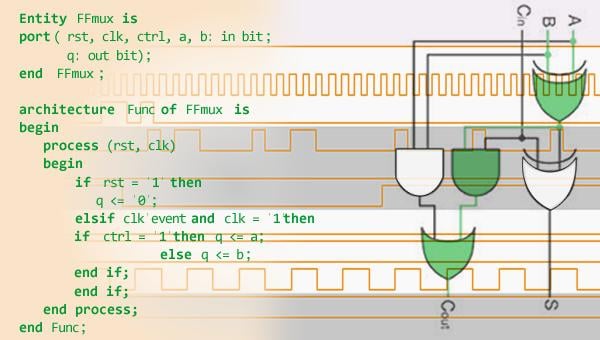
This comprehensive learning module delves into Boolean algebra and its applications in digital circuit design, covering fundamental concepts like Boolean variables, logic gates, and their relationship with digital logic circuits. Participants explore Boolean expressions, simplification techniques, and consensus theorems, including the advanced Quine McCluskey method.
Class Deals by MOOC List - Click here and see Coursera's Active Discounts, Deals, and Promo Codes.
The module also addresses combinational circuits, detailing the design and functionality of adders, subtractors, parity circuits, and multipliers. Encoding complexities are navigated with insights into encoders, decoders, multiplexers, and demultiplexers. Binary shifting operations, emphasizing logical and arithmetic shifting with multiplexers for efficient design, are covered.
Moving forward, the module provides an in-depth exploration of sequential circuits, including latch and flip-flop circuits like SR latch, JK flip-flop, and more. Hazards in digital circuits, along with registers, bidirectional shift registers, and various counters, are thoroughly explained. The exploration concludes with Mealy and Moore state sequential circuits.
Additionally, participants gain a comprehensive understanding of memory systems, programmable logic devices, and VLSI physical design considerations. The module covers SRAM and DRAM, tri-state digital buffers, Read-Only Memory (ROM), and Programmable Logic Devices (PLD) such as PROM, PLA, and PAL. Architecture and implementation of Complex Programmable Logic Devices (CPLD) and Field-Programmable Gate Arrays (FPGA) are discussed, along with the VLSI design cycle and design styles for CPLD, SPLD, and FPGA.
By the end of this course, you will be able to:
- Understand the distinctions between analog and digital signals and the transformative benefits of digitization.
- Comprehend various number systems, Boolean algebra, and its application to logic gates.
- Master Boolean expression manipulation, canonical forms, and simplification techniques.
- Proficiently handle SOP and POS expressions, recognizing relationships between minterms and maxterms.
- Recognize the universality of NAND and NOR gates, implementing functions using De Morgan's Law.
- Master Karnaugh map techniques, including advanced methods and handling don't care conditions.
- Gain a comprehensive understanding of combinational circuits, covering principles and applications.
- Understand binary addition principles and design various adder circuits, including 4-bit ripple carry adders.
- Explore advanced adder designs for arithmetic operations.
- Proficiently design binary subtractors, analyze overflow/underflow scenarios, and understand signed number representation.
- Understand parity generation, detection, and various methods of binary multiplication.
- Master the design and application of various multipliers, incorporating the Booth algorithm.
- Understand applications of comparators, encoders, and decoders in digital systems.
- Proficiently use multiplexers and demultiplexers in digital circuit design, recognizing their role as function generators.
- Understand binary shifting operations, designing logical shifters, and principles of arithmetic and barrel shifting.
- Grasp foundational principles of sequential circuits, focusing on storage elements and designing an SR latch.
- Understand the operation of JK flip-flops, addressing race around conditions, and design master-slave JK flip-flops and Gated SR latches.
- Gain proficiency in designing and analyzing various types of counters in sequential circuits.
- Understand principles and design techniques for Mealy and Moore state sequential circuits.
- Grasp fundamental principles of memory, differentiating internal structures between SRAM and DRAM, and gain practical skills in addressing memory, controlling tri-state digital buffers, and understanding ROM, PLD, and various PLDs.
This course is part of the Chip based VLSI design for Industrial Applications Specialization.
Syllabus
Digital Fundamentals
This comprehensive learning module provides a detailed exploration of Boolean algebra and its practical applications in digital circuit design. Participants will delve into fundamental concepts such as Boolean variables, logic gates, and the relationship between Boolean algebra and digital logic circuits. The module progresses to cover Boolean expressions, simplification techniques, and the derivation of consensus theorems. Practical aspects, including the implementation of Boolean functions using universal gates and the use of Karnaugh maps for simplification, are thoroughly examined. The module also introduces the Quine McCluskey method as an advanced tool for Boolean expression simplification.
Combinational Logic Design
This comprehensive module delves into the intricate world of combinational circuits and arithmetic operations in digital systems. Participants will explore the design and functionality of various circuits, including adders, subtractors, parity circuits, and multipliers. The module navigates through the complexities of encoding and decoding, introducing different types of encoders, decoders, multiplexers, and demultiplexers. Additionally, the module covers binary shifting operations, including logical and arithmetic shifting, utilizing multiplexers for efficient design.
Sequential Logic Design
This comprehensive module provides an in-depth exploration of sequential circuits, covering the fundamental concepts, storage elements, and various types of flip-flops. Participants will gain insights into the design and operation of latch and flip-flop circuits, including SR latch, JK flip-flop, master-slave JK flip-flop, Gated SR latch, D latch, and D flip-flop. The module delves into hazards in digital circuits and explains the characteristics and applications of sequential circuits. Furthermore, the structure, operation, and types of registers are examined, alongside bidirectional shift registers. The module concludes with an extensive coverage of counters, including ring counters, Johnson counters, asynchronous up/down counters, synchronous up/down counters, and mod-n synchronous counters. The concepts of Mealy and Moore state sequential circuits are introduced, including the design of state diagrams, equivalent state tables, and reduction techniques.
Programmable Logic Devices
This module provides a comprehensive understanding of memory systems and programmable logic devices, along with insights into physical design considerations in VLSI. Participants will explore various types of memories, including SRAM and DRAM, examining their internal structures and addressing mechanisms. The module covers tri-state digital buffers, Read-Only Memory (ROM), Programmable Logic Devices (PLD) such as PROM, PLA, and PAL. Additionally, the architecture and implementation of Complex Programmable Logic Devices (CPLD) and Field-Programmable Gate Arrays (FPGA) are discussed. The module delves into the VLSI design cycle, hierarchical design, routing, compaction, extraction, and verification. Various VLSI design styles are explored, and the design processes for CPLD, SPLD, and FPGA are elucidated.