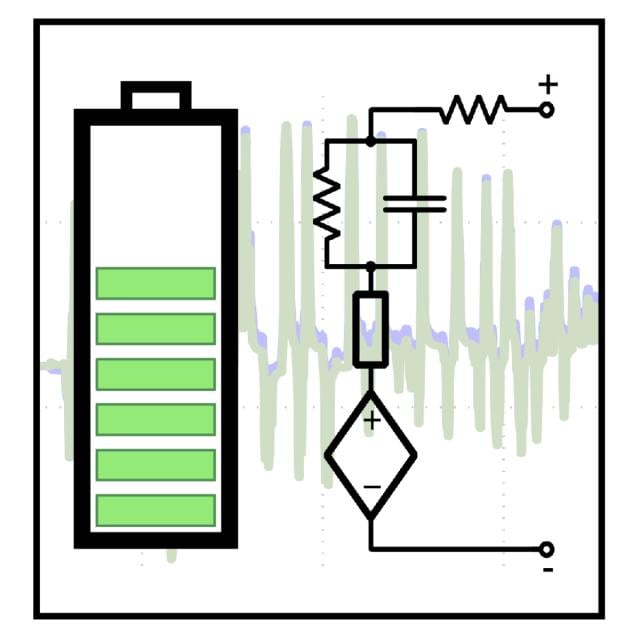
Equivalent Circuit Cell Model Simulation (Coursera)

Equivalent Circuit Cell Model Simulation (Coursera)

In this course, you will learn the purpose of each component in an equivalent-circuit model of a lithium-ion battery cell, how to determine their parameter values from lab-test data, and how to use them to simulate cell behaviors under different load profiles.

Class Deals by MOOC List - Click here and see Coursera's Active Discounts, Deals, and Promo Codes.

By the end of the course, you will be able to:

  • State the purpose for each component in an equivalent-circuit model
  • Compute approximate parameter values for a circuit model using data from a simple lab test
  • Determine coulombic efficiency of a cell from lab-test data
  • Use provided Octave/MATLAB script to compute open-circuit-voltage relationship for a cell from lab-test data
  • Use provided Octave/MATLAB script to compute optimized values for dynamic parameters in model
  • Simulate an electric vehicle to yield estimates of range and to specify drivetrain components
  • Simulate battery packs to understand and predict behaviors when there is cell-to-cell variation in parameter values

What You Will Learn
How to design equivalent-circuit models for lithium-ion battery cells

Course 2 of 5 in the Algorithms for Battery Management Systems Specialization.

Syllabus

Week 1
Defining an equivalent-circuit model of a Li-ion cell
In this module, you will learn how to derive the equations of an equivalent-circuit model of a lithium-ion battery cell.

Week 2
Identifying parameters of static model
In this module, you will learn how to determine the parameter values of the static part of an equivalent-circuit model.

Week 3
Identifying parameters of dynamic model
In this module, you will learn how to determine the parameter values of the dynamic part of an equivalent-circuit model.

Week 4
Simulating battery packs in different configurations
In this module, you will learn how to generalize the capability of simulating the voltage response of a single battery cell to a profile of input current versus time to being able to simulate constant-voltage and constant-power control of a battery cell, as well as different configurations of cells built into battery packs.

Week 5
Co-simulating battery and electric-vehicle load
In this honors module, you will learn how to co-simulate a battery pack and an electric-vehicle load. This ability aids in sizing vehicle components and the battery-pack.

Week 6
Capstone project
In this final module for the course, you will modify three sample Octave programs to create functions that can simulate temperature-dependent cells, battery packs built from PCMs, and battery packs built from SCMs.
Go to Class
MOOC List is learner-supported. When you buy through links on our site, we may earn an affiliate commission.

Related Courses

Physics 102 - AC Circuits and Maxwell's Equations (Coursera) Coursera
Rice University

Physics 102 - AC Circuits and Maxwell's Equations (Coursera)

This course serves as an introduction to the physics of electricity and magnetism. Upon completion, learners will have an understanding of how the forces between electric charges are described by fields, and how these fields are related to electrical circuits. They will gain experience in solving physics problems with tools such as graphical analysis, algebra, vector analysis, and calculus. The course follows the typical progression of topics of a first-semester university physics course: charges, electric forces, electric fields potential, magnetic fields, currents, magnetic moments, electromagnetic induction, and circuits.

Sep 14th 2026
3 Weeks
Distribución de la energía eléctrica (edX) EdX
Tecnológico de Monterrey,TecdeMonterreyX

Distribución de la energía eléctrica (edX)

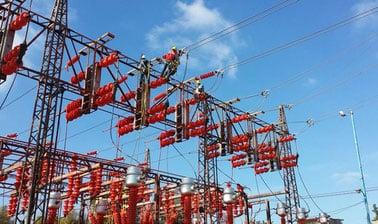
Aprende las formas en que la energía eléctrica se distribuye al usuario final por medio de la infraestructura eléctrica existente. Conoces los procesos que se requieren para llevar la energía eléctrica desde el lugar donde se genera (plantas eléctricas) hasta el lugar donde la necesitas?, ¿sabes cómo funciona una red de distribución? En este curso en línea obtendrás las respuestas, ya que conocerás las formas en las que la energía eléctrica se distribuye al usuario final por medio de la infraestructura existente.

Self Paced
Self-Paced
Haptics: Introduction to Haptics (Stanford Online) Lagunita Stanford Online
Stanford University

Haptics: Introduction to Haptics (Stanford Online)

Participants in this class will learn how to build, program, and control haptic devices, which are mechatronic devices that allow users to feel virtual or remote environments. In the process, participants will gain an appreciation for the capabilities and limitations of human touch, develop an intuitive connection between equations that describe physical interactions and how they feel, and gain practical interdisciplinary engineering skills related to robotics, mechanical engineering, electrical engineering, bioengineering, and computer science.

Self Paced
Self-Paced
Signals and Systems, Part 1 (edX) EdX
IIT Bombay,IITBombayX

Signals and Systems, Part 1 (edX)

This course provides the basic toolkit for any signal processing application - the abstraction of signals and systems, from the point of view of analysis and characterization. We encounter signals and systems extensively in our day-to-day lives, from making a phone call, listening to a song, editing photos, manipulating audio files, using speech recognition softwares like Siri and Google now, to taking EEGs, ECGs and X-Ray images.

No sessions available
5-12 Weeks
Digital Systems: From Logic Gates to Processors (Coursera) Coursera
Universitat Autònoma de Barcelona

Digital Systems: From Logic Gates to Processors (Coursera)

This course gives you a complete insight into the modern design of digital systems fundamentals from an eminently practical point of view. Unlike other more "classic" digital circuits courses, our interest focuses more on the system than on the electronics that support it. This approach will allow us to lay the foundation for the design of complex digital systems.

Sep 28th 2026
5-12 Weeks
Microwave engineering and antennas (Coursera) Coursera
Eindhoven University of Technology

Microwave engineering and antennas (Coursera)

This unique Master-level course provides you with in-depth know-how of microwave engineering and antennas. The course combines both passive and active microwave circuits as well as antenna systems. Future applications, like millimeter-wave 5G/beyond-5G wireless communications or automotive radar, require experts that can co-design highly integrated antenna systems that include both antennas and microwave electronics. We will provide you with the required theoretical foundation as well as hands-on experience using state-of-the-art design tools. The web lectures are supported by many on-line quizzes in which you can practice the background theory.

Sep 28th 2026
5-12 Weeks
Real-Time Mission-Critical Systems Design (Coursera) Coursera
University of Colorado Boulder

Real-Time Mission-Critical Systems Design (Coursera)

Upon completion of this course the learner will know the difference between systems you can bet your life on (mission critical) and those which provide predictable response and quality of service (reliable). This will be achieved not only by study of design methods and patterns for mission critical systems, but also through implementation of soft real-time systems and comparison to hard real-time. Methods of verification to determine ability to meet mission critical as well as soft real-time requirements will be learned so that the learner can properly assess risk, reliability and impact of failure in real-time systems.

Sep 21st 2026
4 Weeks