Linux System Programming and Introduction to Buildroot (Coursera)

Linux System Programming and Introduction to Buildroot (Coursera)

This course provides an overview of System Programming for the Linux operating system, or software which is interfacing directly with the Linux Kernel and C library. The basic components of a Linux Embedded System, including kernel and root filesystem details are discussed. The Buildroot build system is introduced, which students use to build their own custom Embedded Linux system through programming assignments.

Class Deals by MOOC List - Click here and see Coursera's Active Discounts, Deals, and Promo Codes.

What You Will Learn

  • Fundamentals of Linux System Programming, including Processes and Threads.
  • How to build a custom Linux kernel and root filesystem for an Embedded device.
  • How to use Buildroot to build a custom Linux Kernel and root filesystem for an Embedded device.

Syllabus

WEEK 1
Intro to Linux System Programming and Toolchains
In this module, you will learn about Linux shell scripting and System Programming concepts. You will also understand the basics of an Embedded Linux toolchain and setup a cross-compiler.

WEEK 2
File IO, Process Management, Basics of Embeddd Linux
In this module, you will learn the basics of File IO for Linux. You will understand the basics of Process Management, process forking, and Linux daemons. You will build your own Linux kernel and root filesystem, boot and run on QEMU.

WEEK 3
Threads and Multithreading, Introduction to Buildroot
In this module, you will learn the basics of Threading and Multi Thread Synchronization in Linux system programming using POSIX. You will also learn about the Buildroot build system and build a QEMU Image using Buildroot.

WEEK 4
Time and Sockets
In this module, you will learn the fundamentals of signal handling and time management in Linux System Programming. You will learn the basic components of Embedded Linux debugging. You will implement a socket server application and deploy on a QEMU based Embedded System using Buildroot.
Go to Class
MOOC List is learner-supported. When you buy through links on our site, we may earn an affiliate commission.

Related Courses

Programming Mobile Applications for Android Handheld Systems: Part 2 (Coursera) Coursera
University of Maryland, College Park

Programming Mobile Applications for Android Handheld Systems: Part 2 (Coursera)

This course introduces you to the design and implementation of Android applications for mobile devices. You will build upon concepts from the prior course, including handling notifications, using multimedia and graphics and incorporating touch and gestures into your apps.

Sep 28th 2026
5-12 Weeks
Introducción a Java (Coursera) Coursera
Universidad Nacional Autónoma de México

Introducción a Java (Coursera)

Me llamo Elisa Viso y una de mis pasiones es la de programar y enseñar a programar. El lenguaje Java es uno de los que más me ha gustado en mis 45 años que llevo programando. Si bien te podrá parecer un poco complicado empezar a programar en Java, una vez que cubras los conceptos básicos verás qué rápido se avanza. Java, como todos los lenguajes de programación bien hechos, te dejan hacer cualquier cosa (algunas de ellas con más trabajo que en otros lenguajes y otras casi directamente de cómo piensas la solución al problema).

Oct 5th 2026
5-12 Weeks
Programming Mobile Applications for Android Handheld Systems: Part 1 (Coursera) Coursera
University of Maryland, College Park

Programming Mobile Applications for Android Handheld Systems: Part 1 (Coursera)

This course introduces you to the design and implementation of Android applications for mobile devices. You will develop an app from scratch, assuming a basic knowledge of Java, and learn how to set up Android Studio, work with various Activities and create simple user interfaces to make your apps run smoothly.

Sep 28th 2026
5-12 Weeks
Programming for Everybody (Getting Started with Python) (Coursera) Coursera
University of Michigan

Programming for Everybody (Getting Started with Python) (Coursera)

This course aims to teach everyone the basics of programming computers using Python. We cover the basics of how one constructs a program from a series of simple instructions in Python. The course has no pre-requisites and avoids all but the simplest mathematics. Anyone with moderate computer experience should be able to master the materials in this course.

Sep 28th 2026
5-12 Weeks
Silicon Thin Film Solar Cells (Coursera) Coursera
École Polytechnique

Silicon Thin Film Solar Cells (Coursera)

This course consists of a general presentation of solar cells based on silicon thin films. It is the third MOOC of the photovoltaic series of Ecole polytechnique on Coursera. The general aspects of the photovoltaic field are treated in "Photovoltaic Solar Energy". And the detailed description of the crystalline silicon solar cells can be found in "Physics of Silicon Solar Cells".

Oct 5th 2026
3 Weeks
Computer Science: Algorithms, Theory, and Machines (Coursera) Coursera
Princeton University

Computer Science: Algorithms, Theory, and Machines (Coursera)

This course introduces the broader discipline of computer science to people having basic familiarity with Java programming. It covers the second half of our book Computer Science: An Interdisciplinary Approach (the first half is covered in our Coursera course Computer Science: Programming with a Purpose, to be released in the fall of 2018). Our intent is to demystify computation and to build awareness about the substantial intellectual underpinnings and rich history of the field of computer science.

Oct 5th 2026
5-12 Weeks
Python Data Visualization (Coursera) Coursera
Rice University

Python Data Visualization (Coursera)

This if the final course in the specialization which builds upon the knowledge learned in Python Programming Essentials, Python Data Representations, and Python Data Analysis. We will learn how to install external packages for use within Python, acquire data from sources on the Web, and then we will clean, process, analyze, and visualize that data. This course will combine the skills learned throughout the specialization to enable you to write interesting, practical, and useful programs.

Oct 2nd 2026
4 Weeks
Code Yourself! An Introduction to Programming (Coursera) Coursera
University of Edinburgh,Universidad ORT Uruguay

Code Yourself! An Introduction to Programming (Coursera)

Have you ever wished you knew how to program, but had no idea where to start from? This course will teach you how to program in Scratch, an easy to use visual programming language. More importantly, it will introduce you to the fundamental principles of computing and it will help you think like a software engineer.

Sep 28th 2026
5-12 Weeks
Programming Reactive Systems (Scala 2 version) (Coursera) Coursera
École Polytechnique Fédérale de Lausanne

Programming Reactive Systems (Scala 2 version) (Coursera)

Reactive programming is a set of techniques for implementing scalable, resilient and responsive systems as per the Reactive Manifesto. Such systems are based on asynchronous message-passing, and their basic building-blocks are event handlers. This course teaches how to implement reactive systems in Scala and Akka by using high-level abstractions, such as actors, asynchronous computations, and reactive streams.

Oct 5th 2026
5-12 Weeks
Programming Languages, Part A (Coursera) Coursera
University of Washington

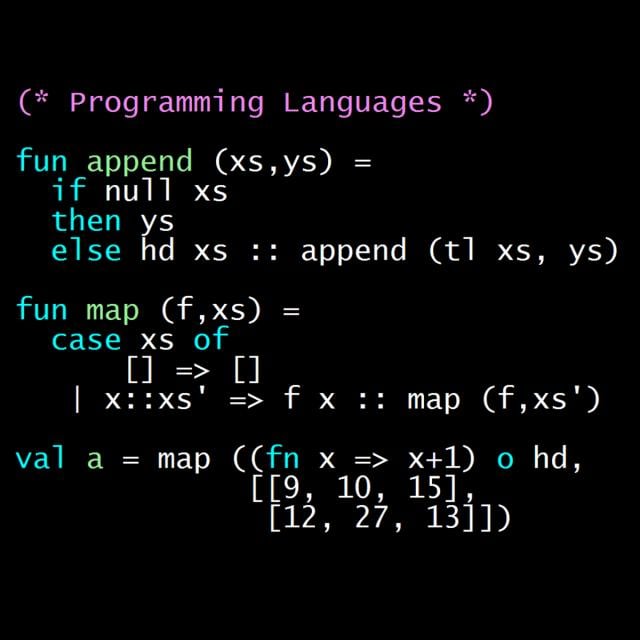
Programming Languages, Part A (Coursera)

This course is an introduction to the basic concepts of programming languages, with a strong emphasis on functional programming. The course uses the languages ML, Racket, and Ruby as vehicles for teaching the concepts, but the real intent is to teach enough about how any language “fits together” to make you more effective programming in any language -- and in learning new ones.

Oct 5th 2026
5-12 Weeks