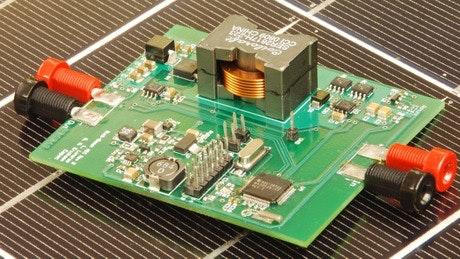
Converter Circuits (Coursera)

Converter Circuits (Coursera)

This course introduces more advanced concepts of switched-mode converter circuits. Realization of the power semiconductors in inverters or in converters having bidirectional power flow is explained. Power diodes, power MOSFETs, and IGBTs are explained, along with the origins of their switching times. Equivalent circuit models are refined to include the effects of switching loss. The discontinuous conduction mode is described and analyzed. A number of well-known converter circuit topologies are explored, including those with transformer isolation.

Class Deals by MOOC List - Click here and see Coursera's Active Discounts, Deals, and Promo Codes.

The homework assignments include a boost converter and an H-bridge inverter used in a grid-interfaced solar inverter system, as well as transformer-isolated forward and flyback converters.
After completing this course, you will:

  • Understand how to implement the power semiconductor devices in a switching converter
  • Understand the origins of the discontinuous conduction mode and be able to solve converters operating in DCM
  • Understand the basic dc-dc converter and dc-ac inverter circuits
  • Understand how to implement transformer isolation in a dc-dc converter, including the popular forward and flyback converter topologies.

Completion of the first course Introduction to Power Electronics is the assumed prerequisite for this course.
What You Will Learn

  • Understand how to implement the power semiconductor devices in a switching converter
  • Understand the origins of the discontinuous conduction mode and be able to solve converters operating in DCM
  • Understand the basic dc-dc converter and dc-ac inverter circuits
  • Understand how to implement transformer isolation in a dc-dc converter, including the popular forward and flyback converter topologies

Course 2 of 4 in the Power Electronics Specialization.

Syllabus

WEEK 1
Ch 4.1: Switch Realization
How to implement the switches using transistors and diodes, including applications having bidirectional power flow or ac outputs.

WEEK 2
Ch 4.2: Power Semiconductor Switches
Basics of power semiconductor switches, including the origins of switching times and switching loss. How to incorporate switching loss into equivalent circuit models. MOSFETs, IGBTs, and gate driver considerations.

WEEK 3
Ch 5: Discontinuous Conduction Mode
The discontinuous conduction mode (DCM) arising from unidirectional switch realization. Analysis of mode boundaries and output voltage.

WEEK 4
Ch 6: Converter Circuits
Some well-known converter circuits and their origins. How to incorporate transformer isolation into a dc-dc converter. Analysis and equivalent circuit modeling of transformer-isolated converters.

Go to Class
MOOC List is learner-supported. When you buy through links on our site, we may earn an affiliate commission.

Related Courses

Image and video processing: From Mars to Hollywood with a stop at the hospital (Coursera) Coursera
Duke University

Image and video processing: From Mars to Hollywood with a stop at the hospital (Coursera)

In this course, you will learn the science behind how digital images and video are made, altered, stored, and used. We will look at the vast world of digital imaging, from how computers and digital cameras form images to how digital special effects are used in Hollywood movies to how the Mars Rover was able to send photographs across millions of miles of space.

Aug 10th 2026
5-12 Weeks
Circuits and Electronics 3: Applications (edX) EdX
MIT,MITx

Circuits and Electronics 3: Applications (edX)

Learn about cool applications, op-amps and filters in the design of microchips used in smartphones, computers, and the internet. Want to learn how your radio works? Wondering how to implement filters using resistors, inductors, and capacitors? Wondering what are some other applications of RLC and CMOS circuits? This free circuit course, taught by edX CEO and MIT Professor Anant Agarwal and MIT colleagues, is for you.

Self Paced
Self-Paced
Magnetics for Power Electronic Converters (Coursera) Coursera
CIRES, University of Colorado at Boulder

Magnetics for Power Electronic Converters (Coursera)

This course covers the analysis and design of magnetic components, including inductors and transformers, used in power electronic converters. The course starts with an introduction to physical principles behind inductors and transformers, including the concepts of inductance, core material saturation, airgap and energy storage in inductors, reluctance and magnetic circuit modeling, transformer equivalent circuits, magnetizing and leakage inductance.

Jul 20th 2026
4 Weeks
Applications in Engineering Mechanics (Coursera) Coursera
Georgia Institute of Technology

Applications in Engineering Mechanics (Coursera)

This course applies principles learned in my course “Introduction to Engineering Mechanics” to analyze real world engineering structures. You will need to have mastered the engineering fundamentals from that class in order to be successful in this course offering. This course addresses the modeling and analysis of static equilibrium problems with an emphasis on real world engineering systems and problem solving.

Aug 10th 2026
5-12 Weeks
Electrónica Digital Bit a Bit: Diseñando circuitos complejos (Coursera) Coursera
Pontificia Universidad Católica de Chile

Electrónica Digital Bit a Bit: Diseñando circuitos complejos (Coursera)

Los circuitos digitales más complejos como memorias y procesadores, que contienen millones de transistores gracias a su reducido tamaño, pueden ser divididos en circuitos más simples ya conocidos para facilitar su diseño e implementación. Lo mismo podemos realizar utilizando Verilog para diseñar circuitos digitales complejos que realizan muchas funciones o cuentan con un gran número de entradas y salidas.

Jun 22nd 2026
5-12 Weeks
The Mechatronics Revolution: Fundamentals and Core Concepts (edX) EdX
Georgia Institute of Technology,GTx

The Mechatronics Revolution: Fundamentals and Core Concepts (edX)

In this course, students will learn to harness the power of microcontrollers, sensors, and actuators to build useful and interesting robotic devices. The Mechatronics Revolution is upon us. Never before has it been easier to build robotic devices and computer-controlled machines. The confluence of low-cost embedded computers, sensors, and actuators has made experimentation and prototyping easier than ever.

Self Paced
Self-Paced
Principles of Modeling, Simulations, and Control for Electric Energy Systems (edX) EdX
MIT,MITx

Principles of Modeling, Simulations, and Control for Electric Energy Systems (edX)

Apply a dynamic systems-level approach and engage emerging research on efficient, sustainable, and physically and economically feasible electric power systems of the future. As global energy demand grows, to mitigate climate change we must drive a swift transition to clean energy resources and enhanced electric power grid infrastructure. In this course, you will explore systemic principles of future electric power system management, such as the role of smart grids, data-enabled machine learning, power electronics-control, and data-driven decision-making.

No session available
5-12 Weeks
Remote Sensing Image Acquisition, Analysis and Applications (Coursera) Coursera
UNSW Sydney - University of New South Wales

Remote Sensing Image Acquisition, Analysis and Applications (Coursera)

Welcome to Remote Sensing Image Acquisition, Analysis and Applications, in which we explore the nature of imaging the earth's surface from space or from airborne vehicles. This course covers the fundamental nature of remote sensing and the platforms and sensor types used. It also provides an in-depth treatment of the computational algorithms employed in image understanding, ranging from the earliest historically important techniques to more recent approaches based on deep learning.

Aug 17th 2026
13-24 Weeks