C Programming: Using Linux Tools and Libraries - 7 (Coursera)

C Programming: Using Linux Tools and Libraries - 7 (Coursera)

Learn how to use professional tools and libraries to write and build C programs within the Linux operating system. This seventh and final course in the C Programming with Linux Specialization will allow you to develop and use your C code within the Linux operating system. Using libraries in C is a fundamental concept when it comes to sharing code with others. In addition to compiling and linking, you will also learn how to pass arguments to an executable program.

Class Deals by MOOC List - Click here and see Coursera's Active Discounts, Deals, and Promo Codes.

As you embark on your future career as a programmer, you will be able to continue your coding adventures with professional coding environments used by C programmers around the world.
Why learn C and not another programming language? Did you know that smartphones, your car’s navigation system, robots, drones, trains, and almost all electronic devices have some C-code running under the hood? C is used in any circumstance where speed and flexibility are important, such as in embedded systems or high-performance computing.
At the end of this course, you will reach the last milestone in the C Programming with Linux Specialization, unlocking the door to a career in computer engineering.
Your job Outlook:

  • Programmers, developers, engineers, managers, and related industries within scientific computing and data science;
  • Embedded systems such as transportation, utility networks, and aerospace;
  • Robotics industry and manufacturing;
  • IoT (Internet of Things) used in smart homes, automation, and wearables.
  • IEEE, the world’s largest technical professional organization for the advancement of technology, ranks C as third of the top programming languages of 2021 in demand by employers. (Source: IEEE Spectrum)

Course 7 of 7 in the C Programming with Linux Specialization.

What You Will Learn

  • Use external libraries
  • Build an application from multiple source files
  • Automate the building process using makefiles
  • Pass and use arguments to the main function. Read from and write to files in C

Syllabus

WEEK 1
Welcome
Week 1: Libraries in C
By the end of Week 1, you will be able to effectively declare and define functions, as well as use external libraries (e.g. math, compression, image).

WEEK 2
Week 2: Modularization Libraries and Makefiles
By the end of Week 2, you will be able to use preprocessor directives, build an application from multiple source files, and automate the building process using Makefiles.

WEEK 3
Week 3: File operations in C
By the end of Week 3, you will be able to pass and use arguments to the main function, read and use a file, write to a file, and install a profession C compiler.
Concluding the course

Go to Class
MOOC List is learner-supported. When you buy through links on our site, we may earn an affiliate commission.

Related Courses

Principles of Computing (Part 2) (Coursera) Coursera
Rice University

Principles of Computing (Part 2) (Coursera)

This two-part course introduces the basic mathematical and programming principles that underlie much of Computer Science. Understanding these principles is crucial to the process of creating efficient and well-structured solutions for computational problems. To get hands-on experience working with these concepts, we will use the Python programming language. The main focus of the class will be weekly mini-projects that build upon the mathematical and programming principles that are taught in the class.

Aug 10th 2026
4 Weeks
The Unix Workbench (Coursera) Coursera
Johns Hopkins University

The Unix Workbench (Coursera)

Unix forms a foundation that is often very helpful for accomplishing other goals you might have for you and your computer, whether that goal is running a business, writing a book, curing disease, or creating the next great app. The means to these goals are sometimes carried out by writing software. Software can’t be mined out of the ground, nor can software seeds be planted in spring to harvest by autumn. Software isn’t produced in factories on an assembly line. Software is a hand-made, often bespoke good. If a software developer is an artisan, then Unix is their workbench.

Aug 3rd 2026
4 Weeks
Functional Program Design in Scala (Scala 2 version) (Coursera) Coursera
École Polytechnique Fédérale de Lausanne

Functional Program Design in Scala (Scala 2 version) (Coursera)

In this course you will learn how to apply the functional programming style in the design of larger Scala applications. You'll get to know important new functional programming concepts, from lazy evaluation to structuring your libraries using monads. We'll work on larger and more involved examples, from state space exploration to random testing to discrete circuit simulators. You’ll also learn some best practices on how to write good Scala code in the real world. Finally, you will learn how to leverage the ability of the compiler to infer values from types.

Aug 10th 2026
5-12 Weeks
操作系统原理 (Operating Systems) (Coursera) Coursera
Peking University

操作系统原理 (Operating Systems) (Coursera)

操作系统原理》是针对计算机科学技术专业三年级本科生开设的一门专业基础课程。本课程着重学生系统观的培养,通过重点讲述操作系统的内部结构、工作原理及典型技术的实现,使学生建立起对操作系统的整体及各个功能模块的认识,从而系统掌握计算机的专业知识,进一步提升学生的软件开发能力乃至系统软件开发能力。

Aug 3rd 2026
13-24 Weeks
An Introduction to Interactive Programming in Python (Part 1) (Coursera) Coursera
Rice University

An Introduction to Interactive Programming in Python (Part 1) (Coursera)

This two-part course is designed to help students with very little or no computing background learn the basics of building simple interactive applications. Our language of choice, Python, is an easy-to learn, high-level computer language that is used in many of the computational courses offered on Coursera. To make learning Python easy, we have developed a new browser-based programming environment that makes developing interactive applications in Python simple.

Aug 10th 2026
5-12 Weeks
Introduction à la programmation orientée objet (en Java) (Coursera) Coursera
École Polytechnique Fédérale de Lausanne

Introduction à la programmation orientée objet (en Java) (Coursera)

Ce cours introduit la programmation orientée objet (encapsulation, abstration, héritage, polymorphisme) en l'illustrant en langage Java. Il présuppose connues les bases de la programmation (variables, types, boucles, fonctions, ...). Il est conçu comme la suite du cours « Initiation à la programmation (en Java) ».

Aug 16th 2026
5-12 Weeks
Programming with Scratch (Coursera) Coursera
The Hong Kong University of Science and Technology - HKUST

Programming with Scratch (Coursera)

Learning coding is not only about understanding the programming language being used, but also developing important computational thinking skills, which are useful for problem solving across many disciplinary areas. In this course, students will learn basic programming skills by creating interactive storybooks, animations, and games with Scratch, which is a block-based visual programming language for anyone new to coding.

Aug 3rd 2026
5-12 Weeks
Programming Languages, Part A (Coursera) Coursera
University of Washington

Programming Languages, Part A (Coursera)

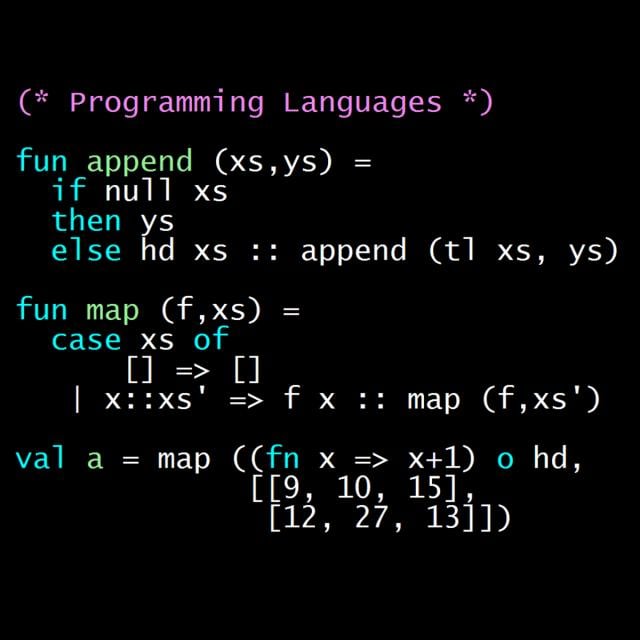
This course is an introduction to the basic concepts of programming languages, with a strong emphasis on functional programming. The course uses the languages ML, Racket, and Ruby as vehicles for teaching the concepts, but the real intent is to teach enough about how any language “fits together” to make you more effective programming in any language -- and in learning new ones.

Aug 10th 2026
5-12 Weeks
Introdução ao Desenvolvimento de Aplicativos Android (Coursera) Coursera
Universidade Estadual de Campinas - UNICAMP

Introdução ao Desenvolvimento de Aplicativos Android (Coursera)

Este curso tem como objetivo propiciar um primeiro contato com a Programação para Dispositivos Móveis que operam na plataforma Android. O Android Studio será utilizado como ambiente de desenvolvimento desde o início do curso e você receberá dicas de como obter ajuda quando alguma tarefa estiver consumindo mais tempo do que o necessário. Ao solucionar problemas por conta própria, você irá adquirir a autonomia necessária para concluir projetos de programação.

Aug 10th 2026
5-12 Weeks
Introduction and Programming with IoT Boards (Coursera) Coursera
Pohang University of Science and Technology - POSTECH

Introduction and Programming with IoT Boards (Coursera)

Internet of Things (IoT) is an emerging area of information and communications technology (ICT) involving many disciplines of computer science and engineering including sensors/actuators, communications networking, server platforms, data analytics and smart applications. IoT is considered to be an essential part of the 4th Industrial Revolution along with AI and Big Data. This course will be very useful to senior undergraduate and graduate students as well as engineers who are working in the industry.

Aug 3rd 2026
5-12 Weeks