EdX

Big Data for Agri-Food: Principles and Tools (edX)

Big Data for Agri-Food: Principles and Tools (edX)

As the big data era unfolds, developments in sensor and information technologies are evolving quickly. As a result, science and businesses are yielding enormous amounts of data. Yet, to reap the actionable business solutions data can unveil, we must learn to ask the right questions. Join Wageningen Wageningen University & Research as the data team bridges the gap between the complexity of computer science and its practical application. Decipher your unsampled big data set.

Class Deals by MOOC List - Click here and see EdX's Active Discounts, Deals, and Promo Codes.

Demystify complex big data technologies
The sheer volume of a typical data set doesn’t fit on even the largest computer. And the tools that can handle big data seem too complex to grasp. To tackle these challenges, principles – such as immutability and pure functions – will help you understand big data technology. This makes big data management accessible, regardless of the programming language.
Specifically, should you scale up or scale out, how do you process big data stacks with map-reduce, using clusters, etc. In short, learn to recognise and put into practice the scalable solution that’s right for your situation. To illustrate, we will use current tools – such as Hadoop HDFS and Apache Spark – on user-friendly, hands-on examples from the agri-food sector. However, these principles can also be applied to other sectors.

Complexity of data collection and processing
Agri-food deserves special focus when it comes to choosing robust commercial data management technologies due to its inherent variability and uncertainty. Ranked the #1 university in Animal Sciences and Agriculture, Wageningen University & Research specialises in the interdisciplinarity between its knowledge domain of healthy food and living environment on the one hand and data science, artificial intelligence (AI) and robotics on the other.
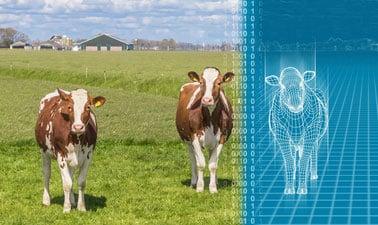
Combining data from the latest sensing technologies (e.g. weather data) with machine learning/deep learning methodologies, allows us to unlock insights we didn’t have access to before. In the areas of smart farming and precision agriculture this allows us to:

  • Better manage dairy cattle by combining animal-level data on behaviour, health and feed with milk production and composition from milking machines.
  • Reduce the amount of fertilisers (nitrogen), pesticides (chemicals) and water used on crops by monitoring individual plants with a robot or drone.
  • More accurately predict crop yields on a continental scale by combining current with historic data on soil, weather patterns and crop yields.

In short, big data will allow us to bring forth effective solutions for smarter, innovative products. The possibilities are seemingly endless!

For whom?
You are a manager or researcher with a big data set on your hands, perhaps considering investing in big data tools. You’ve done some programming before, but your skills are a bit rusty. You want to learn how to effectively and efficiently manage very large datasets. This course will enable you to see and evaluate opportunities for the application of big data technologies within your domain. Enrol now.
This course has been partially supported by the European Union Horizon 2020 Research and Innovation program (Grant #810 775, “Dragon”).

What you'll learn

  • Recognize big data characteristics (volume, velocity, variety, veracity)
  • The difference between scaling up and scaling out
  • Big data principles: immutability and pure functions
  • Processing big data with map-reduce, using clusters
  • Understand technologies: distributed file systems, Hadoop
  • How dataframes and wrapper technology (Apache Spark) make life easier
  • The big data workflow and pipeline
  • How data is organized in datalakes, using lazy evaluation
  • Develop insight how to apply this to your own case

Syllabus

Module 1: Big data definition and characteristics
In module 1, you will learn how to recognize the characteristics of a big data problem in agriculture, to see where its biggest challenge lies. Should the solution focus on size, speed, various formats or uncertainty of data? Should you scale up or scale out?

Module 2: Big data principles: what are they and why do we need them
In module 2, you'll learn the principles that are required for scaling out: immutability and pure functions, and map-reduce. What are these and why do we need them?

Module 3: Bring those principles to practice
Module 3 shows you how to bring those principles into practice. You will learn what a cluster is, and how a distributed file system in a client-server architecture works, with Hadoop. You will understand why such a system is indeed scalable.

Module 4: Big data technologies that make implementation so much easier
Module 4 goes further into the application of big data technology, the “big data stack of technologies". The main message here is that if you know what you want to do, these technologies can take the work out of your hands. For example, you will see Apache Spark, a big data technology platform, that applies map-reduce for you.

Module 5: The big data workflow and pipeline; the how and why of datalakes
Module 5 dives deeper into the data. You'll learn about datalakes and why a datalake is different from a traditional database. You'll understand what a big data workflow looks like and what a pipeline is.

Go to Class
MOOC List is learner-supported. When you buy through links on our site, we may earn an affiliate commission.

Related Courses

Big Data and Education (edX) EdX
University of Pennsylvania,PennX

Big Data and Education (edX)

Learn the methods and strategies for using large-scale educational data to improve education and make discoveries about learning. Online and software-based learning tools have been used increasingly in education. This movement has resulted in an explosion of data, which can now be used to improve educational effectiveness and support basic research on learning.

Self Paced
Self-Paced
Enabling Technologies for Data Science and Analytics: The Internet of Things (edX) EdX
Columbia University,ColumbiaX

Enabling Technologies for Data Science and Analytics: The Internet of Things (edX)

Discover the relationship between Big Data and the Internet of Things (IoT). The Internet of Things is rapidly growing. It is predicted that more than 25 billion devices will be connected by 2020. In this data science course, you will learn about the major components of the Internet of Things and how data is acquired from sensors. You will also examine ways of analyzing event data, sentiment analysis, facial recognition software and how data generated from devices can be used to make decisions.

Self Paced
Self-Paced
Big Data Technology Capstone Project (edX) EdX
The Hong Kong University of Science and Technology - HKUST,HKUSTx

Big Data Technology Capstone Project (edX)

The Big Data Technology Capstone Project will allow you to apply the techniques and theory you have gained from the four courses in this MicroMasters program to a medium-scale project. In this capstone course, you will get an opportunity to apply the knowledge and skills that you have gained throughout this MicroMasters program.

Self Paced
Self-Paced
AI skills: Introduction to Unsupervised, Deep and Reinforcement Learning (edX) EdX
Delft University of Technology,DelftX

AI skills: Introduction to Unsupervised, Deep and Reinforcement Learning (edX)

Learn the fundamentals and principal AI concepts about clustering, dimensionality reduction, reinforcement learning and deep learning to solve real-life problems. In this course you will learn the basics of several machine learning topics to help you solve real life challenges. Unsupervised learning techniques such as clustering and dimensionality reduction are useful to make sense of large and/or high dimensional datasets that are not annotated. Deep learning is a supervised learning technique that is useful to train neural networks to solve more complicated classification and regression tasks. Finally, reinforcement learning techniques can be used to train AI agents that interact with an environment.

Self Paced
Self-Paced
Programming for Data Science (edX) EdX
University of Adelaide,AdelaideX

Programming for Data Science (edX)

Learn how to apply fundamental programming concepts, computational thinking and data analysis techniques to solve real-world data science problems. There is a rising demand for people with the skills to work with Big Data sets and this course can start you on your journey through our Big Data MicroMasters program towards a recognised credential in this highly competitive area. Using practical activities you will learn how digital technologies work and will develop your coding skills through engaging and collaborative assignments.

Self Paced
Self-Paced
Excel avanzado: importación y análisis de datos (edX) EdX
Universitat Politècnica de València,UPValenciaX

Excel avanzado: importación y análisis de datos (edX)

Conoce técnicas y estrategias avanzadas para importar, consolidar y visualizar con Excel datos provenientes de cualquier fuente. En este curso de análisis e interpretación de datos te presentaremos técnicas avanzadas de importación de datos y estrategias diversas para consolidarlos y prepararlos una vez importados de forma que puedas extraer las conclusiones que necesitas (basadas en nuestra experiencia en el uso de Microsoft Excel y demostradas con casos reales).

Self Paced
Self-Paced
Big Data Fundamentals (edX) EdX
University of Adelaide,AdelaideX

Big Data Fundamentals (edX)

Learn how big data is driving organisational change and essential analytical tools and techniques, including data mining and PageRank algorithms. Organizations now have access to massive amounts of data and it’s influencing the way they operate. They are realizing in order to be successful they must leverage their data to make effective business decisions.

Self Paced
Self-Paced
Minería de Datos: Análisis de la Canasta de Compra (edX) EdX
Universidad Anáhuac,AnahuacX

Minería de Datos: Análisis de la Canasta de Compra (edX)

¿Conoces realmente qué productos de la canasta de mercado compran tus clientes o te dejas llevar por lo que aparenta a simple vista? En este curso aprenderás a construir modelos basados en técnicas de data mining o minería de datos, que te permitirán conocer información relevante de tus clientes y descubrir patrones de comportamiento para definir estrategias de marketing de acuerdo a la compra de productos.

Self Paced
Self-Paced
Wiretaps to Big Data: Privacy and Surveillance in the Age of Interconnection (edX) EdX
Cornell University

Wiretaps to Big Data: Privacy and Surveillance in the Age of Interconnection (edX)

Explore the privacy issues of an interconnected world. How does cellular technology enable massive surveillance? Do users have rights against surveillance? How does surveillance affect how we use cellular and other technologies? How does it affect our democratic institutions? Do you know that the metadata collected by a cellular network speaks volumes about its users? In this course you will explore all of these questions while investigating related issues in WiFi and Internet surveillance.

No sessions available
5-12 Weeks
Machine Learning with Python: from Linear Models to Deep Learning (edX) EdX
MIT,MITx

Machine Learning with Python: from Linear Models to Deep Learning (edX)

An in-depth introduction to the field of machine learning, from linear models to deep learning and reinforcement learning, through hands-on Python projects. Machine learning methods are commonly used across engineering and sciences, from computer systems to physics. Moreover, commercial sites such as search engines, recommender systems (e.g., Netflix, Amazon), advertisers, and financial institutions employ machine learning algorithms for content recommendation, predicting customer behavior, compliance, or risk.

May 27th 2024
13-24 Weeks
Data Analytics Basics for Everyone (edX) EdX
IBM

Data Analytics Basics for Everyone (edX)

Learn the fundamentals of Data Analytics and gain an understanding of the data ecosystem, the process and lifecycle of data analytics, career opportunities, and the different learning paths you can take to be a Data Analyst. In this course, you will learn about the various components of a modern data ecosystem and the role Data Analysts, Data Scientists, and Data Engineers play in this ecosystem.

Self Paced
Self-Paced