EdX

Beyond Engineering: Building with Nature (edX)

Beyond Engineering: Building with Nature (edX)

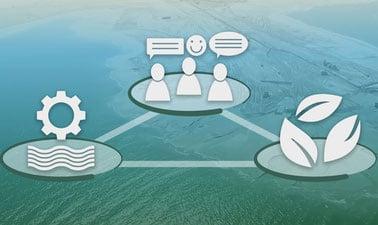
Learn how to use Social Design Principles in developing more effective and sustainable hydraulic infrastructure, with an emphasis on delta, coastal and port environments. If you’re a coastal engineer, ecologist or planner, then this is the course for you. You already know that engineering and ecological principles are not enough to realize nature-friendly solutions in practice. You need people on your side!

Class Deals by MOOC List - Click here and see EdX's Active Discounts, Deals, and Promo Codes.

In this course you will learn how to build a relevant coalition of stakeholders to support the design and implementation of ecosystem-based hydraulic infrastructures. After learning basic stakeholder mapping and game theory techniques, you will apply Social Design Principles to a Building with Nature ecosystem-based design case. This will equip you to identify promising collaborative arrangements for your engineering or planning practice.
The course builds on the previous Building with Nature MOOC, which explored the use of natural materials and ecological processes in achieving effective and sustainable hydraulic infrastructure designs, distilling Engineering and Ecological Design Principles. In this course, the missing element of Social Design Principles are developed and taught.
You’ll learn from renowned Dutch engineers and international environmental scientists, who work at the technical- governance interface. Iconic examples such as the Maasvlakte II expansion to Rotterdam Harbor and the Delfland Sand Engine Mega-nourishment serve as study material. The challenges in designing and implementing these nature-friendly hydraulic infrastructures are explored by the eminent professors who were responsible for their genesis.
Join us in becoming one of the new generation of engineers, ecologists and planners who see the Building with Nature integrated design approach as critical to hydraulic engineering, nature and society.

What you'll learn

  • Identify relevant stakeholders for the design and implementation of nature-friendly hydraulic infrastructure.
  • Analyze the power and interests of these stakeholders, including their interdependence in terms of resources.
  • Apply basic game-theory principles in combination with the stakeholder analysis to determine potential coalitions in a Building with Nature project case.
  • Evaluate the suitability of the coalitions for designing and implementing a particular Building with Nature project case.

Syllabus

  1. Necessary Background Knowledge
  2. Why Beyond Engineering?
  3. Stakeholder Identification and Mapping
  4. Game Theory
  5. Social Design Principles
  6. Towards Coalition Building
Go to Class
MOOC List is learner-supported. When you buy through links on our site, we may earn an affiliate commission.

Related Courses

Project Management of Engineering Projects: Preparing for Success (edX) EdX
Delft University of Technology,DelftX

Project Management of Engineering Projects: Preparing for Success (edX)

Create your own project plan and learn the importance of the early project phases in achieving project success. People are key! Are you a (project) engineer with a technical background but lack management knowledge? Are you eager to improve project performance and want to expand your knowledge? This business and management course will focus on the necessary project management skills to successfully manage projects.

Sep 24th 2026
5-12 Weeks
Sustainability in Architecture: An Interdisciplinary Introduction (edX) EdX
Universitat Politècnica de València,UPValenciaX

Sustainability in Architecture: An Interdisciplinary Introduction (edX)

This course introduces the basic elements and trends that define sustainability practices in Architecture today. It follows an interdisciplinary approach that includes performance assessment and urban policies. This course offers an interdisciplinary approach to sustainability in Architecture. Learners will be introduced to the basic elements of sustainability assessments (first model layer), as well as trends informing the space today.

Self Paced
Self-Paced
Fundamentos de Mecánica para Ingeniería (edX) EdX
Universitat Politècnica de València,UPValenciaX

Fundamentos de Mecánica para Ingeniería (edX)

Estudiaremos la cinemática y la dinámica del punto, los conceptos de trabajo y potencia y la energía mecánica. Se aborda el estudio del universo físico analizando objetos en movimiento. Se definen y analizan todas las magnitudes y leyes físicas que permiten describir geométrica y causalmente el movimiento de cuerpos representados por un punto.

Self Paced
Self-Paced
Introduction to Discrete Choice Models (edX) EdX
École Polytechnique Fédérale de Lausanne,EPFLx

Introduction to Discrete Choice Models (edX)

The course introduces the theoretical foundations to choice modeling and describes the steps of operational modeling. Human behavior is complexand unpredictable. Or is it? The focus of this course is methods for predicting the behavior using mathematical models. More specifically, we'll explore choice modeling in order to obtain disaggregate demand models.

Self Paced
Self-Paced
A System View of Communications: From Signals to Packets (Part 2) (edX) EdX
The Hong Kong University of Science and Technology - HKUST,HKUSTx

A System View of Communications: From Signals to Packets (Part 2) (edX)

Explore the tradeoffs in designing communication systems like mobile phones, and the engineering tools to handle them. Have you ever wondered how information is transmitted using your mobile phone or a WiFi hotspot? This introductory course seeks to enable you to understand the basic engineering tools used and tradeoffs encountered in the design of these communication systems.

Self Paced
Self-Paced
The Basics of Transport Phenomena (edX) EdX
Delft University of Technology,DelftX

The Basics of Transport Phenomena (edX)

Learn the basic framework to work on a broad spectrum of engineering problems concerning transfer of heat, mass and momentum. Learn through examples of everyday processes at home, in the lab and in industry. Have you ever wondered why ventilation helps to cool down your hot chocolate? Do you know why a surfing suit keeps you warm? Why iron feels cold, while wood feels warm at room temperature? Or how air is transferred into aqueous liquids in a water treatment plant? How can we sterilize milk with the least amount of energy? How does medicine spread in our tissue? Or how do we design a new cooling tower of a power plant? All these are phenomena that involve heat transfer, mass transfer or fluid flow.

Self Paced
Self-Paced
A Hands-on Introduction to Engineering Simulations (edX) EdX
CornellX,Cornell University

A Hands-on Introduction to Engineering Simulations (edX)

Learn how to analyze real-world engineering problems using ANSYS simulation software and gain important professional skills sought by employers. In this hands-on course, you’ll learn how to perform engineering simulations using a powerful tool from ANSYS, Inc. This is a problem-based course where you’ll learn by doing. The focus will be on understanding what’s under the blackbox so as to move beyond garbage-in, garbage-out. You’ll practice using a common solution approach to problems involving different physics: structural mechanics, fluid dynamics and heat transfer.

Self Paced
Self-Paced
Dynamics and Control (edX) EdX
Universitat Politècnica de València,UPValenciaX

Dynamics and Control (edX)

This is an interactive course about the basic concepts of Systems, Control and their impact in all the human activities. First, the basic concepts of systems, dynamics, structure and control are introduced. Then, looking at many examples in Nature and human made devices, we will realize that the dynamic behavior of most systems can be modified by adding a control system. Later we will see how knowing how to evaluate the dynamic behavior of a system and measure its performance will provide the tools to design new controlled systems fulfilling some requirements.

Self Paced
Self-Paced
Solar Energy: Photovoltaic (PV) Technologies (edX) EdX
Delft University of Technology,DelftX

Solar Energy: Photovoltaic (PV) Technologies (edX)

Explore the main PV technologies in the current market. Get in-depth knowledge on the design and processing methods of solar cells. The technologies used to produce solar cells and photovoltaic modules are advancing to deliver highly efficient and flexible solar panels. In this course you will explore the main PV technologies in the current market.

Self Paced
5-12 Weeks
Sustainable Development: The Post-Capitalist Order (edX) EdX
SDGAcademyX,SDG Academy

Sustainable Development: The Post-Capitalist Order (edX)

Sustainable development represents a shift from our current system of inequitable capitalism to one that prioritizes prosperity for all, while remaining conscious of its environmental impact and sustainability for future generations. Learn why sustainable development has been adopted by countries and multilateral organizations around the world, and how this approach is transforming the way we live, work, and govern our planet.

Self Paced
Self-Paced
Climate Change Science and Negotiations (edX) EdX
SDGAcademyX,SDG Academy

Climate Change Science and Negotiations (edX)

Humanity is up against a tight timeline to address climate change. Learn how we can deeply decarbonize the global energy systems, and put the world on a 2°C pathway. In this course, learn solutions to mitigate the effects of the global greenhouse gas emissions causing temperature rise, and how to apply these solutions in different national contexts improvements.

Self Paced
Self-Paced