EdX

Behavioural Economics in Action (edX)

Behavioural Economics in Action (edX)

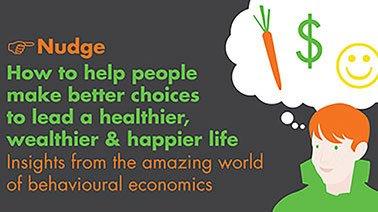
Learn to use principles and methods of behavioural economics to change behaviours, improve welfare and make better products and policy. How can we get people to save more money, eat healthy foods, engage in healthy behaviors, and make better choices in general? There has been a lot written about the fact that human beings do not process information and make decisions in an optimal fashion.

Class Deals by MOOC List - Click here and see EdX's Active Discounts, Deals, and Promo Codes.

This course builds on much of the fascinating work in the area of behavioral economics and allows learners to develop a hands-on approach by understanding its methods and more importantly, how it can be harnessed by suitably designing contexts to “nudge” choice.

In three modules, learners will be able to a). explain and interpret the principles underlying decision-making and compare the nudging approach to other methods of behavior change, b). learn how to critique, design and interpret the results of experiments; and c). design nudges and decision-tools to help people make better decisions.
Understanding experimental design and interpretation is central to your ability to truly use behavioral economics and will set you apart from people who merely know about the behavioral research. After the first two weeks learning the basic principles, we will devote two weeks to studying experimental design and analysis, and the final two weeks to understanding processes for designing nudges and for helping people make better decisions.
You will also witness and participate in weekly topical debates on various topics like “does irrationality impact welfare?” or “what strategy is better for improving welfare – nudging or education?” If you’ve been fascinated with the buzz surrounding behavioral economics but are not sure how to actually use it, this course is for you.
Several leading scholars, policy makers, business people, authors and commentators will briefly join our debate and discussion sections. These guest lecturers include Professor Sendhil Mullainathan (Harvard University), Professor John Lynch (University of Colorado), Rory Sutherland (Ogilvy Group), Owain Service (Behavioural Insights Team, UK Cabinet Office), Shankar Vedantam (NPR Columnist and Author – The Hidden Brain), Professors Andrew Ching, Avi Goldfarb, Nina Mazar, and Claire Tsai, Min Zhao (University of Toronto) and many others!

What you'll learn:

  • Develop an understanding of the philosophy and the principles underlying the field of behavioral economics
  • Understand the differences between choice architecture / nudging and other approaches to behaviour change.
  • Understand the key elements of an experiment, differentiate between three basic types of experimental designs, and gain insight into ANOVA and regression techniques for analyzing data.
  • Use a prescribed process for designing your own nudges, and identify specific resources and tools you will need to execute a nudging strategy.
  • Apply some of the learnings and ideas to policy and business.
Go to Class
MOOC List is learner-supported. When you buy through links on our site, we may earn an affiliate commission.

Related Courses

Computing for Data Analysis (edX) EdX
Georgia Institute of Technology,GTx

Computing for Data Analysis (edX)

A hands-on introduction to basic programming principles and practice relevant to modern data analysis, data mining, and machine learning. The modern data analysis pipeline involves collection, preprocessing, storage, analysis, and interactive visualization of data. In the course, you’ll see how computing and mathematics come together.

Aug 19th 2024
13-24 Weeks
Designing and Running Randomized Evaluations (edX) EdX
MIT,MITx

Designing and Running Randomized Evaluations (edX)

Learn how to both design randomized evaluations and implement them in the field to measure the impact of social programs. A randomized evaluation, also known as a randomized controlled trial (RCT), field experiment or field trial, is a type of impact evaluation that uses random assignment to allocate resources, run programs, or apply policies as part of the study design.

Sep 7th 2021
5-12 Weeks
Foundations of Data Analysis - Part 1: Statistics Using R (edX) EdX
University of Texas at Austin,UTAustinX

Foundations of Data Analysis - Part 1: Statistics Using R (edX)

This is a hands on course with a data lab to teach fundamental statistical topics such as descriptive statistics, inferential testing, and modeling. In this first part of a two part course, we’ll walk through the basics of statistical thinking – starting with an interesting question. Then, we’ll learn the correct statistical tool to help answer our question of interest – using R and hands-on Labs.

No sessions available
5-12 Weeks
Quantitative Biology Workshop (edX) EdX
MIT,MITx

Quantitative Biology Workshop (edX)

A workshop-style introduction to tools used in biological research. Discover how to analyze data using computational methods. Do you have an interest in biology and quantitative tools? Do you know computational methods but do not realize how they apply to biological problems? Do you know biology but do not understand how scientists really analyze complicated data? 7.QBWx: Quantitative Biology Workshop is designed to give learners exposure to the application of quantitative tools to analyze biological data at an introductory level.

Self Paced
Self-Paced
Decision Making in Engineering Design (edX) EdX
Purdue University,PurdueX

Decision Making in Engineering Design (edX)

In this course, you will learn the foundations of decision-making in the design of engineering products, processes, and systems. Decision making is an essential activity in all organizations and teams involved in engineering design and product development. Successful design requires the ability to make good decisions in the presence of risk and uncertainty, and an understanding of how customers and other stakeholders make decisions.

Jan 10th 2022
13-24 Weeks
Machine Learning with Python: from Linear Models to Deep Learning (edX) EdX
MIT,MITx

Machine Learning with Python: from Linear Models to Deep Learning (edX)

An in-depth introduction to the field of machine learning, from linear models to deep learning and reinforcement learning, through hands-on Python projects. Machine learning methods are commonly used across engineering and sciences, from computer systems to physics. Moreover, commercial sites such as search engines, recommender systems (e.g., Netflix, Amazon), advertisers, and financial institutions employ machine learning algorithms for content recommendation, predicting customer behavior, compliance, or risk.

May 27th 2024
13-24 Weeks
Understanding the World Through Data (edX) EdX
MIT,MITx

Understanding the World Through Data (edX)

Become a data explorer – learn how to leverage data and basic machine learning algorithms to understand the world. Speech recognition, drones, and self-driving cars – things that once seemed like pure science fiction – are now widely available technologies, and just a few examples of how humans have taught machines to analyze data and make decisions. In this hands-on, introductory course, you will examine all the forms in which data exists, learn tools that uncover relationships between data, and leverage basic algorithms to understand the world from a new perspective.

Mar 13th 2024
5-12 Weeks
China’s First Empires and the Rise of Buddhism (edX) EdX
HarvardX,Harvard University

China’s First Empires and the Rise of Buddhism (edX)

Learn about the Qin and Han dynasties, and how Buddhism and ideas of self-realization influenced the medieval period. This course, the second in a collection on Chinese history and culture, addresses how the Qin dynasty conquered China and established a new system of government and how the Han dynasty built a stable, centralized empire that lasted for hundreds of years. We cover the early history of Buddhism in China and how the rising feudal aristocracy responded to the loss of empire by looking inward.

Self Paced
Self-Paced
Macroeconomic Forecasting (edX) EdX
International Monetary Fund - IMF,IMFx

Macroeconomic Forecasting (edX)

Learn how to create and assess forecasting models to predict macroeconomic variables such as inflation and economic growth. In this macroeconomics course, you will learn to predict macroeconomic variables such as inflation, growth or consumption, and to create statistical models in economics and use them to predict responses to economic policy.

Self Paced
Self-Paced