Arquitecturas de Big Data (Coursera)

Arquitecturas de Big Data (Coursera)

El curso de Arquitecturas de Big Data busca que identifiques las características de una solución de Big Data, los datos asociados a estas soluciones, la infraestructura requerida, y las técnicas de procesamiento escalable. Desarrollaremos ejemplos usando infraestructuras basadas en Hadoop y en Spark, teniendo presente la pertinencia de las plataformas basadas en nube pública para soportar la escalabilidad de estas soluciones.

Class Deals by MOOC List - Click here and see Coursera's Active Discounts, Deals, and Promo Codes.

El curso está dirigido a personas con conocimientos básicos en manejo de herramientas computacionales y programación en al menos uno de estos lenguajes (Python, Java).
Dado que en este curso se hará uso de un programa descargable, aseguraté de tener un computador con la siguiente configuración mínima:
Mínimo 8 GB de memoria RAM.
Mínimo 200 GB de espacio libre en disco.
Alguno de los siguientes sistemas operativos: Windows, Linux, Macintosh, o Solaris.
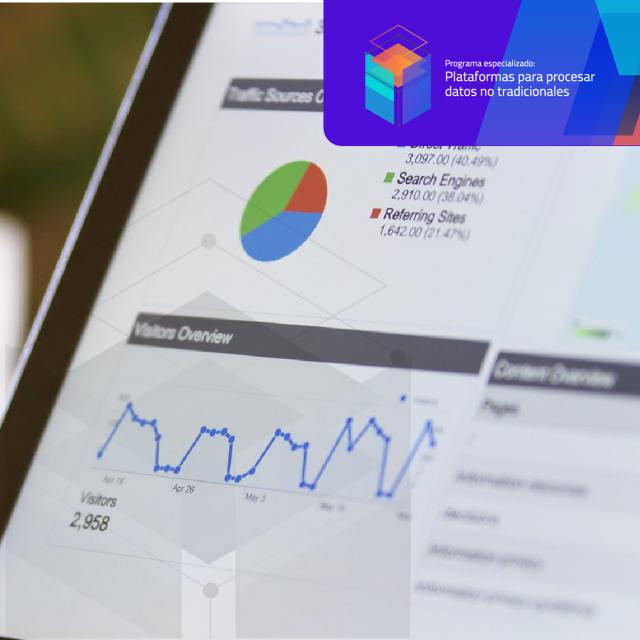
Course 1 of 3 in the Plataformas para procesar datos no tradicionales Specialization.
What You Will Learn

  • Determinar la pertinencia de usar tecnologías de Big Data a un problema dado
  • Desarrollar proyectos sencillos de procesamiento escalable en Spark.   
  • Conocer el rol de la computación en la nube como alternativa para procesar y almacenar Big Data, así como sus ventajas y riesgos
  • Identificar las características de una solución de Big Data, la infraestructura requerida, y las técnicas de procesamiento escalable. 

Syllabus

WEEK 1
Introducción
Te damos la bienvenida al curso "Arquitecturas de Big Data". Te invitamos a realizar las lecturas sobre acceso al curso y recursos.
¿Qué es Big Data?
Bienvenido al primer módulo del curso. En este módulo responderemos a la pregunta ¿Qué es el Big Data? Para ellos nos centraremos en conocer como llegamos hoy al Big Data, cuáles son las 3V principales e identificaremos las diferencias que tiene Big Data con las arquitecturas tradicionales.

WEEK 2
¿Cómo almacenamos Big Data?
Bienvenido al segundo módulo del curso. Dentro de este módulo nos centraremos en responder a la pregunta ¿Cómo almacenamos Big Data? Para ello identificaremos los requerimientos y desafíos de almacenamiento de Big Data, conoceremos acerca de la arquitectura conceptual y veremos algunos ejemplos, y conoceremos sobre sistemas de archivos distribuidos y sistemas manejadores de bases de datos NoSQL.

WEEK 3
¿Cómo procesamos Big Data?
Bienvenido al tercer módulo del curso. Durante el desarrollo de este módulo nos enfocaremos en responder a la pregunta ¿Cómo procesamos Big Data? Para ello trabajaremos en tres temas principales: Procesamiento escalable y Map-Rediuce, Spark y Arquitecturas para procesamientos de datos de flujos.

WEEK 4
¿Cuál es el rol de la nube en entornos Big Data?
Te damos la bienvenida al cuarto y último módulo de nuestro curso. Durante este módulo responderemos a la pregunta ¿Cuál es el rol de la nube en entornos Big Data? Para ello, una vez comprendamos los aspectos conceptuales, revisaremos las posibilidades de procesamiento y almacenamiento que hacen de la nube un entorno ideal para Big Data. También revisaremos las ventajas y riesgos de utilizar servicios públicos en la nube.
Go to Class
MOOC List is learner-supported. When you buy through links on our site, we may earn an affiliate commission.

Related Courses

Big Data Analysis Deep Dive (Coursera) Coursera
Alibaba Cloud Academy

Big Data Analysis Deep Dive (Coursera)

The job market for architects, engineers, and analytics professionals with Big Data expertise continues to increase. The Academy’s Big Data Career path focuses on the fundamental tools and techniques needed to pursue a career in Big Data. This course includes: data processing with python, writing and reading SQL queries, transmitting data with MaxCompute, analyzing data with Quick BI, using Hive, Hadoop, and spark on E-MapReduce, and how to visualize data with data dashboards. Work through our course material, learn different aspects of the Big Data field, and get certified as a Big Data Professional!

Sep 28th 2026
5-12 Weeks
Introduction to PySpark (Coursera) Coursera
Edureka

Introduction to PySpark (Coursera)

Welcome to Introduction to PySpark, a short course strategically crafted to empower you with the skills needed to assess the concepts of Big Data Management and efficiently perform data analysis using PySpark. Throughout this short course, you will acquire the expertise to perform data processing with PySpark, enabling you to efficiently handle large-scale datasets, conduct advanced analytics, and derive valuable insights from diverse data sources.

Oct 12th 2026
1 Week
Infonomics I: Business Information Economics and Data Monetization (Coursera) Coursera
University of Illinois at Urbana-Champaign

Infonomics I: Business Information Economics and Data Monetization (Coursera)

Thriving in the Information Age compels organizations to deploy information as an actual business asset, not as an IT asset or merely as a business byproduct. This demands creativity in conceiving and implementing new ways to generate economic benefits from the wide array of information assets available to an organization. Unfortunately, information too frequently is underappreciated and therefore underutilized.

Oct 12th 2026
4 Weeks
Deploying Machine Learning Models (Coursera) Coursera
University of California, San Diego

Deploying Machine Learning Models (Coursera)

In this course we will learn about Recommender Systems (which we will study for the Capstone project), and also look at deployment issues for data products. By the end of this course, you should be able to implement a working recommender system (e.g. to predict ratings, or generate lists of related products), and you should understand the tools and techniques required to deploy such a working system on real-world, large-scale datasets.

Sep 28th 2026
4 Weeks
Big Data Analytical Platform on Alibaba Cloud (Coursera) Coursera
Alibaba Cloud Academy

Big Data Analytical Platform on Alibaba Cloud (Coursera)

Building an Analytical Platform on Alibaba Cloud can empower how you take in, analyze, and demonstrate clear metrics from a set of Big Data. This course is designed to teach engineers how to use Alibaba Cloud Big Data products. It covers basic distributed system theory and Alibaba Cloud's core products like MaxCompute, DataWorks, E-MapReduce as well as a bundle of ecosystem tools.

Sep 28th 2026
5-12 Weeks
Relational Database Support for Data Warehouses (Coursera) Coursera
University of Colorado System

Relational Database Support for Data Warehouses (Coursera)

Relational Database Support for Data Warehouses is the third course in the Data Warehousing for Business Intelligence specialization. In this course, you'll use analytical elements of SQL for answering business intelligence questions. You'll learn features of relational database management systems for managing summary data commonly used in business intelligence reporting. Because of the importance and difficulty of managing implementations of data warehouses, we'll also delve into storage architectures, scalable parallel processing, data governance, and big data impacts. In the assignments in this course, you can use either Oracle or PostgreSQL.

Sep 28th 2026
5-12 Weeks
Datos no tradicionales en repositorios NoSQL (Coursera) Coursera
Universidad de los Andes

Datos no tradicionales en repositorios NoSQL (Coursera)

El curso Datos no tradicionales en repositorios NoSQL busca que identifiques consideraciones fundamentales para la implementación de una solución basada en información usando tecnologías NoSQL, los criterios para la selección y configuración de las herramientas, teniendo presente las necesidades de la aplicación y la diversidad de aproximaciones al modelaje de información semiestructurada y no estructurada. El curso está dirigido a personas con conocimientos básicos en manejo de herramientas computacionales y programación en al menos uno de estos lenguajes (Python, Java).

Sep 28th 2026
4 Weeks
Big Data Analysis with Scala and Spark (Coursera) Coursera
École Polytechnique Fédérale de Lausanne

Big Data Analysis with Scala and Spark (Coursera)

Manipulating big data distributed over a cluster using functional concepts is rampant in industry, and is arguably one of the first widespread industrial uses of functional ideas. This is evidenced by the popularity of MapReduce and Hadoop, and most recently Apache Spark, a fast, in-memory distributed collections framework written in Scala. In this course, we'll see how the data parallel paradigm can be extended to the distributed case, using Spark throughout.

Oct 12th 2026
4 Weeks
Machine Learning With Big Data (Coursera) Coursera
University of California, San Diego

Machine Learning With Big Data (Coursera)

Want to make sense of the volumes of data you have collected? Need to incorporate data-driven decisions into your process? This course provides an overview of machine learning techniques to explore, analyze, and leverage data. You will be introduced to tools and algorithms you can use to create machine learning models that learn from data, and to scale those models up to big data problems.

Sep 28th 2026
5-12 Weeks
Foundations for Big Data Analysis with SQL (Coursera) Coursera
Cloudera

Foundations for Big Data Analysis with SQL (Coursera)

In this course, you'll get a big-picture view of using SQL for big data, starting with an overview of data, database systems, and the common querying language (SQL). Then you'll learn the characteristics of big data and SQL tools for working on big data platforms. You'll also install an exercise environment (virtual machine) to be used through the specialization courses, and you'll have an opportunity to do some initial exploration of databases and tables in that environment.

Sep 28th 2026
5-12 Weeks
Infonomics II: Business Information Management and Measurement (Coursera) Coursera
University of Illinois at Urbana-Champaign

Infonomics II: Business Information Management and Measurement (Coursera)

Even decades into the Information Age, accounting practices yet fail to recognize the financial value of information. Moreover, traditional asset management practices fail to recognize information as an asset to be managed with earnest discipline. This has led to a business culture of complacence, and the inability for most organizations to fully leverage available information assets. This second course in the two-part Infonomics series explores how and why to adapt well-honed asset management principles and practices to information, and how to apply accepted and new valuation models to gauge information’s potential and realized economic benefits.

Oct 12th 2026
4 Weeks
Spatial Data Science and Applications (Coursera) Coursera
Yonsei University

Spatial Data Science and Applications (Coursera)

Spatial (map) is considered as a core infrastructure of modern IT world, which is substantiated by business transactions of major IT companies such as Apple, Google, Microsoft, Amazon, Intel, and Uber, and even motor companies such as Audi, BMW, and Mercedes. Consequently, they are bound to hire more and more spatial data scientists. Based on such business trend, this course is designed to present a firm understanding of spatial data science to the learners, who would have a basic knowledge of data science and data analysis, and eventually to make their expertise differentiated from other nominal data scientists and data analysts.

Oct 5th 2026
5-12 Weeks