EdX

Antes de Noé: El diluvio en la Antigua Babilonia (edX)

Antes de Noé: El diluvio en la Antigua Babilonia (edX)

Los documentos más antiguos sobre un diluvio universal, que casi elimina la vida de la faz de la tierra, provienen de Babilonia. En este curso, exploraremos las viejas historias del diluvio, cuyos primeros ejemplares tienen hoy unos 3700 años.

Class Deals by MOOC List - Click here and see EdX's Active Discounts, Deals, and Promo Codes.

La existencia de una versión babilónica del diluvio se hizo pública el 3 de diciembre de 1872. En esa fecha, George Smith anunció en la Sociedad de Arqueología Bíblica de Londres que había descubierto fragmentos de esa historia entre las tablillas del Museo Británico provenientes de la biblioteca del rey asirio Aššurbanipal (ca. 668-627 a.C.), hallada en las ruinas de Nínive.
Los invitamos a sumarse a este curso online para conocer las raíces escritas más remotas sobre la historia del diluvio, el contexto histórico en el que se originó y sus varias transformaciones.

What you'll learn

  • Conocer las fuentes escritas más antiguas de las que se dispone en la actualidad para conocer la historia del diluvio
  • Vamos a explicar el contexto geográfico e histórico en el que se ubican estas historias, así como el sistema de escritura y las lenguas en las que están escritas
  • Se trabajarán cuatro textos. Estos textos son: “La épica de Atra-ḫasīs”, “La tablilla del arca”, “La historia sumeria del diluvio” (provenientes de la primera mitad del segundo milenio antes de nuestra era), y la tablilla XI de “El poema de Gilgameš” (de la primera mitad del primer milenio antes de nuestra era)
  • Para cada uno de los textos presentaremos los manuscritos más representativos, proporcionaremos información sobre la distribución geográfica y temporal de esos ejemplares
  • Se presentarán, un resumen del contenido, los detalles y motivos literarios más relevantes de esas historias
  • Veremos la manera cómo la historia del diluvio se relaciona con otros textos literarios que eran aproximadamente contemporáneos y hacen referencia o reescriben sobre esa catástrofe
  • Hablaremos también de la importancia que la historia del diluvio ha tenido dentro de la tradición literaria de la Mesopotamia antigua

Syllabus

Introducción:
Este curso tiene por objetivo presentar y contextualizar las fuentes documentales más antiguas sobre la historia del diluvio que provienen de Babilonia a partir de la primera mitad del segundo milenio antes de nuestra era. Esos manuscritos, descubiertos en la segunda mitad del siglo XIX d.C., son importantes para comprender el papel de las historias sobre el diluvio en las tradiciones culturales y políticas del Cercano Oriente antiguo, así como su presencia en otros textos y tradiciones culturales.

Módulo 1:
Se explicarán las características generales de las tablillas cuneiformes sobre las que se escribieron los manuscritos y de las lenguas en las que fueron escritas las historias más tempranas sobre el diluvio. Asimismo, se hablará sobre el primer descubrimiento de la historia del diluvio antes de la Biblia y se presentarán los cuatro textos que se discutirán en los módulos siguientes, es decir, “La épica de Atra-ḫasīs”, la llamada “Tablilla del arca”, “La historia sumeria del diluvio” y, por último, la tablilla XI de “El poema de Gilgameš”.

Módulo 2:
Se trabajará el texto conocido como “La épica de Atra-ḫasīs”, partiendo de la distribución espacio-temporal de los manuscritos y el significado del título moderno y del antiguo que se usan para denominar a esta obra. Se explicará el contenido del texto y se darán detalles de los episodios más destacados.

Módulo 3:
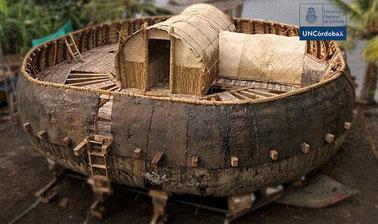
Comenzaremos con un ejemplar único, “La tablilla del arca”, un texto publicado en 2014 que proporciona las dimensiones y la forma de la embarcación con la que se salvaron del exterminio una familia y todos los animales que llevaron a bordo. Luego veremos “La historia sumeria del diluvio”, las características distintivas de este texto y sus relaciones con “La épica de Atra-ḫasīs”. Estos tres textos provienen de la primera mitad del segundo milenio antes de nuestra era.

Módulo 4:
El último texto es la tablilla XI de Gilgameš escrita en el dialecto babilónico estándar que data del primer milenio a.C. Veremos cómo se inserta la historia del diluvio en otro texto cuyas historias habían experimentado transformaciones previas. Reflexionaremos sobre las similitudes y diferencias con los textos discutidos en los dos módulos anteriores.

Módulo 5:
Finalmente, repasamos los puntos de mayor relevancia presentados previamente, reflexionamos sobre la antigüedad de estos textos, la posibilidad de tradiciones aún más remotas, y el uso del diluvio como evento que separa los tiempos míticos de los tiempos históricos en documentos como la Lista Real Sumeria.

Go to Class
MOOC List is learner-supported. When you buy through links on our site, we may earn an affiliate commission.

Related Courses

Recovering the Humankind's Past and Saving the Universal Heritage (Coursera) Coursera
Sapienza University of Rome

Recovering the Humankind's Past and Saving the Universal Heritage (Coursera)

Archaeology has as its objective the recovery and revival of humankind past, and as its aim the rescue and preservation of cultural heritage. Archaeology is, among human sciences, the discipline with the strongest importance for the rediscovery, but also for the preservation and protection of cultural heritage, as Humankind’s universal patrimony. You will be introduced to the way we ourselves reflect on and are engaged with the study of human past: from the practical and material recovery of ancient traces in the field to the study and interpretation. On the other hand, the discovery of human past implies the correct conservation and presentation for both experts and general public: the study and protection of the past we share every day prevent from any possible destruction, misuse, abuse and thus cancellation of human memory.

Jun 1st 2026
5-12 Weeks
The History of Medieval Medicine Through Jewish Manuscripts (edX) EdX
University of Pennsylvania,PennX

The History of Medieval Medicine Through Jewish Manuscripts (edX)

Learn about medieval Jewish medical training and thought by exploring and interpreting medical manuscripts. This mini-course is a general introduction to both to medieval medicine and to the value of using manuscripts. Professor Y. Tzvi Langermann presents a case study that builds from a unique 15th-century volume in which three important medical manuscripts in Hebrew and Judeo-Arabic (Arabic in Hebrew characters) are sewn together.

Self-Paced
Self-Paced
Introduction to Typography (Coursera) Coursera
California Institute of the Arts

Introduction to Typography (Coursera)

Typography is the art of manipulating the visual form of language to enrich and control its meaning. It’s an essential area of skill and knowledge for graphic designers. Typography predates modern graphic design by around 500 years; it is rich in rules, conventions, and esoteric terminology—but it remains an exciting space for invention and expression.

Jun 1st 2026
4 Weeks
Women Making History: Ten Objects, Many Stories (edX) EdX
HarvardX,Harvard University

Women Making History: Ten Objects, Many Stories (edX)

Learn how American women created, confronted, and embraced change in the 20th century while exploring ten objects from Radcliffe’s Schlesinger Library. As we approach the centennial of the passage of women’s suffrage in 1920, there has been a recent burst of activism among American women. Women are running for political office in record numbers. Women are organizing and taking to the streets to demand change. Women are grappling with inclusion and intersectionality.

Self Paced
Self-Paced
The Holocaust: The Destruction of European Jewry (Coursera) Coursera
University of California, Santa Cruz

The Holocaust: The Destruction of European Jewry (Coursera)

The Holocaust: The Destruction of European Jewry is an adaptation of an on-campus course that has been co-taught by Murray Baumgarten, Distinguished Professor of English and Comparative Literature (Literature Department), and Peter Kenez, Professor Emeritus (History Department), for over 20 years at UC Santa Cruz. In this course, you will explore the Holocaust from the overlapping perspectives of literature and history—through memoirs, historical documents, poetry, documentary footage, filmic representations, and novels.

Jun 1st 2026
5-12 Weeks
Biblical Archaeology: The archaeology of ancient Israel and Judah (edX) EdX
IsraelX

Biblical Archaeology: The archaeology of ancient Israel and Judah (edX)

Join me as I share with you my passion for archaeological discovery and learn about the exciting methods of modern archaeology. Explore how archaeology illuminates biblical Israel and Judah, and the archaeological finds relate to the bible. Join me for an introductory course on biblical archaeology of ancient Israel and Judah during the Iron Age (ca. 1200-586 BCE).

Nov 1st 2022
5-12 Weeks
The Bible's Prehistory, Purpose, and Political Future (Coursera) Coursera
Emory University

The Bible's Prehistory, Purpose, and Political Future (Coursera)

With its walls razed to ground by Babylon’s armies, Jerusalem joined a long line of ancient vanquished cities—from Ur and Nineveh and Persepolis to Babylon itself. While some recovered from the destruction, others did not. But none responded to political catastrophe by fashioning the kind of elaborate and enduring monument to their own downfall that we find in the Bible. Most conquered populations viewed their subjugation as a source of shame. They consigned it to oblivion, opting instead to extol the golden ages of the past. The biblical authors in contrast reacted to loss by composing extensive writings that acknowledge collective failure, reflect deeply upon its causes, and discover thereby a ground for collective hope.

Jun 1st 2026
5-12 Weeks
Was Alexander Great? The Life, Leadership, and Legacies of History’s Greatest Warrior (edX) EdX
Wellesley College,WellesleyX

Was Alexander Great? The Life, Leadership, and Legacies of History’s Greatest Warrior (edX)

Was Alexander Great? If so, how? If not, why not? This course explores the life, leadership, and legacies of history’s greatest warrior. Alexander the Great conquered most of the world known to the ancient Greeks, fused the eastern and western peoples of his empire, and became a god – before his 33rd birthday.

No sessions available
4 Weeks
A Global History of Architecture (edX) EdX
MIT,MITx

A Global History of Architecture (edX)

Learn about humanity’s rich architectural history on this journey around the globe – from 100,000 BCE to ca. 1,600 CE. How do we understand architecture? One way of answering this question is by looking through the lens of history, beginning with First Societies and extending to the 16th century. This course in architectural history is not intended as a linear narrative, but rather aims to provide a more global view, by focusing on different architectural "moments."

Oct 18th 2023
5-12 Weeks