EdX

Visualizing Imperialism & the Philippines, 1898-1913 (edX)

Offered by MIT, MITx,
Visualizing Imperialism & the Philippines, 1898-1913 (edX)

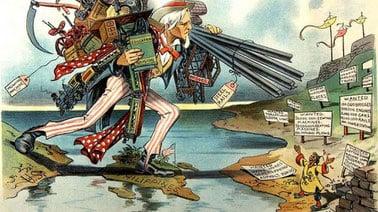
Remarkable political cartoons and photography at the turn of the 20th century reveal debates over US entry into global imperialism through the conquest and occupation of the Philippines. Historians tour this rich content drawn from MIT Visualizing Cultures.

Class Deals by MOOC List - Click here and see EdX's Active Discounts, Deals, and Promo Codes.

In this course we use visual records as a way of understanding history at the turn of the 20th century. Learners will learn how to navigate visual primary sources and use them to investigate:

  • the historical debates that emerged in political cartoons;
  • issues of race and prejudice in both cartooning and photography;
  • photography as a tool of power in conquest and colonization;
  • the often forgotten Philippine-American war;
  • ethnographic photography;
  • how the theme of civilization and barbarism appeared to justify imperial wars;
  • early use of cross-cultural photography in mass media.

The roundtable discussion format of the course will set up a discursive and exploratory style of learning. Learners will be exposed to multiple points of view as the teaching team brings together scholars who have studied the topics from different disciplines. Learners will also learn how to work with visual evidence as primary sources to assemble arguments.
For teachers, the course presents a number of units developed for the MIT Visualizing Cultures (VC) project. The instructors are the authors who created the VC resource, and the course provides a pathway into the VC website content. The VC website is widely taught in both secondary and college courses, and is the primary resource for this course. Educators can selectively pick modules that target needs in their classrooms; the course can be used in a “flipped” classroom where students are assigned modules as homework.

What you'll learn
This course invites learners into the process of exploring history through content that looks back at a complex millennial time. Learners will acquire background and skills that will help with:

  • the study of history and how it uses visual sources
  • how political and cultural debates that occurred then shed light on similar issues today
  • how to work with visual images
  • how to engage challenging, at times disturbing, historical sources
  • the study of databases and visual communication.

Course Syllabus

Module I—Introduction
This module introduces the MIT Visualizing Cultures project and approach to history through the visual record, the source for the content and methodology.
Overview of course content, methods of visual analysis, and background on Philippine and US history.
Instructional team introduce their approaches to visual history, and present critical questions of race, power, and intercultural exchange that will frame discussion throughout the course.
The evolution of digital education.

Module II—Civilization & Barbarism: Cartooning and Global Imperialism
Based on the Visualizing Cultures unit, “Civilization and Barbarism: Cartoon Commentary & the ‘White Man’s Burden’ (1898-1902)”.
This unit explores pro- and anti-imperialist imagery in the United States and international cartooning on the subject of “civilization” and colonialism at the turn of the century.
How did Americans learn about U.S. colonialism in the Philippines?
How did Filipinos and US-based critics of empire challenge and question American policies?
How can visual evidence from the past serve as the basis for new digital forms of history?

Module III—Photography and Power I: the Philippine-American War
Based on the Visualizing Cultures unit: “Photography & Power in the Colonial Philippines l: Conquest by the Camera (1898–1902)”.
This module explores the role of photography in the Philippine American War (1898-1902).
How did soldiers represent war experiences for themselves and for audiences in the United States?
How did Filipinos respond to US colonization, and what role did visual images play in their responses?

Module IV—Photography & Power II: How Photography Colonized the Philippines
Based on the Visualizing Cultures unit: “Photography & Power in the Colonial Philippines ll: Dean Worcester’s Photographic Record of the Philippines (1898–1913)”.
This module uses the photographic archive of US colonial official Dean Worcester to consider relationship of photography to anthropology and colonial governance.
How did photography serve as a basis for cultural engagement—both in positive and negative ways?
What are the “ethics of looking”? What responsibilities do we have today when confronting potentially difficult images?

Module V—Conclusion: Images of Power/the Power of Images
A roundtable discussion on the relationship between visual images and US expansion, as well as the contemporary implications of teaching and disseminating images in a digital environment.
Go to Class
MOOC List is learner-supported. When you buy through links on our site, we may earn an affiliate commission.

Related Courses

Biblical Archaeology: The archaeology of ancient Israel and Judah (edX) EdX
IsraelX

Biblical Archaeology: The archaeology of ancient Israel and Judah (edX)

Join me as I share with you my passion for archaeological discovery and learn about the exciting methods of modern archaeology. Explore how archaeology illuminates biblical Israel and Judah, and the archaeological finds relate to the bible. Join me for an introductory course on biblical archaeology of ancient Israel and Judah during the Iron Age (ca. 1200-586 BCE).

Nov 1st 2022
5-12 Weeks
Was Alexander Great? The Life, Leadership, and Legacies of History’s Greatest Warrior (edX) EdX
Wellesley College,WellesleyX

Was Alexander Great? The Life, Leadership, and Legacies of History’s Greatest Warrior (edX)

Was Alexander Great? If so, how? If not, why not? This course explores the life, leadership, and legacies of history’s greatest warrior. Alexander the Great conquered most of the world known to the ancient Greeks, fused the eastern and western peoples of his empire, and became a god – before his 33rd birthday.

No sessions available
4 Weeks
Recovering the Humankind's Past and Saving the Universal Heritage (Coursera) Coursera
Sapienza University of Rome

Recovering the Humankind's Past and Saving the Universal Heritage (Coursera)

Archaeology has as its objective the recovery and revival of humankind past, and as its aim the rescue and preservation of cultural heritage. Archaeology is, among human sciences, the discipline with the strongest importance for the rediscovery, but also for the preservation and protection of cultural heritage, as Humankind’s universal patrimony. You will be introduced to the way we ourselves reflect on and are engaged with the study of human past: from the practical and material recovery of ancient traces in the field to the study and interpretation. On the other hand, the discovery of human past implies the correct conservation and presentation for both experts and general public: the study and protection of the past we share every day prevent from any possible destruction, misuse, abuse and thus cancellation of human memory.

Jun 1st 2026
5-12 Weeks
Paradoxes of War (Coursera) Coursera
Princeton University

Paradoxes of War (Coursera)

The Paradoxes of War teaches us to understand that war is not only a normal part of human existence, but is arguably one of the most important factors in making us who we are. Through this course, I hope that you will come to appreciate that war is both a natural expression of common human emotions and interactions and a constitutive part of how we cohere as groups. That is, war is paradoxically an expression of our basest animal nature and the exemplar of our most vaunted and valued civilized virtues.

Jun 1st 2026
13-24 Weeks
La España de El Quijote (edX) EdX
Universidad Autonoma de Madrid,UAMx

La España de El Quijote (edX)

La España de El Quijote es un viaje a nuestro esplendor cultural. A un Siglo de Oro que elevó las artes y las letras hispanas a la excelencia mundial. En un lugar de la UAM, cuyo nombre merece recordar, habita la España de El Quijote. Un espacio en el que su monarquía creó el primer imperio global de la Historia. Un tiempo, entre los siglos XVI y XVII, en el que su sociedad alcanzó la excelencia en las artes y las letras.

Self Paced
Self-Paced
Invasions, Rebellions, and the Fall of Imperial China (edX) EdX
HarvardX,Harvard University

Invasions, Rebellions, and the Fall of Imperial China (edX)

An overview of modern Chinese history, including the fall of the Qing and the end of imperial China. In the 18th century, the Qing Dynasty is at its height; it is the wealthiest, most powerful, most civilized state on earth. And yet the 19th century brought enormous challenges for the Qing and for the place we call China. By the 20th century, a 2,000-year imperial tradition is gone. What happened?

Self Paced
Self-Paced
The Civil War and Reconstruction - 1850-1861: A House Divided (edX) EdX
Columbia University,ColumbiaX

The Civil War and Reconstruction - 1850-1861: A House Divided (edX)

Discover how the issue of slavery came to dominate American politics, and how political leaders struggled and failed to resolve the growing crisis in the nation. A House Divided: The Road to Civil War, 1850-1861 begins by examining how generations of historians have explained the crisis of the Union. After discussing the institution of slavery and its central role in the southern and national economies, it turns to an account of the political and social history of the 1850s.

Self Paced
Self-Paced
Creating Modern China: The Republican Period to the Present (edX) EdX
HarvardX,Harvard University

Creating Modern China: The Republican Period to the Present (edX)

Explore the birth of modern China with a focus on the time between the fall of the Qing and the end of World War II. What does it mean to be modern? What constitutes modern politics, modern institutions, a modern military, and modern infrastructure? In this period of great excitement and experimentation, the country is asking itself: How do you become modern and remain true to the Chinese national identity?

Self Paced
Self-Paced
Casing the Joint: Introducing Histories of Australian Crime (edX) EdX
The University of Newcastle, Australia,NewcastleX

Casing the Joint: Introducing Histories of Australian Crime (edX)

Learn about approaches to the study of the history of crime and punishment, especially in Australia. Crime holds a special place in Australian history, having facilitated colonisation, provided its most celebrated anti-hero in Ned Kelly and been used to sell millions of newspapers, books and movie tickets. Drawing upon a rich array of digital history resources, this course offers you a guided tour of the origins of Australian underworlds and of the study of the history of crime and punishment.

No sessions available
3 Weeks
Globalization: Past and Future (edX) EdX
SDGAcademyX,SDG Academy

Globalization: Past and Future (edX)

Is globalization a new phenomenon or a cyclical pattern throughout human history? In this four-part mini-course, Professor Jeffrey Sachs argues that we have always lived in a global world. He takes students on a historical and anthropological tour of six distinct waves of globalization and outlines the key factors that drove innovation, technology dispersal and development during these epochs.

Self Paced
Self-Paced
Seeing Through Photographs (Coursera) Coursera
The Museum of Modern Art

Seeing Through Photographs (Coursera)

Although taking, sharing, and viewing photographs has become second nature for many of us, our regular engagement with images does not necessarily make us visually literate. This course aims to address the gap between seeing and truly understanding photographs by introducing a diversity of ideas, approaches, and technologies that inform their making. In this course you will look closely at 100 photographs from the collection of The Museum of Modern Art, going behind the scenes of the Museum and into artist studios through original films and audio interviews.

Jun 1st 2026
5-12 Weeks