Whole Class with PhET for STEM Education (Coursera)

Whole Class with PhET for STEM Education (Coursera)

PhET Interactive Simulations, a project of the University of Colorado Boulder, provides fun, free, interactive, research-based science and mathematics simulations for use across, primary, secondary, and higher education levels. We extensively test and evaluate each simulation to ensure educational effectiveness. All simulations are open source and free to all students and teachers.

Class Deals by MOOC List - Click here and see Coursera's Active Discounts, Deals, and Promo Codes.

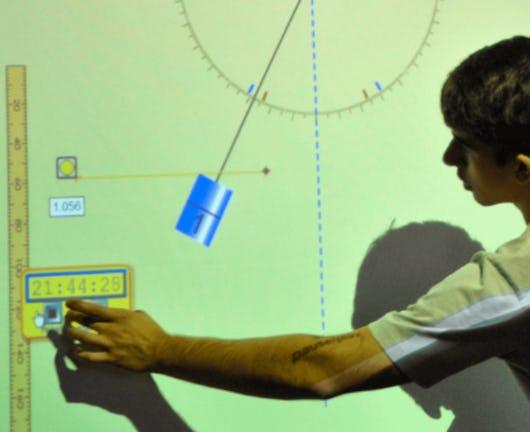
In this course, you will learn strategies for how to use PhET in circumstances where you are presenting a simulation in front of the whole class using a projector, interactive whiteboard, or while sharing your screen online.
This course is the second in the specialization “Active Learning in STEM with PhET Interactive Simulations,” which includes 4 courses in total.
To finish this course, you need to complete two of three possible assignments with Peer Review: 1) Whole Class Inquiry, 2) Interactive Lecture Demonstrations, 3) Concept Questions.
This course is also available in Spanish as “Clase Entera con PhET para la Educación STEM” and Portuguese as "Classe Entera com PhET para a Educação STEM".
This course is part of the Active Learning in STEM with PhET Interactive Simulations Specialization.

What you'll learn

  • Whole Class Inquiry: Strategies for open-ended discussion.
  • Interactive Lecture Demonstration: Strategies for making predictions.
  • Concept Questions: Strategies for classroom voting and Peer Instruction.

Syllabus

Module 1: PhET in Whole Class Strategies
In this course, we will review strategies for how to use PhET in circumstances where you are presenting a simulation in front of the whole class using a projector, television, interactive whiteboard, or while sharing your screen online.

Module 2: Whole Class Inquiry
This module will introduce you to general strategies for getting students to respond to open-ended questions as a whole class: Whole Class Inquiry. These strategies can help you as a teacher to be more creative in the types of questions you ask, and can help to reveal students’ prior knowledge especially at the introduction of a new topic.

Module 3: Interactive Lecture Demonstrations
In this module, you will learn about how to ask pointed prediction questions, and help scaffold students’ responses through the use of a structured worksheet and discussions in pairs and as a whole class: Interactive Lecture Demonstrations. This strategy is especially effective for focusing students’ thinking on specific concepts and helping them to think about their own thinking.

Module 4: Concept Questions
This module will introduce you to how to effectively write multiple choice questions to promote critical thinking: Concept Questions. These questions may include open-ended predictions, contrasting cases, ordering and ranking cases, and interpreting representations, among others. However, in all cases, these questions are written in such a way that they allow students to vote and engage in peer instruction.

Module 5: Planning to Use Whole Class Strategies
In this module, you will design two activities for a whole class setup using two of the three strategies reviewed in this course: Whole Class Inquiry, Interactive Lecture Demonstrations, and Concept Questions.

Module 6: Conclusion and Next Steps
In this final module, we will ask you to reflect on your achievements and identify room for improvement, provide feedback on this course, and share information about how to download your certificate once you have completed all requirements


Go to Class
MOOC List is learner-supported. When you buy through links on our site, we may earn an affiliate commission.

Related Courses

Enseñanza de las matemáticas de primaria (Coursera) Coursera
Universidad de los Andes

Enseñanza de las matemáticas de primaria (Coursera)

En este tercer curso de acceso gratuito* del programa especializado Educación Matemática para profesores de primaria, conocerás los conceptos y técnicas para planificar e implementar tus clases. El curso tiene una duración aproximada de seis semanas, con una dedicación promedio de 4 horas semanales. Todas las evaluaciones tienen retroalimentación y podrás descargar la mayoría de los recursos del curso.

Oct 12th 2026
5-12 Weeks
Introduction to EdTech (Coursera) Coursera
EDHEC Business School

Introduction to EdTech (Coursera)

Co-developed by Supercharger Ventures and EDHEC Business School. EdTech, short for Education Technology, is one of the most exciting sectors in the economy today poised to re-shape how education systems work and how people learn around the world. Introduction to EdTech MOOC is designed to explore EdTech fundamentals and build the foundational knowledge for educators, institutions, entrepreneurs and governments to appreciate the impact and potential of new tools, technologies, business models and learning methods in education.

Oct 12th 2026
4 Weeks
Copyright for Educators & Librarians (Coursera) Coursera
Duke University,Emory University,University of North Carolina at Chapel Hill

Copyright for Educators & Librarians (Coursera)

Fear and uncertainty about copyright law often plagues educators and sometimes prevents creative teaching. This course is a professional development opportunity designed to provide a basic introduction to US copyright law and to empower teachers and librarians at all grade levels. Course participants will discover that the law is designed to help educators and librarians.

Oct 12th 2026
5-12 Weeks
Disability Inclusion in Education: Building Systems of Support (Coursera) Coursera
University of Cape Town

Disability Inclusion in Education: Building Systems of Support (Coursera)

Worldwide millions of children are not able to fully participate in schooling, and this is especially a problem for children with disabilities. In this course, we explore the support that teachers need in order to meet the needs of children with severe to profound hearing, visual and intellectual disabilities. We consider how this can be done by talking with a range of experts (from teachers to activists) about inclusive education as well as sharing experiences of education.

Oct 12th 2026
5-12 Weeks
Assessing Achievement with the ELL in Mind (Coursera) Coursera
Arizona State University

Assessing Achievement with the ELL in Mind (Coursera)

In this course, you will learn how to design assessments around the needs of your ELL students and their language level. You will learn how to incorporate language and content requirements for both formative and summative assessment types. You will learn to assess your ELL students through the use of project and task-based assignments.

Oct 5th 2026
5-12 Weeks
Innovative Teaching with ChatGPT (Coursera) Coursera
Vanderbilt University

Innovative Teaching with ChatGPT (Coursera)

Despite what you may have heard, ChatGPT offers exciting possibilities for supporting innovative teaching and personalized education. This course provides practical techniques that any educator, from K-12 to higher education, can use to help support their teaching. No experience with ChatGPT, prompt engineering, or Generative AI is required.

Oct 12th 2026
1 Week
THINK GLOBAL: TEACHERS TRAINING COURSE (IDP-ICE) (Coursera) Coursera
University of Barcelona

THINK GLOBAL: TEACHERS TRAINING COURSE (IDP-ICE) (Coursera)

A group of seven European partners from Catalonia, Belgium, and Wales worked together on the Erasmus+ funded ‘Think Global’ project on global competence. The project seeks to address the following research question through development and piloting of practical classroom activities: What is global competence, and how can it be learned effectively?

Oct 12th 2026
5-12 Weeks
ICT in Primary Education: Transforming children's learning across the curriculum (Coursera) Coursera
University of London

ICT in Primary Education: Transforming children's learning across the curriculum (Coursera)

Why and how are teachers integrating ICT (Information and Communication Technology) into primary education? In this course we analyse examples from schools in different parts of the world, and bring professional teachers, headteachers and policymakers together to share their best ideas and inspiring stories. The materials in the course are based on studies carried out for the UNESCO Institute of IT in Education, Moscow.

Oct 5th 2026
5-12 Weeks
Inclusive Online Teaching Teach-Out (Coursera) Coursera
Johns Hopkins University

Inclusive Online Teaching Teach-Out (Coursera)

In this course, higher education faculty will examine students’ barriers to learning, including unconscious bias, physical impairments, and lack of motivation. Participants will explore and discuss how inclusive pedagogy and Universal Design for Learning (UDL) can help to address those barriers and improve student learning outcomes.

Oct 5th 2026
2 Weeks
Educating Deaf Children: Becoming an Empowered Teacher (Coursera) Coursera
University of Cape Town

Educating Deaf Children: Becoming an Empowered Teacher (Coursera)

Many Deaf children around the world still leave school functionally illiterate. In some cases there is no allowance made for education of Deaf children at all. This 4 week course provides you with invaluable knowledge and skills about teaching Deaf children. You will learn about the importance of Deaf culture and community, the need for a language rich environment for the Deaf child from as young as possible, and that having access to sign language can help Deaf children academically, emotionally, and socially.

Oct 12th 2026
4 Weeks
Critical Thinking Skills for University Success (Coursera) Coursera
The University of Sydney

Critical Thinking Skills for University Success (Coursera)

In this course, you will learn how to develop your Critical Thinking Skills to help you achieve success in your university studies. After completing this course, you will be able to: 1. Use critical thinking and argumentation in university contexts to improve academic results ; 2. Understand the importance and function of critical thinking in academic culture ; 3. Use a variety of thinking tools to improve critical thinking ; 4. Identify types of argument, and bias within arguments, in order to better evaluate the strength of arguments; 5. Use evidence to support claims in arguments ; 6. Apply critical thinking and argumentation to real world problems and issues

Oct 5th 2026
5-12 Weeks