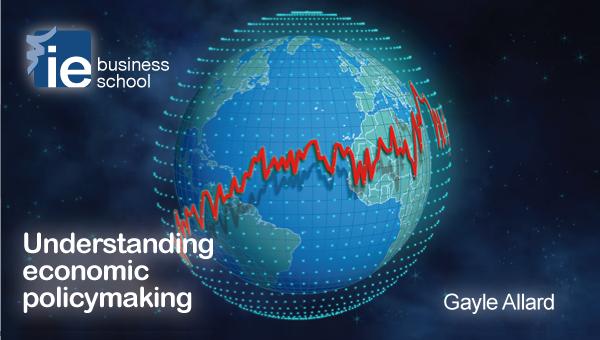
Understanding economic policymaking (Coursera)

Offered by IE Business School,
Understanding economic policymaking (Coursera)

This course will employ a non-technical approach to analyze how governments use policy to influence a country's economy. Upon completing the course you should be able to discuss national debts and deficits, examine fiscal and monetary policy and their appropriateness to the situation of an economy, and anticipate the results of fiscal and monetary policies and structural reform on a country.

Class Deals by MOOC List - Click here and see Coursera's Active Discounts, Deals, and Promo Codes.

These concepts will give you the tools to develop your own position in many current economic debates, such as fiscal stimulus vs. austerity, the merits of quantitative easing, the need for higher interest rates or the future growth path of many modern economies.
Course 1 of 3 in the Globalization, Economic Growth and Stability Specialization

Syllabus

WEEK 1
Macroeconomy Overview
We are surrounded by news and commentary on the macroeconomy. To understand it, we need to grasp the meaning of GDP, inflation and unemployment and see what their “normal” levels are and how they relate to one another. Though these levels and relationships are far from mechanical, they provide an essential foundation to understanding what governments are doing in a macroeconomy.

WEEK 2
The Fiscal Policy Tool
Welcome to Module 2! We will be going into fiscal policy, which is one of the key tools that authorities have to influence the economy and bring GDP closer to its ideal growth rate. It consists of changes in government spending and taxes. To try to gauge how much spending and taxes need to change to bring GDP to potential, we use two concepts: the multiplier, and crowding out. However, spending and tax revenues also move automatically across the business cycle, helping make the economy more stable. Thanks for being with us! Enjoy learning!

WEEK 3
Deficits, Debts, Myths and Realities
Welcome to Module 3!
Now we know how fiscal policy is supposed to work in the economy, to close recessionary or inflationary gaps. In this module we will get into the nuts and bolts of deficits and debts in the real world and I am sure we will have some interesting follow-up discussions! How is it really used? What are government deficits and debts? When governments run deficits and need to borrow money, how and where do they do it? When are these deficits and debts more of a problem? This module will look at the US and other leading economies in recent years to answer these questions, clear up some common misconceptions, and point to what the most important concerns are with deficits and debts at the present time. Good luck and see you online!

WEEK 4
Monetary Policy
Welcome to Module 4!
This week we're tackling a fascinating issue, which is monetary policy, and I anticipate some very interesting debates. Monetary policy is the other main tool that governments can use to influence the economy. Monetary authorities work through the money supply and can use open market operations, their own lending rates and reserve or cash ratios to influence money markets and hence the real economy. Just as with fiscal policy, once the gap in the economy is identified, expansive monetary policy should be used in a recessionary gap and restrictive monetary policy in an inflationary gap. Monetary policy is superior to fiscal policy in many ways, but its greatest weakness is that it does not work nearly as well in recessionary gaps as in inflationary gaps. Keep up the good work!

WEEK 5
Combining Policies and Other Policy Tools
Welcome, Courserians, to our fifth module in the Understanding Economic Policy course! We have so many tools in hand now that we can spend our last sessions putting the pieces together and tackling real-world policy questions. There is little that could be more relevant, and I hope you will enjoy it. In the real world, fiscal and monetary authorities may move in the same policy directions or they may act in opposition to one another. We will explore what happens as fiscal and monetary policies interact in the real economy. Additionally, economic decision-makers have two other policies that they can use to influence the economy, which are exchange-rate policy and structural policy. We will discuss how these work, and what special complications and advantages they present. There is also a peer-evaluated assignment for this course, and it’s included in this module. You will use the Economic Policy Simulator, a free interactive exercise, to make policy for an unknown country. Use all of the tools that we have learned together, and enjoy getting a chance to run a country! Thanks for your enthusiastic participation, and enjoy these last two modules of the course!

WEEK 6
Policymaking in the Wake of the Financial Crisis
You are now in the last module of our Understanding Economic Policymaking course! Having reviewed the theory behind economic policymaking, we devote the last module to discovering what policymakers are actually doing in the leading developed countries of the world. We will discuss whether interest rates have been appropriate in a group of countries, and what the consequences are if they are not. We will also discuss quantitative easing, the main “unconventional” monetary policy, and anticipate some of its consequences. We will have a look at deficits and debt in some countries and use the tools to determine whether they are problematic; we will analyze the “austerity” policies applied in many European countries; and we will have a look at the combination of fiscal, monetary and structural policies being used in Japan, dubbed “Abenomics”. We´ll also consider the perils of policymakers´ aggressive pursuit of growth at a time when it is becoming more elusive. The final exam will have questions from this module and from each of the previous modules, so you can study your earlier quizzes to prepare. Good luck as you complete the course! I´ve enjoyed getting to know you a little. Warm regards.

WEEK 7
Capstone
Go to Class
MOOC List is learner-supported. When you buy through links on our site, we may earn an affiliate commission.

Related Courses

Business Opportunities and Risks in a Globalized Economy (Coursera) Coursera
IE Business School

Business Opportunities and Risks in a Globalized Economy (Coursera)

This is the last of the three courses part of the Globalization, Economic Growth and Stability Specialization.¨Business Opportunities and Risks in a Globalized World¨ is the the 3rd and final course of the ¨Globalization, Economic Growth and Stability¨ Specialization taught by IE Business School's Professor Gayle Allard. This course is designed to help an investor, businessperson or economist approach macroeconomic, institutional and international data and derive information from the indicators that point to the types of opportunities and risks that they present.

Aug 3rd 2026
5-12 Weeks
Climate Change Mitigation in Developing Countries (Coursera) Coursera
University of Cape Town

Climate Change Mitigation in Developing Countries (Coursera)

This course challenges you to consider how one might lift societies out of poverty while also mitigating greenhouse gas emissions. We explore the inherent complexity of developing country governments wanting to grow their economies in a climate friendly way. You will be introduced to an approach with which to address this challenge. The approach consists of a facilitated process whereby academic researchers and high-level influential actors within society co-produce knowledge. You will track this process in four Latin American countries - Brazil, Chile, Colombia, Peru, and South Africa. You will hear from various professionals about their contexts and the different challenges and opportunities the process includes.

Aug 24th 2026
5-12 Weeks
Business English: Finance and Economics (Coursera) Coursera
Arizona State University

Business English: Finance and Economics (Coursera)

Do you work in finance or interact with finance professionals? Is it necessary to speak, write or understand English in your career? Follow the authentic characters in this course as they work through common business situations in finance and economics. Learn from your successes and failure, and think critically about your own communication options.

Aug 17th 2026
5-12 Weeks
Economie du sol et de l'immobilier II (Coursera) Coursera
École Polytechnique Fédérale de Lausanne

Economie du sol et de l'immobilier II (Coursera)

Quels sont les liens entre les prix fonciers, les prix immobiliers et les prix pour l'usage des immeubles? Est-ce que les prix immobiliers permettent de comprendre les prix fonciers? Ou l'inverse? Quels sont les calculs faits par les opérateurs sur ces marchés? On a le sentiment que ces marchés sont liés les uns aux autres. Avec ce cours, vous comprendrez mieux comment. En passant, vous aurez acquis une meilleure compréhension des mécanismes économiques qui peut être utile dans d'autres domaines.

Aug 10th 2026
5-12 Weeks
Analizando las Políticas Económicas (Coursera) Coursera
IE Business School

Analizando las Políticas Económicas (Coursera)

Este curso utiliza un enfoque no técnico para analizar la forma en la que los gobiernos utilizan políticas económicas para influenciar la economía de sus países. Al finalizar el curso el participante hablará con propiedad sobre temas tan importantes como la deuda y el déficit de los países, podrá examinar las políticas fiscales y monetarias así como las reformas estructurales de los países.

Aug 17th 2026
5-12 Weeks
Financial Markets (Coursera) Coursera
Yale University

Financial Markets (Coursera)

An overview of the ideas, methods, and institutions that permit human society to manage risks and foster enterprise. Emphasis on financially-savvy leadership skills. Description of practices today and analysis of prospects for the future. Introduction to risk management and behavioral finance principles to understand the real-world functioning of securities, insurance, and banking industries. The ultimate goal of this course is using such industries effectively and towards a better society.

Aug 3rd 2026
5-12 Weeks
Chinese Politics Part 1 - China and Political Science (Coursera) Coursera
The Hong Kong University of Science and Technology - HKUST

Chinese Politics Part 1 - China and Political Science (Coursera)

This course offers a conceptual framework for understanding China that highlights the intersection of politics and economics. It shows that rather than develop into a full blown market economy, state and party officials at all levels of the political system maintain significant influence in economic development. Such a “political” economy has had both positive and negative outcomes, which we will assess in detail.

Aug 17th 2026
5-12 Weeks
Infonomics I: Business Information Economics and Data Monetization (Coursera) Coursera
University of Illinois at Urbana-Champaign

Infonomics I: Business Information Economics and Data Monetization (Coursera)

Thriving in the Information Age compels organizations to deploy information as an actual business asset, not as an IT asset or merely as a business byproduct. This demands creativity in conceiving and implementing new ways to generate economic benefits from the wide array of information assets available to an organization. Unfortunately, information too frequently is underappreciated and therefore underutilized.

Aug 17th 2026
4 Weeks
Game Theory (Coursera) Coursera
Stanford University,The University of British Columbia

Game Theory (Coursera)

Popularized by movies such as "A Beautiful Mind," game theory is the mathematical modeling of strategic interaction among rational (and irrational) agents. Beyond what we call `games' in common language, such as chess, poker, soccer, etc., it includes the modeling of conflict among nations, political campaigns, competition among firms, and trading behavior in markets such as the NYSE.

Aug 3rd 2026
5-12 Weeks