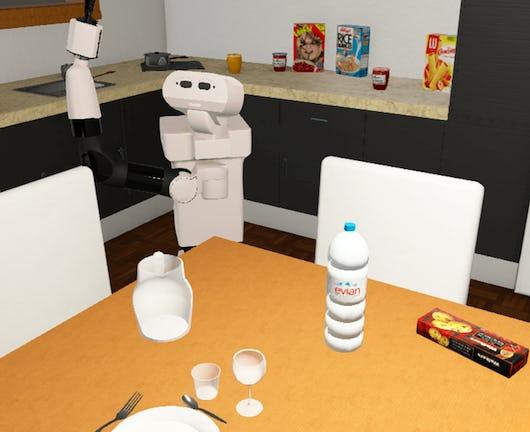
This course, which is the last and final course in the Introduction to Robotics with Webots specialization, will teach you basic approaches for planning robot trajectories and sequence their task execution. In "Robotic Path Planning and Task Execution", you will develop standard algorithms such as Breadth-First Search, Dijkstra's, A* and Rapidly Exploring Random Trees through guided exercises. You will implement Behavior Trees for task sequencing and experiment with a mobile manipulation robot "Tiago Steel".
Class Deals by MOOC List - Click here and see Coursera's Active Discounts, Deals, and Promo Codes.
It is recommended that you complete the first and second courses of this specialization, “Introduction to Robotics: Basic Behaviors” and "Robotic Mapping and Trajectory Generation" , before beginning this one.
This course is part of the Introduction to Robotics with Webots Specialization.
What you'll learn
- Use discrete planning techniques such as Dijkstra and A* to compute optimal robot trajectories.
- Implement complex sequences of behaviors using behavior trees.
- Plan and implement a complex robotic controller for autonomous mobile manipulation behavior.
Syllabus
Path Planning
Module 1
The first week in this course provides an introduction to path planning and presents a series of optimal algorithms for finding the shortest path on a graph that increase in complexity and efficiency. You will be introduced to various algorithms, including Bread-First Search to Dijkstra's and A*.
Collision Checking and Randomized Algorithms
Module 2
In this week, you will learn how to efficiently plan in non-grid worlds and in high-dimensional spaces.
Behavior Trees
Module 3
This week introduces you to a new programming abstraction known as "Behavior Trees", which offers solutions to shortcomings of Finite State Machines and simple reactive controllers.
Basic Manipulation
Module 4
This week you will learn how to extend a mobile base with a robotic arm and trigger the ability to grasp objects.
Final Project for This Specialization
Module 5
In this last week, you will complete a final project to demonstrate your knowledge of both this course and the entire specialization. It consists of implementing a complete mobile manipulation solution.