EdX

Mathematics of Waves: Visualized with Neural Networks (edX)

Offered by Purdue University, PurdueX,
Mathematics of Waves: Visualized with Neural Networks (edX)

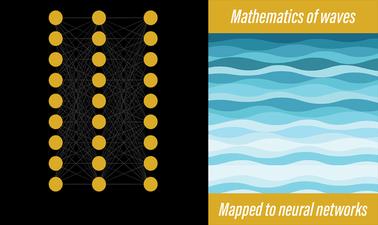
All around us, information is carried by waves of many kinds, like acoustic, electromagnetic, gravitational or probability waves. Enjoy this unifying view of all wave phenomena using neural networks to visualize the underlying mathematics.

Class Deals by MOOC List - Click here and see EdX's Active Discounts, Deals, and Promo Codes.

In the physical world we are surrounded by waves of all kinds, each with its own underlying physics. Acoustic waves for example involve the vibrations of the medium which we can hear, while electromagnetic waves involve vibrations of electric fields that require no medium and are detected with specially designed antennas. These vibrations are physically very different and are usually taught in very different courses although they are governed by very similar partial differential equations. Furthermore, the equations are sufficiently opaque that they hide the underlying unity. Our aim is to make this unity apparent through a unifying viewpoint, using neural networks (NN) as a pictorial tool to visualize the underlying mathematics.
All waves can be viewed as a collection of individual oscillators, and so we will start in Week 1 by laying out the mathematical and conceptual framework for oscillatory systems as diverse as mechanical oscillators (mass-spring), electrical oscillators (inductor-capacitor), ferromagnets and quantum spins. The physical variables are very different and even the equations may look different, but we will stress their unifying characteristics, introducing the concept of normal modes and mapping them all to an NN model. In Week 2 , we will show how the coupling of different elementary oscillators leads to different wave systems, with quantitative illustrative examples.
This is a pilot 2-week course where we will illustrate the basic idea for acoustic, Schrödinger and electromagnetic waves, all in Week 2. In future versions, our aim will be to expand the content with more illustrative examples as well as with more advanced topics such as quantized oscillators and waves.

What you'll learn

  • The mathematical structure underlying diverse oscillatory systems along with a pictorial representation using neural networks along with the concept of normal modes.
  • The formation of wave systems by coupling individual oscillators along with the concepts of dispersion relation and group velocity.
  • How to perform quantitative calculations of the waves generated by sources.
  • Visualizing diverse systems in terms of recurrent neural networks that can be used to compute and visualize numerical solutions.

Syllabus

Week 1: Oscillators
1.1. Simple oscillators
1.2. Normal modes
1.3. Spinor oscillators
1.4. Vector oscillators
1.5. Tensor oscillators

Week 2: Waves
2.1. Scalar waves
2.2. Group velocity
2.3. Schrödinger wavepackets
2.4. Electromagnetic waves
2.5. Acoustic waves


Go to Class
MOOC List is learner-supported. When you buy through links on our site, we may earn an affiliate commission.

Related Courses

Algèbre Linéaire (Partie 3) (edX) EdX
École Polytechnique Fédérale de Lausanne,EPFLx

Algèbre Linéaire (Partie 3) (edX)

Un MOOC francophone d'algèbre linéaire accessible à tous, enseigné de manière rigoureuse et ne nécessitant aucun prérequis. Vous voulez apprendre l'algèbre linéaire, un précieux outil complémentaire à vos connaissances acquises durant vos études en économie, ingénierie, physique, ou statistique? Ou simplement pour la beauté de la matière? Alors ce cours est fait pour vous!

Self Paced
Self-Paced
Data Science Readiness Assessment (edX) EdX
University of Notre Dame,NotreDameX

Data Science Readiness Assessment (edX)

Evaluate your level of preparedness in key aspects of mathematics and programming that are fundamental to a career in Data Science. Are you interested in pursuing a degree in Data Science, but unsure whether you have the necessary Math and Programming skills? This assessment will help you identify your current readiness in three core areas required for the study of Data Science; Calculus, Linear Algebra, and Programming.

No session available
Self-Paced
Math in Sports (edX) EdX
University of Notre Dame,NotreDameX

Math in Sports (edX)

In this course you will learn to use some mathematical tools that can help predict and analyze sporting performances and outcomes. This course will help coaches, players, and enthusiasts to make educated decisions about strategy, training, and execution. We will discuss topics such as the myth of the Hot Hand and the curse of the Sports Illustrated cover; how understanding data can improve athletic performance; and how best to pick your Fantasy Football team.

No sessions available
4 Weeks
AP® Physics 1 - Part 4: Exam Prep (edX) EdX
Rice University,RiceX

AP® Physics 1 - Part 4: Exam Prep (edX)

The fourth of four courses in a dynamic, comprehensive series that provides a solid base in introductory physics and helps prepare you for the AP Physics 1 Exam. Free textbook included! In this four-part series, we will explore AP Physics 1 concepts and prepare for the AP Physics 1 Exam in an exciting and entirely new way. Increase your skills – and your readiness – for the AP Exam though quality videos, inquiry labs, Hollywood-style Concept Trailers™, Direct Measurement Videos, AP problem-solving sessions and more!

No sessions available
4 Weeks
Introduction to Differential Equations (edX) EdX
MIT,MITx

Introduction to Differential Equations (edX)

Scientists and engineers understand the world through differential equations. You can too. Differential equations are the language of the models we use to describe the world around us. In this mathematics course, we will explore temperature, spring systems, circuits, population growth, and biological cell motion to illustrate how differential equations can be used to model nearly everything in the world around us.

This course is archived
5-12 Weeks
Complex Analysis with Physical Applications (edX) EdX
NUST MISIS,MISISx

Complex Analysis with Physical Applications (edX)

Learn to master differential equations and special functions in this graduate level course. In this advanced math course, you will learn how to build solutions to important differential equations in physics and their asymptotic expansions. Armed with the tools mastered in this course, you will have a solid command of the methods of tackling differential equations and integrals encountered in theoretical and applied physics and material science.

No sessions available
5-12 Weeks
Differential Equations: Fourier Series and Partial Differential Equations (edX) EdX
MIT,MITx

Differential Equations: Fourier Series and Partial Differential Equations (edX)

Learn to use Fourier series to solve differential equations with periodic input signals and to solve boundary value problems involving the heat equation and wave equation. Differential equations are the mathematical language we use to describe the world around us. Many phenomena are not modeled by differential equations, but by partial differential equations depending on more than one independent variable.

Mar 22nd 2023
5-12 Weeks
Cours préparatoire: Fonctions trigonométriques, logarithmiques et exponentielles (edX) EdX
École Polytechnique Fédérale de Lausanne,EPFLx

Cours préparatoire: Fonctions trigonométriques, logarithmiques et exponentielles (edX)

Ce cours donne les connaissances fondamentales liées aux fonctions trigonométriques, logarithmiques et exponentielles. Le cours propose une approche très détaillée et précise des notions fondamentales liées aux fonctions trigonométriques, logarithmiques et exponentielles.

Self Paced
Self-Paced
Applications of Linear Algebra Part 1 (edX) EdX
Davidson College,DavidsonX

Applications of Linear Algebra Part 1 (edX)

Learn to use linear algebra in computer graphics by making images disappear in an animation or creating a mosaic or fractal and in data mining to measure similarities between movies, songs, or friends. From simulating complex phenomenon on supercomputers to storing the coordinates needed in modern 3D printing, data is a huge and growing part of our world.

No sessions available
4 Weeks