Journalism Skills for Engaged Citizens (Coursera)

Journalism Skills for Engaged Citizens (Coursera)

This is a course in basic journalism skills designed for citizens who are using new media to publish news, views and information. We cover writing skills, interviews, ethics, law and accessing public forums and documents. We also introduce basic investigative skills.

Class Deals by MOOC List - Click here and see Coursera's Active Discounts, Deals, and Promo Codes.

This is a course in basic journalism skills, designed for the many people who are now taking advantage of new media to publish news, views and information. For five hundred years, the privilege of being able to publish was enjoyed by very few people – those who had access to a printing press or a radio microphone or a television camera. Now, almost anyone can publish to the world within minutes of being able to do so. But is it journalism?
How does a citizen journalist find things out, so they can report facts and news - moving beyond merely braying opinion? And what are the legal and ethical pitfalls to publishing facts that some people might prefer remain secret?
Over eight weeks, this course teaches the basics of news writing, how to interview people to gain crucial information, how to develop and manage your sources and how to use your legal rights to access public information - and stay on the right side of the law when you publish. We discuss the ethics behind journalism practice, and conduct a mock investigation into local government. This course aims to empower engaged citizens to better participate in the news ecology.

Syllabus

WEEK 1
What is a Journalist, and What is News?
This week we will discuss what journalism is, what journalists do, and how this has been affected over time by technology. We'll think about the exciting changes of our own time – the first in human history when the means of publication are in everyone's hands. We will then talk about the principles of news writing, and the nature of news. Finally, we will introduce Newstown, a fictitious place in Victoria, Australia. We also attend a news conference held in the Newstown Council Chambers. We will be using Newstown as the basis of our skills based exercises in this MOOC, so please take the time to become familiar with the town and its issues by following the link to Newstown in the course resources.

WEEK 2
Attribution, Verification and the Structure of News Writing
This week we discuss some more core skills of journalism, particularly the very important concepts of attribution of information, and verification. We explore the structure of news writing in some more detail. Finally, make sure you take a close look at the Newstown site, and keep looking at it from now on as the course develops. Some new information has been posted that you will need to use in this week's first assessable news writing exercise.

WEEK 3
Finding Things Out: Places, Paper and People
This week we discuss some more core skills of journalism, particularly the very important concepts of attribution of information, and verification. We explore the structure of news writing in some more detail. Finally, make sure you take a close look at the Newstown site, and keep looking at it from now on as the course develops. Some new information has been posted that you will need to use in this week's first assessable news writing exercise.

WEEK 4
More on Interviews
This week we delve further into the art of interviewing, and watch and discuss some good and bad examples involving the key characters in Newstown.

WEEK 5
Contacts and Confidential Sources; Applying the Skills and Organising Your Material
This week we explore the complications of dealing with off the record sources and long term contacts. We watch an encounter with a Newstown 'Deep Throat' and discuss how to handle the encounter and the information offered. Remember to check out the Newstown website for more information becoming available. We begin to pull all the threads of the Newstown story together, and apply the skills we have learned in the earlier modules of this course. We talk about how to read and analyse the public documents on the Newstown site, how to organise material, what questions to ask based on this material, and how to pull it all together into a story for The Alternative. We also provide you with an exemplar news report to give you some guidance for the final news writing assessment and how it might be done.

WEEK 6
Media Law and Impartiality; Wrapping Up the Course
This week we concentrate on two aspects of media law – defamation and contempt, and we consider the meaning of journalistic impartiality. We wrap up the course by revisiting the key principles of journalism and what we have learned. We also have a few things to say about the public nature of journalism, and how bruising that can be.


Go to Class
MOOC List is learner-supported. When you buy through links on our site, we may earn an affiliate commission.

Related Courses

English for Journalists, Part 2 (edX) EdX
University of California, Berkeley,BerkeleyX

English for Journalists, Part 2 (edX)

Improve your English grammar, vocabulary and writing skills through topics in journalism including free speech, sports, humor and broadcast writing. English for Journalists offers instruction in English language development for students who are studying journalism, or working journalists who want to improve their English proficiency. Students with a basic understanding and interest in journalism are encouraged to sign up.

Self Paced
Self-Paced
U.S. Citizenship Test Preparation Course (ALISON) ALISON
ALISON

U.S. Citizenship Test Preparation Course (ALISON)

Prepares for the U.S. Citizenship naturalization test which is required in the US citizenship naturalization process. This free online Preparatory U.S. Citizenship Test course will help you to pass the US naturalization test. Applicants for U.S. citizenship must pass a two-part naturalization test, which aims to make sure that people securing U.S Citizenship can read, write, and talk English, and that they understand United States history and government structures. This free online course will help you make sure that you pass on your first attempt.

Self Paced
Self-Paced
Making Sense of News (edX) EdX
University of Hong Kong,HKUx

Making Sense of News (edX)

With social media and a 24/7 news cycle, how do we — as news consumers — make sense of what we hear and read? At a time when we are flooded with an abundance of information and disinformation, it is essential for each one of us to become a more discerning news consumer.

No sessions available
4 Weeks
Crash Course on Professional Interviewing for Beginners (Skillshare) Skillshare
Skillshare

Crash Course on Professional Interviewing for Beginners (Skillshare)

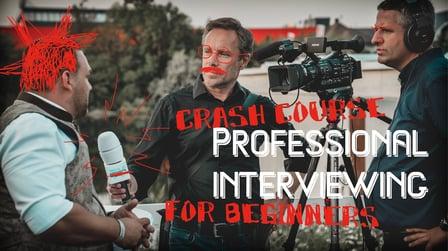
The class: Experienced interviewer and university lecturer in qualitative interviewing Zack Koretsky guides you through your preparation for your first journalistic, blogging, podcast, academic or school interview! Filled with insightful tips and a bit of theory, it’s a perfect crash course for beginner journalists, bloggers and students.

Self Paced
Self-Paced
Introduction to Journalism (FutureLearn) FutureLearn
University of Strathclyde

Introduction to Journalism (FutureLearn)

Learn about the key principles and debates in journalism and enact the role of a journalist in the context of an escalating story. This free online course is aimed at those curious about journalism and looking to gain a better understanding of what the subject entails. Run by a team of internationally-renowned scholars and journalism practitioners at the University of Strathclyde, it gives you a behind-the-scenes look at the professional world of reporters and editors.

No sessions available
5-12 Weeks
Secure Passwords (Totem) Totem
Totem project

Secure Passwords (Totem)

Pa$$word123, really? Follow your guide to good password management. By this point in the evolution of technology, most of us have a fairly large number of online accounts to keep track of, and to keep safe. It seems like we need multiple accounts for everything - email, messaging, social media, shopping, banking, project-managing, file-sharing, etc, etc - it’s all a bit endless.

Self Paced
Self-Paced
Phishing Attacks (Totem) Totem
Totem project

Phishing Attacks (Totem)

Think before you click. Phishing happens to everyone, but most people only become aware of it once they have become a victim of an attack. Protecting yourself from phishing attacks starts with identifying an email or message as an attack before you click on the link or download the file. But even if you are careful, a phishing attack can still sometimes be successful. Don’t panic.

Self Paced
Self-Paced
Participation citoyenne : méthodes et civic tech (FUN) FUN
INRIA

Participation citoyenne : méthodes et civic tech (FUN)

Enquête publique, consultation citoyenne, budget participatif, démocratie participative, autant d'initiatives dont vous avez sans doute déjà entendu parler. Mais de quoi s'agit-il réellement ? Et comment déployer des démarches participatives à l'ère du numérique ? En complément des rencontres en présentiel, les réseaux sociaux et les technologies du numérique, ou "Civic Tech", permettent d'impliquer les publics à l'échelle d'Internet. Dans ce cours intitulé "Participation citoyenne, méthodes et Civic Tech", proposé par Inria et Missions Publiques, vous bénéficierez d'un accompagnement pendant 5 semaines pour comprendre la plus-value d'une démarche participative et ses approches, pour découvrir un panel diversifié et complet de méthodes de participation, établir les meilleures conditions d'un processus participatif alliant rencontres de terrain et Civic Tech, proposer des consultations innovantes pour un meilleur engagement des publics à l'échelle d'Internet, et concevoir votre propre démarche participative.

No sessions available
5-12 Weeks