EdX

Generative Modelling (edX)

Generative Modelling (edX)

This course focuses on generating spatial information models capturing various relationships and constraints. You will learn a set of advanced modelling techniques for generating spatial models. You will create multiple procedures that annotate and query your models using attribute data. By the end of the course, you will be able to create your own scripts consisting of multiple procedures working together to generate complex spatial information models.

Class Deals by MOOC List - Click here and see EdX's Active Discounts, Deals, and Promo Codes.

As part of our “Spatial Computational Thinking” program, this “Generative Modelling” course focuses on the generation of complex spatial information models capturing various relationships and constraints. You will learn how to tackle challenging problems by integrating multiple procedures that work together to generate spatial information models.
This course will build on the previous procedural modelling course. In this course, the complexity of the spatial information modelling tasks will increase, requiring a more advanced type of generative modelling approach. You will learn advanced generative modelling techniques, such as using law curves and resolving spatial constraints by implementing your own solvers. You will learn skeletal modelling strategies that make it easier to control the complexity of the generative process.
You will also learn a range of general mathematic techniques that are critical to basic types of spatial reasoning, including working with vectors, rays, and planes, and using various mathematical functions such as periodic functions, and dot product and cross product functions. You will also revisit the debugging process, learning how flowcharts can be used to isolate errors.
In the process, you will also further develop your coding skills. You will revisit the loops and conditional and discover how these can be nested to create more complex control flows. You will also discover how list and dictionary data structures can be nested to create more complex types of data structures.
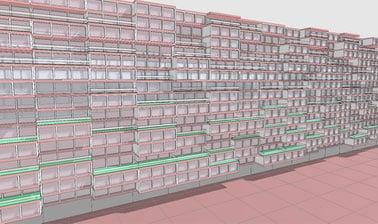
The modelling exercises and assignments during this course will also become more advanced. The spatial information models will now represent complex buildings with a range of different types of components and parts, tagged with attributes and grouped into collections.
The course prepares you for the next and final course in the "Spatial Computational Thinking” program , focusing on performative modelling.

What you'll learn

Learning algorithmic thinking:

  • How parameters define a search space of possible configurations
  • How to decompose a problem by breaking it down into smaller sub-problems
  • Recognise underlying algorithmic principles within spatial configurations

Learning generative modelling:

  • Using skeletal modelling strategies to control model complexity
  • Modelling spatial relationships using law curves
  • Modelling with spatial constraints, for example, Floor-Area Ratio
  • Strategies for solving constraints
  • Creating simple constraint solvers using ‘for loops’
  • Pushing attributes through the topological hierarchy
  • Visualizing models with colour and materials
  • Understanding polygon normals and their impact on light
  • Importing and exporting geometric and geospatial data models

Learning coding:

  • Spatial reasoning with vector mathematics
  • Working with infinite planes and infinite rays
  • Modelling with periodic functions: sin(), cos(), tan()
  • Spatial reasoning using the dot product and cross product functions
  • Optimizing code to improve execution speed
  • Developing complex data structures using nested lists and dictionaries
  • Using nested loops and nested conditionals
  • Strategies for looping: using a counter or iterating over a list?
  • How to avoid deep nesting of loops using data structures

Learning Möbius Modeller:

  • Strategies for creating and debugging flowcharts
  • Documenting flowcharts and parameters
  • Publishing flowcharts online for others to interact with and explore
  • The Möbius Spatial Information data model
  • Interrogating models in the 3D viewer
  • Difference between local and global functions
  • Creating flowcharts that can be imported as global functions

Prerequisites:
Completion of Course-1: Procedural modellingof 'Spatial Computational Thinking'Professional Certificate program.

Go to Class
MOOC List is learner-supported. When you buy through links on our site, we may earn an affiliate commission.

Related Courses

Dynamic Energy Modelling of Buildings: Thermal Simulation (edX) EdX
Delft University of Technology,DelftX

Dynamic Energy Modelling of Buildings: Thermal Simulation (edX)

Understand the dynamics of buildings’ thermal behavior and learn how to optimize their design and operation through thermal modeling. Many engineers are puzzled by questions such as: how to shift or reduce peak heating demand to obtain a better match with a smart grid or renewable energy system? What is thermally more efficient: a heavy concrete building or a light timber-frame building? How effective is night ventilation in warm periods? This course will provide you with the answers to these and many other questions related to dynamic thermal behavior in buildings.

Future dates to be announced
5-12 Weeks
Algorítmica Básica (edX) EdX
Tecnológico de Monterrey,TecdeMonterreyX

Algorítmica Básica (edX)

Aprende los fundamentos del pensamiento algorítmico, estructuras de datos y los principios básicos de programación con aplicación a los negocios. Los algoritmos pueden ser utilizados para la solución de problemas de negocio. En este curso aprenderás los conceptos básicos de algoritmos y el manejo de estructuras de datos.

Self Paced
Self-Paced
Algorithmic Thinking (Part 1) (Coursera) Coursera
Rice University

Algorithmic Thinking (Part 1) (Coursera)

Experienced Computer Scientists analyze and solve computational problems at a level of abstraction that is beyond that of any particular programming language. This two-part class is designed to train students in the mathematical concepts and process of "Algorithmic Thinking", allowing them to build simpler, more efficient solutions to computational problems.

Sep 7th 2026
4 Weeks
GitHub Copilot: The AI Pair Programmer for Coding (Coursera) Coursera
Edureka

GitHub Copilot: The AI Pair Programmer for Coding (Coursera)

Welcome to the 'GitHub Copilot: The AI Pair Programmer for Coding' course, where you will embark on an insightful journey to develop a profound understanding of the AI principles that power GitHub Copilot's coding assistance. This course is designed to transform your coding practices, leveraging the advanced capabilities of GitHub Copilot.

Sep 14th 2026
1 Week
How to Win Coding Competitions: Secrets of Champions (edX) EdX
ITMO University,ITMOx

How to Win Coding Competitions: Secrets of Champions (edX)

Enhance programming skills to boost your career and win prizes led by ITMO University, the only 6-time winner of the world’s top coding cup. Want to be the programmer hot tech companies are looking for? Take your programming skills to the next level and prove your excellence by learning how to succeed in programming competitions.

No sessions available
5-12 Weeks
Recommender Systems: Behind the Screen (edX) EdX
Université de Montréal,UMontrealX

Recommender Systems: Behind the Screen (edX)

How are items recommended when you’re browsing for movies, jobs or clothing online? Register here and you’ll discover the fundamental concepts and methods allowing the most relevant item suggestions to users from e-commerce to online advertisement. In this course, you will explore and learn the best methods and practices in recommender systems, which are an essential component of the online ecosystem. This course was developed by IVADO and HEC Montréal as part of a workshop that took place in Montreal.

Self Paced
5-12 Weeks
Unreal Engine Interactive 3D: Blueprints, Animation, Audio, & Environments (edX) EdX
Rochester Institute of Technology,RITx

Unreal Engine Interactive 3D: Blueprints, Animation, Audio, & Environments (edX)

Expand your interactive Unreal Engine 3D skills with Blueprints, Landscapes, Audio and AI. In this course, you’ll build on your knowledge from UNRL 101 by learning visual scripting using Blueprints. This node-based system based on C++ enables powerful programming without the syntax typically involved in coding. You will gain basic coding skills to use multiple tools for accelerating work and building immersive interactive functionality.

Self Paced
Self-Paced
Algoritmos y Programación en R (edX) EdX
Tecnológico de Monterrey,TecdeMonterreyX

Algoritmos y Programación en R (edX)

Aprende los fundamentos del pensamiento algorítmico, estructuras de datos y los principios básicos de programación con aplicación a los negocios. Los algoritmos pueden ser utilizados para la solución de problemas de negocio. En este curso aprenderás los conceptos básicos de algoritmos y el manejo de estructuras de datos.

Self Paced
Self-Paced
Gen AI for Code Generation for Python (Coursera) Coursera
Edureka

Gen AI for Code Generation for Python (Coursera)

Welcome to the 'Gen AI for Code Generation for Python' course, where you'll embark on a journey to explore and develop your skills in the art of code generation with Generative AI. Throughout this short course, you will delve into various techniques for generating Python code effortlessly, ranging from simple scripts to complete end-to-end projects.

Sep 14th 2026
1 Week