Effective Altruism (Coursera)

Offered by Princeton University,
Effective Altruism (Coursera)

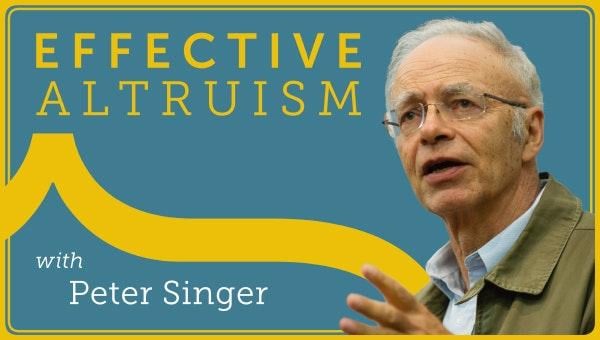
Effective altruism is built on the simple but unsettling idea that living a fully ethical life involves doing the most good one can. In this course you will examine this idea's philosophical underpinnings; meet remarkable people who have restructured their lives in accordance with it; and think about how effective altruism can be put into practice in your own life.

Class Deals by MOOC List - Click here and see Coursera's Active Discounts, Deals, and Promo Codes.

All the features of this course are available for free. It does not offer a certificate upon completion.

Syllabus

WEEK 1
Getting Started with the Course
This week we share what this course is about. We will give those of you who do not have a background in philosophy, or who need a refresher, an opportunity to study two areas of ethics: meta-ethics and normative ethical theories.

WEEK 2
Poverty and Affluence
What obligations do the affluent have towards those who live in extreme poverty? This week we look at one distinct argument based on consequentialist ethics and also begin the discussion of the effectiveness of aid programs. This week also includes a conversation with Raymond Offenheiser. Furthermore, we discuss poverty as human rights violations. You will also find a conversation with Dean Karlan about effective solutions to poverty problems in this week.

WEEK 3
What is the Best Cause? How Much Ought We Do to Help Others?
How do you get the most value for your charitable dollars? How can you compare different causes to each other, and how do you compare different charities to each other? One of the guests this week is Elie Hassenfeld from GiveWell, an organization that tries to find the answers to these questions. This week you will also meet three individuals who in different ways embody the ideal of effective altruism: Zell Kravinsky, Julia Wise and Alexander Berger.

WEEK 4
Effective Altruism and Career Choice
This week Will MacAskill and Matt Wage discuss effective altruism and career choice.

WEEK 5
The Giving Game
In this week you will have the opportunity to play the Giving Game.

WEEK 6
Why Act Ethically?
In this last week, we circle back to some foundational questions in ethics. What is the relationship between rationality, self-interest, and ethics? How demanding is morality, and why exactly should be trying to live an ethical life? In this week you will also find the final essay assignment.


Go to Class
MOOC List is learner-supported. When you buy through links on our site, we may earn an affiliate commission.

Related Courses

Avoiding AI Harm (Coursera) Coursera
Fred Hutchinson Cancer Center

Avoiding AI Harm (Coursera)

This course is designed for those in roles with decision making power, to help them understand major topics to consider for using and developing Artificial Intelligence (AI) responsibly, including popular Generative AI tools like ChatGPT and others. It covers real-world examples of situations where AI was used in variety of fields and situations in ways hat revealed ethical concerns. Strategies are suggested to avoid doing harm working with AI, including a framework for working responsibly with AI.

Jun 29th 2026
1 Week
Ethics of Technology (Coursera) Coursera
University of Notre Dame

Ethics of Technology (Coursera)

This course explores the ethical implications of data analytics. It connects old ideas – privacy, surveillance, power, justice, accountability, corporate responsibility, stakeholder theory – with new technologies and cases, such as the use of machine learning to predict crime. The course will prepare you to evaluate strategic arguments about the ethics of data analytics and to relate data analytics to ethical concepts so that you approach newer, ambiguous capabilities of technology and artificial intelligence with a critical eye.

Jun 29th 2026
4 Weeks
Beyond the Sustainable Development Goals (SDGs): Addressing Sustainability and Development (Coursera) Coursera
University of Michigan

Beyond the Sustainable Development Goals (SDGs): Addressing Sustainability and Development (Coursera)

We’re excited you’re here! This course, “Beyond the Sustainable Development Goals (SDGs): Addressing Sustainability and Development,” is the first course in the upcoming Sustainability and Development MasterTrack Certificate program (Fall 2020), but you can also take this course as a stand-alone learning opportunity.

Jul 1st 2026
5-12 Weeks
Generative AI: Impact, Considerations, and Ethical Issues (Coursera) Coursera
IBM

Generative AI: Impact, Considerations, and Ethical Issues (Coursera)

In this course, you will explore the impact of generative artificial intelligence (AI) on society, the workforce, organizations, and the environment. This course is suitable for anyone interested in learning about the ethical, economic, and social implications of generative AI and how generative AI can be used responsibly. It will benefit professionals, executives, policymakers, and students.

Jun 29th 2026
3 Weeks
Ethics of Communication (Coursera) Coursera
University of Notre Dame

Ethics of Communication (Coursera)

Welcome to Ethics of Communication. Geared toward working professionals in both the corporate and nonprofit sectors, Ethics of Communication covers key topics in the modern world of business. Areas of focus include an in-depth examination of the ethical dimensions of professional communication, self-examination of individual conflict styles and preferences, and crisis management scenario analysis and strategy. You will develop and enhance skills related to these concepts through lectures conducted by Notre Dame Professor, Dr. Amanda G. McKendree, written communication exercises, self-reflection, peer-graded assignments, and a variety of readings.

Jun 29th 2026
4 Weeks
Create Compelling Business Cases (Coursera) Coursera
Coursera Instructor Network

Create Compelling Business Cases (Coursera)

In this one-week course, we’ll focus on the 5 most crucial elements of a business case, including what is a business case and how it is used to make investment decisions. Whether you are a student or a professional, this course will give you the fundamentals you need, from defining the problem to gathering data and performing a financial analysis.

Jun 29th 2026
1 Week
Ethical Issues in Data Science (Coursera) Coursera
University of Colorado Boulder

Ethical Issues in Data Science (Coursera)

Computing applications involving large amounts of data – the domain of data science – impact the lives of most people in the U.S. and the world. These impacts include recommendations made to us by internet-based systems, information that is available about us online, techniques that are used for security and surveillance, data that is used in health care, and many more. In many cases, they are affected by techniques in artificial intelligence and machine learning.

Jun 29th 2026
5-12 Weeks
Ethical Issues in Computing Applications (Coursera) Coursera
University of Colorado Boulder

Ethical Issues in Computing Applications (Coursera)

Computing systems and technologies fundamentally impact the lives of most people in the world, including how we communicate, get information, socialize, and receive healthcare. This course is the third of a three course sequence that examines ethical issues in the design and implementation of computing systems and technologies, and reflects upon the broad implication of computing on our society. It covers medical applications, uses of robotics, autonomous vehicles, and the future of work.

Jun 29th 2026
5-12 Weeks
Media ethics & governance (Coursera) Coursera
University of Amsterdam

Media ethics & governance (Coursera)

This course explores some of the basic theories, models and concepts in the field of media ethics. We will introduce influential ethical theories and perspectives, explore changing societal demands and expectations of media creation and media use, and we will elaborate on existing ethical norms for media professionals. After following this course, you will be able to reflect on ethical dilemmas and develop a well-substantiated argumentation for ethical decision making in a variety of media-related contexts.

Jun 29th 2026
4 Weeks
Measuring and Maximizing Impact of COVID-19 Contact Tracing (Coursera) Coursera
Johns Hopkins University

Measuring and Maximizing Impact of COVID-19 Contact Tracing (Coursera)

This course aims to provide managers and developers of contact tracing programs guidance on the most important indicators of performance of a contact tracing program, and a tool that can be used to project the likely impact of improvements in specific indicators. Students who complete the course will be proficient in using the Contact Tracing Evaluation and Strategic Support Application (ConTESSA) to estimate the impact of their contact tracing program on transmission and strategizing about how to increase their program’s impact.Free enrollment available until December 31, 2020. Valid for one enrollment per person.

Jun 29th 2026
1 Week
Artificial Intelligence Data Fairness and Bias (Coursera) Coursera
LearnQuest

Artificial Intelligence Data Fairness and Bias (Coursera)

In this course, we will explore fundamental issues of fairness and bias in machine learning. As predictive models begin making important decisions, from college admission to loan decisions, it becomes paramount to keep models from making unfair predictions. From human bias to dataset awareness, we will explore many aspects of building more ethical models.

Jun 29th 2026
3 Weeks
Computing, Ethics, and Society 1 - Foundations (Coursera) Coursera
University of Colorado Boulder

Computing, Ethics, and Society 1 - Foundations (Coursera)

Computing systems and technologies fundamentally impact the lives of most people in the world, including how we communicate, get information, socialize, and receive healthcare. This course is the first of a three-course sequence that examines ethical issues in the design and implementation of computing systems and technologies and reflects upon the broad implication of computing on our society. It covers ethical theories, privacy, security, social media, and misinformation.

Jun 29th 2026
4 Weeks