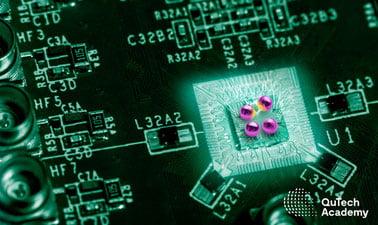
Unravel the physics behind Germanium qubits, their fabrication process, control, and applications. Learn how to apply machine learning for auto-tuning, and how to perform quantum error correction and quantum algorithms.
Class Deals by MOOC List - Click here and see EdX's Active Discounts, Deals, and Promo Codes.
In the race towards a fault-tolerant quantum computer, the semiconducting qubit platform is the only one that has, thus far, been shown to be scalable. Germanium qubits are a new type of semiconducting qubits, and their progress has been exceptionally fast since the development of the material in 2018.
You will learn about the physics behind Germanium qubits, their advantages, and challenges compared to other qubit platforms, and the electrical components that are needed to control them. In addition, you will familiarize yourself with different companies from the semiconducting industry, the fabrication facilities, and the latest developments in the field.
This course is a collaboration between several parties, all of whom have state-of-the-art facilities for fabrication, control, or applications using Germanium qubits. By taking this course you will have the opportunity to learn about Germanium qubits from professionals in the field who are conducting innovative research that is not being done elsewhere.
The course is a journey of discovery, so we encourage you to bring your own experiences, insights, and thoughts via the forum!
This course is part of the Quantum 301: Quantum Computing with Semiconductor Technology Professional Certificate.
What you'll learn
- Understand the physics behind Germanium qubits and their advantages and challenges.
- Learn how Germanium qubits can be controlled and how this process can be automatized using machine learning.
- Familiarize yourself with different companies in the semiconducting industry and their facilities.
- Identify how quantum algorithms and quantum error correction can be performed using Germanium qubits.
Syllabus
WEEK 1: Semiconductor devices and materials
- Semiconductor devices - industrial approach
What can CMOS technology do for quantum computing?
Semiconductor devices and their scaling using the industrial approach
Semiconductor foundry facilities: the good and the bad for qubits
IMEC's latest qubit developments
Summary and outlook
- Semiconductor materials - structure and growth
Semiconductors for spin qubits
Germanium quantum wells on silicon
Germanium quantum wells on silicon-germanium
Growth methods
Characterization techniques
WEEK 2: Germanium qubits
- Quantum dot qubits and Germanium physics
- Germanium qubits - single spin and scaling
- Germanium qubits - multi-spin encodings
Physics of holes
Hole spin qubits
- Mid-term exam (multiple choice)
WEEK 3: Tuning quantum dots
- Electronics for quantum computing
Introduction to electronics for quantum computing
Room temperature electronics
Cryogenic qubit chip carriers
Contribution to IGNITE
- Quantum dots auto-tuning - experimental
Auto-tuning a quantum computer
Tuning and operation of arrays
Finding operation points example
- Quantum dots auto-tuning - theor
What is auto-tuning?
Neural network tuning
Navigating charge stability diagrams
Experimental implementation
Towards universal quantum algorithms
WEEK 4: Quantum error correction and quantum algorithms
- Quantum error correction
Classical error correction
Quantum error correction
Progress and challenges
- Quantum algorithms
Introduction to quantum algorithms
The first algorithms
Quantum annealing
Quantum machine learning
WEEK 5:
Final exam (multiple choice)