Brain Tumor Classification Using Keras (Coursera)

Brain Tumor Classification Using Keras (Coursera)

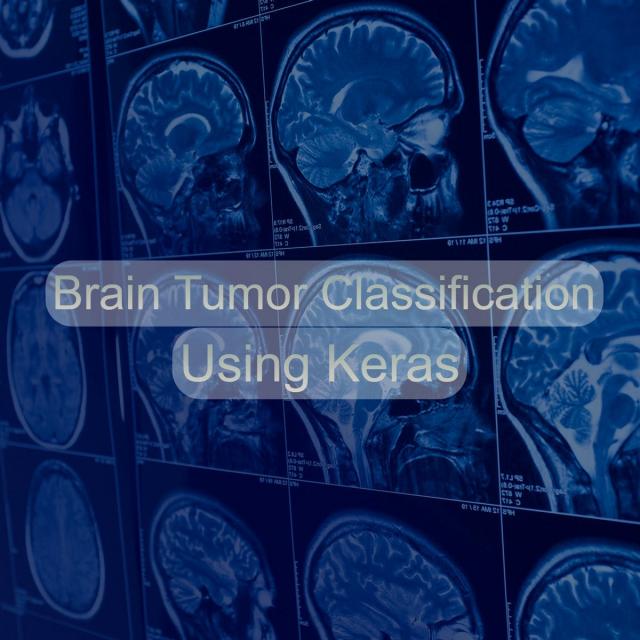
In this 2-hour-long guided project, we will use an efficient net model and train it on a Brain MRI dataset. This dataset has more than 3000 Brain MRI scans which are categorized in four classes - Glioma Tumor, Meningioma Tumor, Pituitary Tumor and No Tumor. Our objective in this project is to create an image classification model that can predict Brain MRI scans that belong to one of the four classes with a reasonably high accuracy. Please note that this dataset, and the model that we train in the project, is for educational purposes only.

Class Deals by MOOC List - Click here and see Coursera's Active Discounts, Deals, and Promo Codes.

Project Prerequisite: Before you attempt this project, you should be familiar with programming in Python. You should also have a theoretical understanding of Convolutional Neural Networks, and optimization techniques. This is a hands on, practical project that focuses primarily on implementation, and not on the theory behind Convolutional Neural Networks.
We will be carrying out the entire project on the Google Colab environment so you will need a free Gmail account to complete this project.
This Guided Project was created by a Coursera community member.

In this Guided Project, you will:

  • Learn to use Efficient Net to classify Brain MRI Scans in one of the four classes of Brain Tumor in Keras.

Learn step-by-step

  1. Introduction to the project.
  2. Clone dataset and Import Libraries
  3. Create directories to store Training and Test Data
  4. Data Visualization
  5. Create a function to crop images
  6. Save the cropped images to respective directories.
  7. Data Augmentation and Data Loading
  8. Model Creation
  9. Training and evaluating the model
  10. Prediction on Test Data
Go to Class
MOOC List is learner-supported. When you buy through links on our site, we may earn an affiliate commission.

Related Courses

Big Data Analysis Deep Dive (Coursera) Coursera
Alibaba Cloud Academy

Big Data Analysis Deep Dive (Coursera)

The job market for architects, engineers, and analytics professionals with Big Data expertise continues to increase. The Academy’s Big Data Career path focuses on the fundamental tools and techniques needed to pursue a career in Big Data. This course includes: data processing with python, writing and reading SQL queries, transmitting data with MaxCompute, analyzing data with Quick BI, using Hive, Hadoop, and spark on E-MapReduce, and how to visualize data with data dashboards. Work through our course material, learn different aspects of the Big Data field, and get certified as a Big Data Professional!

Sep 28th 2026
5-12 Weeks
Programación en Python (Coursera) Coursera
Universidad de los Andes

Programación en Python (Coursera)

¡Te damos la bienvenida al curso de Programación en Python de la Universidad de los Andes! El propósito de este curso es ofrecerte un ambiente interactivo para que desarrolles tus habilidades de pensamiento computacional, aprendas a programar en el lenguaje Python y te entrenes en la resolución de problemas utilizando un computador. La estrategia pedagógica empleada es el aprendizaje activo basado en casos.

Sep 28th 2026
4 Weeks
Using Databases with Python (Coursera) Coursera
University of Michigan

Using Databases with Python (Coursera)

This course will introduce students to the basics of the Structured Query Language (SQL) as well as basic database design for storing data as part of a multi-step data gathering, analysis, and processing effort. The course will use SQLite3 as its database. We will also build web crawlers and multi-step data gathering and visualization processes. We will use the D3.js library to do basic data visualization.

Sep 28th 2026
5-12 Weeks
Python Data Structures (Coursera) Coursera
University of Michigan

Python Data Structures (Coursera)

This course will introduce the core data structures of the Python programming language. We will move past the basics of procedural programming and explore how we can use the Python built-in data structures such as lists, dictionaries, and tuples to perform increasingly complex data analysis. This course will cover Chapters 6-10 of the textbook “Python for Everybody”. This course covers Python 3.

Sep 28th 2026
5-12 Weeks
Estruturas de dados Python (Coursera) Coursera
University of Michigan

Estruturas de dados Python (Coursera)

Este curso apresentará as estruturas de dados centrais da linguagem de programação Python. Vamos superar os fundamentos da programação de procedimentos e explorar como podemos usar as estruturas de dados integradas do Python, como listas, dicionários e tuplas, para realizar análises de dados cada vez mais complexas. Este curso cobrirá os capítulos 6 a 10 do livro “Python para Todos”. Este curso aborda o Python 3.

Oct 5th 2026
5-12 Weeks
Data Science in Stratified Healthcare and Precision Medicine (Coursera) Coursera
University of Edinburgh

Data Science in Stratified Healthcare and Precision Medicine (Coursera)

An increasing volume of data is becoming available in biomedicine and healthcare, from genomic data, to electronic patient records and data collected by wearable devices. Recent advances in data science are transforming the life sciences, leading to precision medicine and stratified healthcare. In this course, you will learn about some of the different types of data and computational methods involved in stratified healthcare and precision medicine.

Oct 5th 2026
5-12 Weeks
Programming for Everybody (Getting Started with Python) (Coursera) Coursera
University of Michigan

Programming for Everybody (Getting Started with Python) (Coursera)

This course aims to teach everyone the basics of programming computers using Python. We cover the basics of how one constructs a program from a series of simple instructions in Python. The course has no pre-requisites and avoids all but the simplest mathematics. Anyone with moderate computer experience should be able to master the materials in this course.

Sep 28th 2026
5-12 Weeks
The Fundamental of Data-Driven Investment (Coursera) Coursera
Sungkyunkwan University - SKKU

The Fundamental of Data-Driven Investment (Coursera)

In this course, the instructor will discuss the fundamental analysis of investment using R programming. The course will cover investment analysis topics, but at the same time, make you practice it using R programming. This course's focus is to train you to do the elemental analysis for investment management that you might need to do in your job every day. Additionally, the study note to do using Python programming will be provided.

Oct 5th 2026
4 Weeks
Python Data Visualization (Coursera) Coursera
Rice University

Python Data Visualization (Coursera)

This if the final course in the specialization which builds upon the knowledge learned in Python Programming Essentials, Python Data Representations, and Python Data Analysis. We will learn how to install external packages for use within Python, acquire data from sources on the Web, and then we will clean, process, analyze, and visualize that data. This course will combine the skills learned throughout the specialization to enable you to write interesting, practical, and useful programs.

Oct 2nd 2026
4 Weeks
Foundations of Data Science: K-Means Clustering in Python (Coursera) Coursera
University of London,Goldsmiths, University of London

Foundations of Data Science: K-Means Clustering in Python (Coursera)

This MOOC, designed by an academic team from Goldsmiths, University of London, will quickly introduce you to the core concepts of Data Science to prepare you for intermediate and advanced Data Science courses. It focuses on the basic mathematics, statistics and programming skills that are necessary for typical data analysis tasks.

Oct 5th 2026
5-12 Weeks