Biosphere 2 Science for the Future of Our Planet (Coursera)

Offered by University of Arizona,
Biosphere 2 Science for the Future of Our Planet (Coursera)

Are you ready to take an incredible journey around Planet Earth and beyond? In this course, you will delve into a world of innovative science and learn from a team of Biosphere 2 and University of Arizona researchers. From plants and soils, to oceans and rainforests, the Moon, Mars, and more, this course is an exciting opportunity for anyone interested in science and Earth stewardship.

Class Deals by MOOC List - Click here and see Coursera's Active Discounts, Deals, and Promo Codes.

Learn how a unique research station in the Arizona desert is used to investigate big ideas, such as how Earth systems interact, the effects of climate change, and what our future holds. Go back in time thousands of years with information locked in ancient trees, and travel into an imagined future where humans become Martians. Collect and analyze your own scientific data, discuss big questions with participants from around the world, and gain novel insights and understanding about our wonderfully unique planet.

Syllabus

WEEK 1
Biosphere 2, an Icon of Possibilities
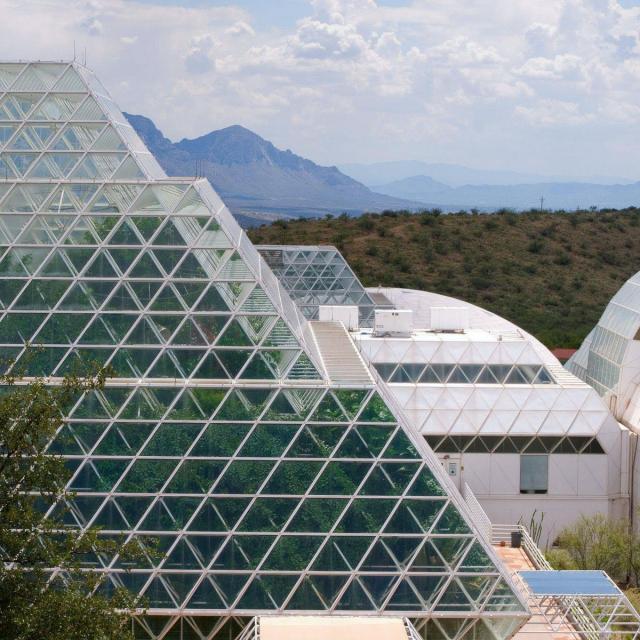
Why would anyone build an enormous glass structure in the Arizona desert? In Module 1, you will get a virtual introduction to the engineering marvel that is Biosphere 2. Learn about the fascinating history of Biosphere 2 and how it is currently used as the world’s best research instrument for earth systems science. Discover how the ocean, rainforest, and desert can be studied in one enclosed, three-acre structure in the Arizona desert. With Dr. Joaquin Ruiz, University of Arizona (UA) Vice President for Innovation, Director of Biosphere 2, Dean of UA Science, Geoscientist, and John Adams, Deputy Director, UA Biosphere 2.

WEEK 2
Climate Disruption
How do we know that human activity is changing the climate? In Module 2, you will hear from scientists who reconstruct past climates by unlocking information held in ancient trees. Discover how tree rings help us understand drought and wildfire patterns across time and space. Learn what global warming is, exactly, and how it is accelerated by carbon emissions. With Dr. Kevin Anchukaitis, Geography and UA Laboratory of Tree-Ring Research, and Dr. David Frank, UA Laboratory of Tree-Ring Research.

WEEK 3
The Science of Water Availability
Where is Earth’s water? In Module 3, you will learn about the global water cycle and discover how much water exists, where it exists, and how it moves around the environment. Learn how Biosphere 2 and Critical Zone research are used to study the water cycle. With Dr. Peter Troch, Director of Science at Biosphere 2, UA Hydrology.

WEEK 4
Desert Plants, Climate, and Changing Landscapes
How can many different species coexist in once place? In Module 4, go beyond Biosphere 2 to UA Tumamoc Hill—the world’s oldest long-term desert ecology research site near the University of Arizona. Learn how living and nonliving components of the environment are related, how different species coexist, and how climate variation affects Sonoran Desert plants. With Dr. Larry Venable, UA Ecology & Evolutionary Biology.

WEEK 5
Rainforests in an Altered World
What can the Biosphere 2 rainforest tell us about the future? Module 5 focuses on tropical rainforests in the Amazon Basin of South America, and the controlled rainforest inside Biosphere 2. Learn about the fascinating activity of tropical forests, the major roles they play in global climate, and the potential impacts of deforestation and climate change. With Dr. Joost Van Haren, Biosphere 2, UA Honors, and Dr. Scott Saleska, UA Ecology & Evolutionary Biology.

WEEK 6
Sea Changes in our Marine Environment
Why are coral reefs in peril, and what can we do about it? In Module 6, discover the immense role that oceans play in global climate, heat distribution, and human livelihoods. Learn why global warming is sometimes called ocean warming, how ocean acidification affects marine life, and innovative ways in which the ocean is studied. With Dr. Julia Cole, U. of Michigan, UA Biosphere 2 Marine Research.

WEEK 7
Soil Science - Foundations & Implications
How can soil be alive? In Module 7, discover the fascinating, microscopic world within soils and their critical role in Earth systems. Learn how soils provide functions and services that make them vital to our health and wellbeing. With Dr. Rachel Gallery, UA School of Natural Resources and the Environment, and Dr. Katerina Dontsova, UA Soil Water & Environmental Science, Biosphere 2.

WEEK 8
Feeding the Future
Can a Mars or Lunar greenhouse help feed people on Earth? In Module 8, learn how space-farming models can be applied on Earth as we move towards a global population of 10 billion people. Discover innovative controlled agricultural systems, learn more about how plants grow, and get a chance to produce your own hydroponically grown vegetables at home! With Dr. Gene Giacomelli, UA Controlled Environment Agriculture Center.

WEEK 9
Life and Resources in Space - Should We Go There?
When will humans live beyond Earth’s gravity? Module 9 is a fascinating and inspiring journey into space. Ignite your imagination as you learn about space tourism, asteroid-mining, moon elevators, robotic space explorers, and Mars colonization. While focusing on space, this module is sure to reaffirm your appreciation of Planet Earth. With Dr. Chris Impey, Associate Dean UA College of Science, UA Astronomy.

Go to Class
MOOC List is learner-supported. When you buy through links on our site, we may earn an affiliate commission.

Related Courses

What is Climate Change? (Coursera) Coursera
University of Colorado Boulder

What is Climate Change? (Coursera)

In this course, learners will become familiar with the scientific evidence that demonstrates human-caused climate change. We will explore how greenhouse gases cause the Earth to warm, and why our recent warming is attributed to human activities. We will also discuss where our climate is headed, including anticipated future temperature, precipitation, and sea level. Learners will engage with the consequences of these changes on our ecosystems, infrastructure, and communities.

Jun 1st 2026
3 Weeks
Philosophy, Science and Religion: Science and Philosophy (Coursera) Coursera
University of Edinburgh

Philosophy, Science and Religion: Science and Philosophy (Coursera)

Philosophy, Science and Religion mark three of the most fundamental modes of thinking about the world and our place in it. Are these modes incompatible? Put another way: is the intellectually responsible thing to do to ‘pick sides’ and identify with one of these approaches at the exclusion of others? Or, are they complementary or mutually supportive? As is typical of questions of such magnitude, the devil is in the details. For example, it is important to work out what is really distinctive about each of these ways of inquiring about the world. In order to gain some clarity here, we’ll be investigating what some of the current leading thinkers in philosophy, science and religion are actually doing.

Jun 1st 2026
5-12 Weeks
Our Energy Future (Coursera) Coursera
University of California, San Diego

Our Energy Future (Coursera)

This course is designed to introduce students to the issues of energy in the 21st century – including food and fuels – which are inseparably linked – and will discuss energy production and utilization from the biology, engineering, economics, climate science, and social science perspectives. This course will cover the current production and utilization of energy, as well as the consequences of this use, examining finite fossil energy reserves, how food and energy are linked, impacts on the environment and climate, and the social and economic impacts of our present energy and food production and use.

Jun 1st 2026
5-12 Weeks
Economics and Policies of Climate Change (Coursera) Coursera
EDHEC Business School

Economics and Policies of Climate Change (Coursera)

Being aware of the urgency and importance of climate change is not enough to tackle it effectively. To avoid the worst climate outcomes, decisive action has to be taken. But what realistic options do we have? Since our resources are limited, is it better to act now or wait until we have more advanced and less expensive technology? How big do our abatement efforts have to be? This MOOC will help you understand how economists try to answer these questions and find the optimal course of action. Most important, it will give you the conceptual tools to draw your own conclusions.

Jun 1st 2026
5-12 Weeks
Planning with Climate Change in Mind (Coursera) Coursera
University of Colorado Boulder

Planning with Climate Change in Mind (Coursera)

This course focuses on the climate impacts occurring and expected to occur across the United States. Our approach will be regional and sectoral, with consideration of impacts on water resources, transportation, energy, agriculture, forests, health, and coastal/marine resources. We will also look at how you can apply information about climate risks to motivate climate action in your household, in your community, or in your workplace.

Jun 1st 2026
3 Weeks
Doing Economics: Measuring Climate Change (Coursera) Coursera
University of London,University College London,CORE

Doing Economics: Measuring Climate Change (Coursera)

This course will give you practical experience in working with real-world data, with applications to important policy issues in today’s society. Each week, you will learn specific data handling skills in Excel and use these techniques to analyse climate change data, with appropriate readings to provide background information on the data you are working with. You will also learn about the consequences of climate change and how governments can address this issue.

Jun 1st 2026
4 Weeks
Driving business towards the Sustainable Development Goals (Coursera) Coursera
Erasmus University Rotterdam

Driving business towards the Sustainable Development Goals (Coursera)

Extreme weather events, wars, famine and environmental destruction are just a few of the wicked problems faced by humanity. That’s why in 2015 the United Nations adopted the 2030 Agenda for Sustainable Development. This agenda includes 17 Sustainable Development Goals (SDGs) that target the big challenges such as how to eliminate poverty, how to protect the environment and how to bring about peace. Every member state committed to achieving these goals by 2030. What can businesses do to counter climate change and create a sustainable business culture? Why is this relevant for business anyway? Explore how business can contribute to a better future for people AND the planet without giving up profits.

Jun 1st 2026
5-12 Weeks
How Do We Manage Climate Change? (Coursera) Coursera
University of Colorado Boulder

How Do We Manage Climate Change? (Coursera)

In this course, learners will identify the types of actions that we can pursue to address climate change. These actions fall into two broad categories: 1) mitigation, which refers to efforts to reduce greenhouse gas emissions or enhance carbon sinks, and 2) adaptation, which refers to our preparations for climate impacts. We will explore the technologies, programs, and policies related to both mitigation and adaptation. Learners should leave the course with an improved ability to identify and evaluate climate actions undertaken by communities, governments, and businesses.

Jun 1st 2026
3 Weeks
Climate Aware Investing (Coursera) Coursera
EDHEC Business School

Climate Aware Investing (Coursera)

Finance may have a central role to play against climate change on the condition that risks are properly measured and managed. In this course you will be introduced to the latest academic research findings and the most commonly used methods in industry to cope with climate change financial risks. How do we assess these kinds of risks? Can our portfolios perform well and at the same time contribute to the transition towards a low-carbon economy? How do climate change risks affect financial markets?

Jun 1st 2026
5-12 Weeks
Beyond the Sustainable Development Goals (SDGs): Addressing Sustainability and Development (Coursera) Coursera
University of Michigan

Beyond the Sustainable Development Goals (SDGs): Addressing Sustainability and Development (Coursera)

We’re excited you’re here! This course, “Beyond the Sustainable Development Goals (SDGs): Addressing Sustainability and Development,” is the first course in the upcoming Sustainability and Development MasterTrack Certificate program (Fall 2020), but you can also take this course as a stand-alone learning opportunity.

Jun 3rd 2026
5-12 Weeks