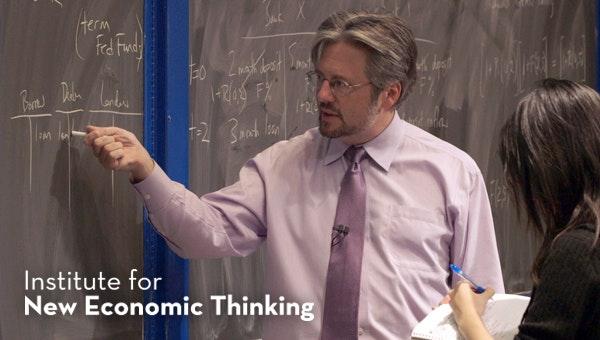
Understanding Financial Markets (Coursera)

Offered by University of Geneva,
Understanding Financial Markets (Coursera)

In this course, you will learn what the main financial markets and their characteristics are as well as how they are linked to the economy. Our very diversified team of experts will start by teaching you how the price of stocks and bonds are computed and why they move while you will become increasingly aware of the notion of risk and why it matters when measuring an investment's performance. The focus will then move to less popular markets such as gold, emerging markets, real estate, hedge funds and private markets.

Class Deals by MOOC List - Click here and see Coursera's Active Discounts, Deals, and Promo Codes.

These will be analyzed with an emphasis on their particular risks and return opportunities as well as how they can help in building efficient portfolios. Finally, the policies of central banks and their impact on financial markets will be presented to you along with the link between the economy and the price of financial assets.
All along these different steps, experts from UBS, our corporate partner, will show you how the concepts you just acquired are effectively applied in a leading global bank. This focus on practicality means you will not only understand what is going on in global financial markets but also start to figure out how you can use them to achieve financial goals, be it a client's or your own.
Course 1 of 5 in the Investment Management Specialization.

Syllabus

WEEK 1: General Introduction and Key Concepts
WEEK 2: Major Financial Markets
WEEK 3: Other Financial Markets
WEEK 4: Financial Markets and the Economy

Go to Class
MOOC List is learner-supported. When you buy through links on our site, we may earn an affiliate commission.

Related Courses

Trading Algorithms (Coursera) Coursera
Indian School of Business - ISB

Trading Algorithms (Coursera)

This course covers two of the seven trading strategies that work in emerging markets. The seven include strategies based on momentum, momentum crashes, price reversal, persistence of earnings, quality of earnings, underlying business growth, behavioral biases and textual analysis of business reports about the company.

Jul 20th 2026
4 Weeks
Managerial Economics: Buyer and Seller Behavior (Coursera) Coursera
Illinois Tech

Managerial Economics: Buyer and Seller Behavior (Coursera)

Why are markets commonly believed to be the best way of allocating resources and organizing economic activity? This course will answer this critical question while examining its implications for pricing, market entry and exit, short-term and long-term business strategies, and the forecasting of key market variables. The course introduces fundamental topics in the economic analysis of markets, and some of the analytical tools used to study them, as a means to build an economic intuition and fostering an understanding of a variety of market conditions and market forces.

Jul 20th 2026
4 Weeks
The Power of Markets III: Input Markets and Promoting Efficiency (Coursera) Coursera
University of Rochester

The Power of Markets III: Input Markets and Promoting Efficiency (Coursera)

The final module of the Power of Markets course begins by further exploring firm behavior in imperfectly competitive market settings: how firms with monopoly power can increase profits through price discrimination; and the price-output combinations we can expect firms to select in cases of monopolistic competition and oligopoly. We will also analyze monopolies from an efficiency perspective and look at the effects of imperfect information on firm and consumer behavior. We will next turn to exploring input markets and what determines the demand for an input by a firm, an industry, and the overall market.

Aug 3rd 2026
4 Weeks
Fundamentals of Equities (Coursera) Coursera
Interactive Brokers

Fundamentals of Equities (Coursera)

In this course, will look at industries and economic sectors that neatly define an economy. We will also introduce you to fundamental concepts involved in a company’s annual statements such as balance sheets, cash flows and its income statement, plus explore popular fundamental values used to filter vast amounts of corporate stocks. And finally, we’ll examine mutual funds and ETFs as alternatives to individual stocks for investing.

Jul 20th 2026
3 Weeks
Contexto de Negocios en LATAM: Factores Políticos, Sociales y Económicos (Coursera) Coursera
Pontificia Universidad Católica de Chile

Contexto de Negocios en LATAM: Factores Políticos, Sociales y Económicos (Coursera)

Latinoamérica resulta ser muy atractiva al momento de decidir realizar nuevos negocios, pero en algunos casos este proceso se considera algo distinto a cómo opera el mercado mundial, por lo que es importante conocer algunos elementos que permitan entender de mejor manera este contexto y así definir estrategias más efectivas cuando se piensa comenzar un negocio en esta región.

Jul 20th 2026
4 Weeks
The Power of Markets I: The Basics of Supply and Demand and Consumer Behavior (Coursera) Coursera
University of Rochester

The Power of Markets I: The Basics of Supply and Demand and Consumer Behavior (Coursera)

This opening module of the Power of Markets course covers the basic assumptions about market participants made by economists, the concept of opportunity cost, and the key determinants of supply and demand. We will then learn how to use the supply-demand framework to explain and predict market outcomes and to show how government policies affect those market outcomes. We will look at how quantity demanded and supplied respond to their key determinants in quantitative (elasticity) as well as qualitative terms. The last two weeks of the first module will investigate consumer behavior more closely and show how consumer choices are driven by the interplay of preferences and budget constraints.

Aug 3rd 2026
4 Weeks
Surviving Disruptive Technologies (On Demand) (Coursera) Coursera
University of Maryland, College Park

Surviving Disruptive Technologies (On Demand) (Coursera)

The purpose of this course is to help individuals and organizations survive when confronted with disruptive technologies that threaten their current way of life. We will look at a general model of survival and use it to analyze companies and industries that have failed or are close to failing. Examples of companies that have not survived include Kodak, a firm over 100 years old, Blockbuster and Borders.

Jul 27th 2026
4 Weeks
Understanding the Australian economy: An introduction to macroeconomic and financial policies (Coursera) Coursera
The University of Sydney

Understanding the Australian economy: An introduction to macroeconomic and financial policies (Coursera)

This four-week, four-module course explores selective aspects of the Australian economy, with emphasis on macroeconomic and financial policies. The course introduces participants to several key attributes of the Australian economy and discusses how they are influenced by both domestic and international forces. We will examine some of the key issues and dilemmas facing the Australian economy and how policymakers can deal with them using monetary and fiscal policies.

Aug 3rd 2026
4 Weeks
Financial Markets and Instruments (Coursera) Coursera
Yunus Social Business Fund Bengaluru

Financial Markets and Instruments (Coursera)

This course is part of a Specialization titled “Strategy and Finance for a Lifecycle of a Social Business”. The beauty of a modern decision-making framework is that it can be used to understand value creation at any level – the individual or business or societal. The applications however become increasingly complex as your lens expands from the individual to the corporate/nonprofit to the global society.

Jul 22nd 2026
5-12 Weeks
Firm Level Economics: Markets and Allocations (Coursera) Coursera
University of Illinois at Urbana-Champaign

Firm Level Economics: Markets and Allocations (Coursera)

In this class, we will derive equilibrium outcomes across a variety of market structures. We will begin by understanding equilibrium under a market structure called Perfect Competition, a benchmark construction. Economists have tools to measure the efficiency of market outcomes. We next consider the polar extreme of a competitive market: a monopoly market. We will determine the monopoly equilibrium price and quantity and efficiency properties. Much economic activity takes place in markets with just a handful of very large producers.

Jul 20th 2026
4 Weeks