Simulation Analysis for Mechanical Engineers with Autodesk Fusion 360 (Coursera)

Offered by Autodesk,
Simulation Analysis for Mechanical Engineers with Autodesk Fusion 360 (Coursera)

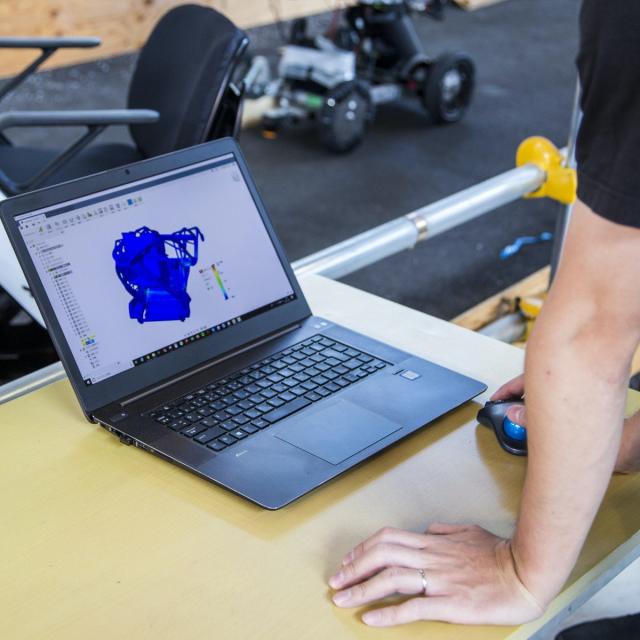
The foundation of engineering design is often coupled with validation. Simulation is a great tool that allows engineers to test, validate, and modify designs before they become a physical prototype. When used early in the process for simulation driven design and throughout the development process, simulation can help drive the design, make informed design decisions, speed up time to production, and most importantly, identify and eliminate costly design mistakes.

Class Deals by MOOC List - Click here and see Coursera's Active Discounts, Deals, and Promo Codes.

Like any other tool though, it must be used properly to yield the best results. In this course, we’ll explore the usage static stress simulation, shape optimization, thermal and other mechanical simulation types to better understand how we can apply these tools to everyday design problems.
After taking this course, you'll be able to:

  • Describe the simulation workflow in Fusion 360.
  • Summarize the use cases for various types of simulation studies.
  • Demonstrate knowledge and skills in more advanced Fusion 360 CAD and CAE skills.
  • Explain and identify simulation results

What You Will Learn

  • Describe the simulation workflow in Fusion 360.
  • Summarize the use cases for various types of simulation studies.
  • Demonstrate knowledge and skills in more advanced Fusion 360 CAD and CAE skills.
  • Explain and identify simulation results

Course 3 of 4 in the Autodesk CAD/CAM/CAE for Mechanical Engineering Specialization.

Syllabus

WEEK 1
Static Stress Simulation
In Week 1, we’ll explore the setup, solve, and understanding surrounding static stress simulations. Starting with the basics and moving to more advanced tools such as bolted connections we’ll walk through how to prepare and process a static simulation.

WEEK 2
Using Shape Optimization to Drive a Design
In Week 2, we’ll cover shape optimization simulation study type to explore load paths in designs. This simulation study will help engineers identify critical load paths in a design to make more informed decisions on material removal.

WEEK 3
Nonlinear Response, Buckling and Modal Frequencies
In Week 3, we’ll focus on some additional simulation study types in Fusion 360, namely nonlinear response, structural buckling and modal frequencies. These study types allow for greater insight into structural and mechanical problems associated with a wide variety of designs. We will focus on various aspects of our gear reduction assembly as well as explore other examples suited for these types of simulations.

WEEK 4
Thermal and Thermal Stress
In Week 4, we’ll explore and compare the effects of thermal and thermal stresses on designs. Temperature and heat can be a major factor in the failure of a design so exploring a design’s performance can lead to better informed design decisions. As a bonus, we’ll also look at event simulation and how a design performs when subject to motion and how it responds to an impact.
Go to Class
MOOC List is learner-supported. When you buy through links on our site, we may earn an affiliate commission.

Related Courses

Designing Hardware for Raspberry Pi Projects (Coursera) Coursera
Johns Hopkins University

Designing Hardware for Raspberry Pi Projects (Coursera)

This is course 4 of this specialization (although it can be taken out of order) and focuses on applying experience and knowledge gained in the first three courses to build physical electronics hardware. Specifically, this course focuses on four areas: circuit simulation, schematic entry, PCB layout, and 3D CAD modeling. There are many excellent commercial applications available in these areas, however to give everyone access we'll be using all free and open-source software.

Jun 8th 2026
4 Weeks
Modern Robotics, Course 1: Foundations of Robot Motion (Coursera) Coursera
Northwestern University

Modern Robotics, Course 1: Foundations of Robot Motion (Coursera)

Do you want to know how robots work? Are you interested in robotics as a career? Are you willing to invest the effort to learn fundamental mathematical modeling techniques that are used in all subfields of robotics? If so, then the "Modern Robotics: Mechanics, Planning, and Control" specialization may be for you. This specialization, consisting of six short courses, is serious preparation for serious students who hope to work in the field of robotics or to undertake advanced study. It is not a sampler.

Jun 1st 2026
4 Weeks
Intelligent Machining (Coursera) Coursera
University at Buffalo,The State University of New York

Intelligent Machining (Coursera)

Manufacturers are increasingly utilizing machine tools that are self-aware – they perceive their own states and the state of the surrounding environment – and are able to make decisions related to machine activity processes. This is called intelligent machining, and through this course students will receive a primer on its background, tools and related terminology.

Jun 1st 2026
4 Weeks
3D CAD Fundamental (Coursera) Coursera
National Taiwan University

3D CAD Fundamental (Coursera)

There have many three-dimensional shape of the object in your brain that are wanted to share, but do not know how to express? How to "sketch" the three-dimensional image in your mind? 3D modeling technology can help us construct the most intuitive and understandable three-dimensional model. The use of floor plan interpret the three-dimensional object process-the most direct and effective expression of our ideas.

Jun 1st 2026
5-12 Weeks
Introduction to Engineering Mechanics (Coursera) Coursera
Georgia Institute of Technology

Introduction to Engineering Mechanics (Coursera)

This course is an introduction to learning and applying the principles required to solve engineering mechanics problems. Concepts will be applied in this course from previous courses you have taken in basic math and physics. The course addresses the modeling and analysis of static equilibrium problems with an emphasis on real world engineering applications and problem solving.

Jun 1st 2026
5-12 Weeks
Modern Robotics, Course 3: Robot Dynamics (Coursera) Coursera
Northwestern University

Modern Robotics, Course 3: Robot Dynamics (Coursera)

Do you want to know how robots work? Are you interested in robotics as a career? Are you willing to invest the effort to learn fundamental mathematical modeling techniques that are used in all subfields of robotics? If so, then the "Modern Robotics: Mechanics, Planning, and Control" specialization may be for you. This specialization, consisting of six short courses, is serious preparation for serious students who hope to work in the field of robotics or to undertake advanced study. It is not a sampler.

Jun 1st 2026
4 Weeks
Engineering and Product Design Processes (Coursera) Coursera
Arizona State University

Engineering and Product Design Processes (Coursera)

Welcome to “Engineering and Product Design Processes!” In this short course, you will learn how engineering design processes and product design processes are carried out. After the course, you will be familiar with the steps in both design processes. You will also be familiar with the main goal of each design process, as well as their similarities and differences.

Jun 1st 2026
4 Weeks
Intro to Siemens NX: Engineering Essentials and Part Design (Coursera) Coursera
Siemens

Intro to Siemens NX: Engineering Essentials and Part Design (Coursera)

Welcome to Intro to Siemens NX: Engineering Essentials and Part Design!! This course will provide you with the essential skills needed to excel in computer-aided design (CAD), computer-aided manufacturing (CAM), and computer-aided engineering (CAE) using Siemens NX software. Be prepared to dive into the versatile capabilities of NX as it empowers engineers and designers to efficiently create, simulate, and manufacture products.

Jun 8th 2026
4 Weeks
Ideal Gases (Coursera) Coursera
University of Colorado Boulder

Ideal Gases (Coursera)

Course 3 of Statistical Thermodynamics, Ideal Gases, explores the behavior of systems when intermolecular forces are not important. This done by evaluating the appropriate partition functions for translational, rotational, vibrational and/or electronic motion. We start with pure ideal gases including monatomic, diatomic and polyatomic species.

Jun 8th 2026
3 Weeks
Dense Gases, Liquids and Solids (Coursera) Coursera
University of Colorado Boulder

Dense Gases, Liquids and Solids (Coursera)

Course 4 of Statistical Thermodynamics addresses dense gases, liquids, and solids. As the density of a gas is increased, intermolecular forces begin to affect behavior. For small departures from ideal gas behavior, known as the dense gas limit, one can estimate the change in properties using the concept of a configuration integral, a modification to the partition function.

Jun 8th 2026
4 Weeks
Introduction to Thermodynamics: Transferring Energy from Here to There (Coursera) Coursera
University of Michigan

Introduction to Thermodynamics: Transferring Energy from Here to There (Coursera)

This course provides an introduction to the most powerful engineering principles you will ever learn - Thermodynamics: the science of transferring energy from one place or form to another place or form. We will introduce the tools you need to analyze energy systems from solar panels, to engines, to insulated coffee mugs. More specifically, we will cover the topics of mass and energy conservation principles; first law analysis of control mass and control volume systems; properties and behavior of pure substances; and applications to thermodynamic systems operating at steady state conditions.

Jun 1st 2026
5-12 Weeks